
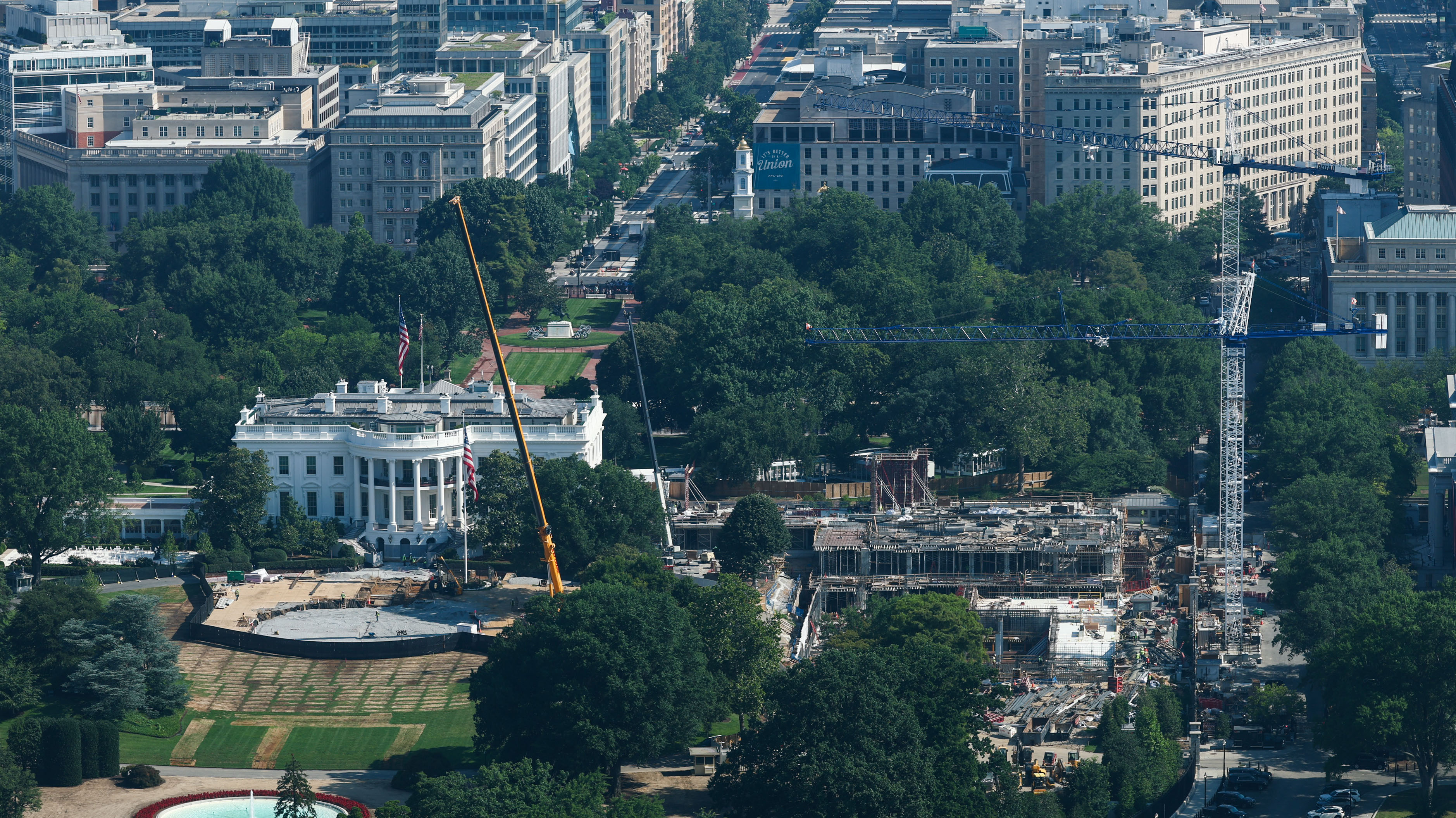
(WASHINGTON) — A federal appeals court issued a ruling Friday blocking the construction of President Donald Trump’s $400 million White House ballroom, concluding that congressional approval is needed for the project.
Judges Patricia Millett and Bradley Garcia rebuked President Trump for making the unprecedented changes to the historic structure without consulting Congress.
“Each President is a temporary tenant, not the owner, of the White House and its Executive Residence. The President has no — and claims no — constitutionally assigned authority over that property,” they wrote.
They concluded that the National Trust for Historic Preservation, which sued to block the construction, demonstrated that only Congress has the authority to approve the changes, and that it never delegated that authority to Trump.
“Whether or not a massive ballroom should be constructed is for Congress to decide and is not a matter for Executive self-help,” they wrote.
“This holding has nothing at all to do with whether the proposed ballroom is desirable, or not, as a matter of policy. This ruling does not even necessarily mean that the Defendants may not ultimately construct the ballroom. What it does mean is that the Defendants may not do so during the district court’s expeditious litigation without securing Congress’s authorization, as the Constitution and laws require,” they said.
Trump, in a social media post, said he would immediately appeal the ruling to the Supreme Court.
Judge Neomi Rao dissented from the majority, concluding that the National Trust for Historic Preservation does not have the jurisdiction to bring the lawsuit. She also argued that it is “likely within the President’s authority to make improvements to the Executive Residence” and that the Trump administration would be harmed by the blocking construction.
“The district court elevated the aesthetic displeasure of a single passerby over the government’s security interests in the ballroom and the security risks of leaving an open construction site at the President’s home and office,” she wrote.
“In deciding the ballroom construction “has to stop!” the district court transgressed the equitable authority of the federal courts. The preliminary injunction is a clear abuse of discretion and must be vacated,” Judge Neomi Rao wrote.
The ruling does not take effect for two weeks, allowing time for the Trump administration time to appeal.
The White House announced the construction of the 90,000-square foot ballroom last July, and demolition began suddenly on the East Wing in late October when workers were spotted tearing down that wing of the White House.
While the appeals court acknowledged the national security concerns associated with the East Wing renovations, the majority said that those concerns are not an “automatic get-out-of-law-free card” to violate the law.
“Congress has not given the Park Service authority, specifically and expressly, or otherwise, to raze protected historic sites in the name of presidential functions or national security,” wrote Judges Patricia Millett and Bradley Garcia.
The majority added that national security concerns are exactly the reason why Congress should be involved in the project.
“It is Congress’s job to ensure that any major construction and security projects at the White House will protect the safety of all Presidents, present and future, while preserving the historical and architectural significance of that unique location. Congress cannot perform its constitutional function when the Executive chooses to proceed wholly unilaterally,” they wrote.
Judge Neomi Rao disagreed with her colleagues, saying that halting the construction “inevitably extends the time during which the President’s residence remains less secure.”
“The security risks presented by large offsite events involving the President were unfortunately confirmed by the assassination attempt against President Trump at the Washington Hilton during the White House Correspondents’ Dinner,” she added in a footnote.
Judge Rao criticized the analysis reached by her colleagues, arguing that the harms suffered by the Trump administration from a delay would outweigh the “aesthetic harm” cited by the National Trust for Historic Preservation.
“The government should not be forced to rely on the district court’s architectural approval to secure the President’s home and office,” she wrote.
The district court judge who originally blocked the construction of the ballroom modified his injunction in April to allow work related to security to proceed, while the ballroom-related construction was halted.
Even if the Supreme Court does not side in Trump’s favor, the current legal posture would allow “below-ground construction of national security facilities, work necessary to provide for presidential security, and construction necessary to protect and secure the White House and the construction site itself,” the judge wrote.
Copyright © 2026, ABC Audio. All rights reserved.