
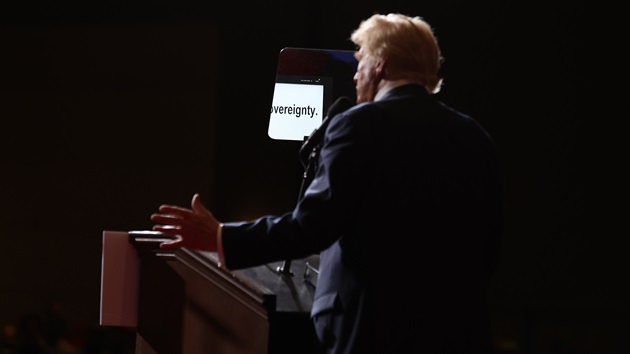
(WASHINGTON) — When President Donald Trump approached the podium to deliver his State of the Union address in February, one of the few people who knew what he was about to say was allegedly setting himself up to profit from the president’s words.
Trump’s longtime teleprompter operator is believed to have made tens of thousands of dollars by placing bets on that speech and more than a dozen others on the prediction market Kalshi, federal investigators with the Commodity Futures Trading Commission found, sources familiar with the matter told ABC News.
Gabriel Perez, a technical assistant to the president who has been operating Trump’s teleprompter since 2016, is in talks with federal regulators to settle allegations he used his inside knowledge of the president’s speeches to win more than $100,000, the sources said.
According to the sources, Kalshi alerted its regulator, the Commodity Futures Trading Commission (CFTC), to the suspicious activity on its “Mentions” market, where users can bet on whether specific words, phrases or topics are uttered during a public speech.
“Our surveillance team promptly flagged and referred these trades to the CFTC, and we are cooperating and assisting regulators,” Kalshi’s lead lawyer, Bobby DeNault, said in a statement provided to ABC News.
“The White House has strict ethics guidelines that we expect all staffers and officials to follow,” said White House spokesperson Davis Ingle when contacted by ABC News. “The staffer in question is fully cooperating with the CFTC.”
A spokesperson for the CFTC declined to comment.
In addition to the State of the Union, sources said CFTC investigators discovered that Perez placed bets on more than a dozen Trump speeches over a three-month period, including a December primetime address, a January speech at the World Economic Forum in Davos, Switzerland, and Trump’s remarks in March during a Medal of Honor ceremony.
Later in March, the White House issued an internal memo warning staff against using nonpublic information to place bets on prediction markets, sources previously confirmed to ABC News.
Perez continues to serve as one of Trump’s teleprompter operators — a role he has served since Trump’s first presidential campaign.
Of all Trump’s closest aides, sources say Perez typically has the final eyes on nearly all of the president’s prepared remarks — and is often known to take last-minute edits from Trump himself. He previously came under scrutiny by congressional and federal investigators over the edits that were made prior to the delivery of Trump’s remarks surrounding the Jan. 6, 2021, attack on the U.S. Capitol.
Trump is known to frequently deviate from his prepared remarks, as he himself often acknowledges.
“You know, when you go up here, you take a big chance, especially me because I go off teleprompter about 80% of the time,” Trump said during remarks in January to the Detroit Economic Club, another speech federal investigators believe was among those Perez betted on.
In certain instances, investigators uncovered times when Perez would back out of certain bets mid-speech when Trump skipped over a portion of the speech that included a word he had previously bet would be mentioned, the sources said.
According to sources familiar with the investigation, Perez sat for an interview with regulators in recent months and acknowledged some of the trades. At some point during the investigation, the sources said the CFTC alerted federal prosecutors in Manhattan, who declined to open a criminal investigation.
Regulators at the CFTC have expressed a willingness to settle with Perez, and have discussed terms with him that would require Perez to give back his profits and refrain from making similar trades, according to sources familiar with the ongoing discussions.
Kalshi has a policy against users placing bets based on information obtained as part of their jobs.
Last month, the company updated its policies to require users to disclose their place of employment.
“If you have information by virtue of your job or your employment, something that you have a legal duty surrounding, and you have an obligation not to take that, misappropriate it for yourself,” DeNault told ABC News in May.
The Department of Justice in recent months brought the two first cases of insider trading on prediction markets, involving a special forces soldier who allegedly bet on the capture of Venezuelan President Nicolás Maduro, and, separately, a Google employee who allegedly bet on user searches using internal company data. Both pleaded not guilty.
President Trump has occasionally criticized prediction markets, but said in April that he supports them because the United States could be “left out in the cold” if the country does not allow companies like Kalshi and Polymarket to operate.
“Well the whole world, unfortunately, has become somewhat of a casino, and you look at what’s going on all over the world in Europe and every place they’re doing these betting things. I was never much in favor of it. I don’t like it conceptually, but it is what it is,” Trump told reporters.
Last October, Trump’s social media company, Trump Media and Technology Group, announced it was looking into launching its own prediction market offering.
Copyright © 2026, ABC Audio. All rights reserved.