
What you need to know about cyclosporiasis: How it spreads, how it’s treated

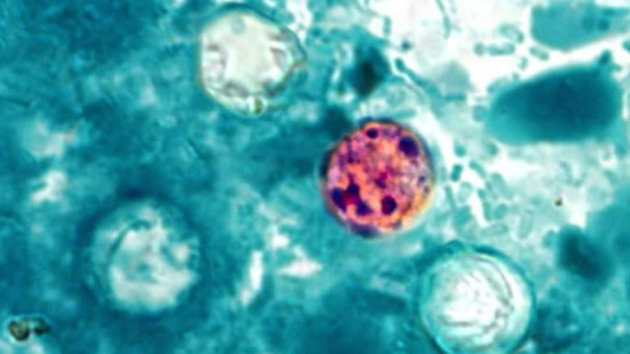
Cyclospora cayetanensis is a unicellular parasite that causes an intestinal infection called cyclosporiasis. (CDC)

(NEW YORK) — Multiple states are reporting an increase in cyclosporiasis cases, an intestinal infection caused by a parasite.

Health officials in Michigan have reported more than 1,200 cases and, in neighboring Ohio, cases have topped 170.

Here’s what you need to know about the infection, including how it spreads, how it’s diagnosed and how to treat it.

What is Cyclosporiasis?

Cyclosporiasis is an intestinal infection caused by the microscopic parasite Cyclospora cayetanensis, also known as Cyclospora, according to the Centers for Disease Control and Prevention (CDC).

The infection affects the small intestine and can cause watery diarrhea with sometimes “explosive” bowel movements, according to the federal health agency.

Other symptoms can include cramping, bloating, low-grade fever, nausea and vomiting.

The agency further said it takes about one week from the time of infection to become symptomatic, but that time can range from two days to two weeks.

How it spreads

The parasite usually spreads through food or water contaminated with feces, according to the CDC.

Foodborne outbreaks of cyclosporiasis have been linked to various types of imported fresh produce, such as raspberries, basil, snow peas, mesclun lettuce and cilantro, according to the CDC.

How the infection is diagnosed

A healthcare provider will diagnose cyclosporiasis by testing stool samples, according to the CDC.

Patients may have to submit several stool samples on different days to detect the parasite because laboratory tests may have a hard time detecting Cyclospora.

The CDC says a patient’s healthcare provider will need to specifically request testing for the parasite.

How cyclosporiasis is treated

Cyclosporiasis is treated with the oral antibiotic trimethoprim-sulfamethoxazole (TMP-SMX), commonly sold as Bactrim, Septra and Cotrim, and taken for 10 days, according to the CDC.

The CDC says most people with healthy immune systems will eventually recover without treatment, but if left untreated, patients may be sick for a few days to a month or longer.

How to prevent infection

It’s unclear exactly how Cyclospora contaminates food and water, according to the CDC.

The agency says people can prevent infection by thoroughly washing produce, cutting away bruised or damaged parts of fruits and vegetables, and refrigerating pre-prepared or pre-cut produce.

Additionally, the CDC recommends washing hands thoroughly with soap and water before handling or preparing raw fruits and vegetables.

Copyright © 2026, ABC Audio. All rights reserved.

Boy’s preschool eye exam uncovers life-saving cancer diagnosis

Click here for updates on this story    BARDSTOWN, Kentucky (WLKY) -- A 4-year-old boy from Bardstown, Kentucky, is back in school after a routine preschool eye exam uncovered a rare and life-threatening eye cancer.Hayden Rouse was 3 years old when his mother, Terra, took him to have a routine checkup for his hemangioma. Terra said at that appointment the doctor noticed a mass.“It was a very large tumor, unfortunately. But it sat in a good spot that he was able to get arterial chemo,” Rouse said.Hayden had retinoblastoma, a rare childhood eye cancer that, if caught early enough, can be cured.Hayden and his family spent months traveling to Wisconsin for treatment. While the chemotherapy successfully eliminated the tumor, it caused significant side effects, including shrinking his eye and blurring his vision.“On July 29, we took him in. You know, he wore his Spider-Man costume to the O.R., and he had his eye removed," Rouse said. "And now, we're done."After completing his treatment, Hayden celebrated by ringing the bell, a milestone for cancer patients."He's not missed a beat. He has confirmed to us that he was not using that eye, because there's been no adaptation for him. Within two days of being home, he was off. He was on running, playing, jumping all the things," said Rouse. “We’ve gotten Hayden back. And that has been the biggest thing for me."Now, Hayden is back to school and enjoying life as a typical 4-year-old.His mom said he will get his prosthetic eye, complete with an engraving of his favorite superhero, Spider-Man, in a few weeks.Dr. Heather Felton with Norton Children’s echoed Rouse’s message about the importance of routine checkups.“The whole reason we’re doing it is to check for things like abnormalities in the eye or in the ear. Sometimes I pick up things like a new heart murmur or a mass in the abdomen. There could be all kinds of different things,” Felton said.“Hayden’s life was saved by a required preschool eye exam, fortunately. Or else we might have not known for months,” Rouse said.To help the Rouse family with medical expenses, proceeds from the "Buck Haven" Car Show on Oct. 17 in New Haven, Kentucky, will go to the family. All cars are welcome to enter.Please note: This story was provided to CNN Wire by an affiliate and does not contain original CNN reporting. This content carries a strict local market embargo. If you share the same market as the contributor of this article, you may not use it on any platform.
Read Next Story