
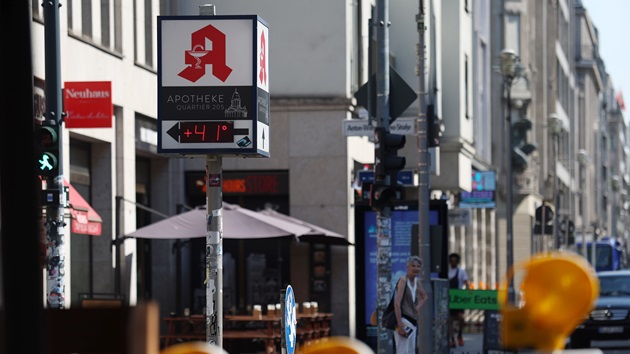
Western Europe just experienced its hottest June on record

A display indicates the temperature of 41 degrees Celsius during a sweltering summer day on June 27, 2026 in Berlin, Germany. (Maryam Majd/Getty Images)

(LONDON) — One of the most brutal heat waves to impact Europe in the last 50 years broke temperature records in multiple countries, according to Copernicus, Europe’s climate change service.

Western Europe, the region most affected by the heat wave during the second half of June, experienced its warmest June on record, the agency said.

The average land temperature in Europe in June 2026 was the second-highest on record, at 19.14 degrees Celsius, or 66.45 degrees Fahrenheit, according to Copernicus. This marks 1.78 degrees Celsius, or 3.2 degrees Fahrenheit, above the 1991 to 2020 average for the month.

Rising atmospheric and ocean temperatures “reflect a climate system continuing to accumulate heat” — resulting in increasingly intense heatwaves, a persistently warm ocean and growing risks for people and ecosystems, Samantha Burgess, strategic lead for climate at the European Centre for Medium-Range Weather Forecasts, said in a statement.

“June 2026 underscored how profoundly the climate is changing,” Burgess said. “Western Europe recorded its warmest June on record, and continued record warmth in the global ocean.”

Many June and some all-time records for daily maximum temperature were broken in several countries, according to Copernicus.

Weather officials in the United Kingdom said temperatures on June 24 rose in some areas to 35.7 degrees Celsius, or about 96.2 degrees Fahrenheit, topping a June 1976 record of 35.6 C.

In France, the country’s national heat index — a daily average — hit 30 degrees Celsius, or about 86 degrees Fahrenheit, on June 24 — the highest-ever temperature recorded, according to weather officials at Meteo-France, the national weather service. High temperatures in Paris were in the triple digits in the days after.

The Louvre and the Eiffel Tower closed early several days in a row as a result of the high temperatures.

The high temperatures also impacted cities like Madrid and Rome, which hit the high 90s during the last week of June.

Reuters reported there were more than 5,000 excess deaths in Germany alone — mostly residents 75 and older — and another 4,700 deaths in France, Belgium, Spain and the Netherlands between June 20 and 28.

“Heat stress is often called the ‘silent killer’ – and European homes, workplaces and schools were not built for these temperatures,” WHO Director-General Dr. Tedros Adhanom Ghebreyesus said in an X post.

Overall, the planet experienced its second-warmest June globally, according to Copernicus.

In addition, much of Western Europe, including Italy, large parts of central and eastern Europe and the southern U.K., experienced drier-than-average conditions, associated with persistent high-pressure and heatwave conditions, according to Copernicus.

River flow was also below average across Europe, consistent with the widespread dry conditions, according to Copernicus. Large parts of France, much of central and eastern Europe and parts of northeastern Europe were especially impacted.

Globally, June 2026 was the second-warmest on record, with an average surface air temperature of 16.5 degrees Celsius, about 61.8 degrees Fahrenheit — about .56 degrees Celsius, or about 1 degree Fahrenheit — above the June average for 1991 to 2020.

Sea surface temperature at extrapolar oceans, or oceans outside the Arctic and Antarctic, was the highest on record for June at 20.86 degrees Celsius, or 69.5 degrees Fahrenheit, according to Copernicus.

Surface sea temperatures also remain “exceptionally high” across a large portion of the tropical Pacific, where El Nino conditions are present and forecast to strengthen in the coming months, the agency said.

Copyright © 2026, ABC Audio. All rights reserved.

How OJ Simpson’s infamous Bronco chase captured a changing era of US sports coverage in the 1990s

(CNN) — Editor’s note: Watch CNN Original Series “Decades in Sports” on the CNN app. Across six episodes, the series explores the defining moments, athletes and cultural shifts that shaped sports over the past six decades, from the television revolution and Civil Rights Movement of the 1960s, right up to the impact of social media on today’s biggest stars.It was Jun 17, 1994, and Madison Square Garden was packed for Game 5 of the NBA Finals between the New York Knicks and Houston Rockets.The series was hanging in the balance tied at two games apiece. The winner would move within one victory of lifting the Larry O’Brien Trophy that Michael Jordan and the Chicago Bulls had a stranglehold over for the previous three years.It should have been one of the biggest sporting nights of the year, and it was – but not because of the game.As Ian O’Connor, columnist at The Athletic, highlights in the series, “You have to understand (that) the Knicks hadn’t won a championship in more than two decades.“And here they are, about to take a 3-2 lead in the NBA Finals over the Houston Rockets… and nobody is watching the game.”That was because on the other side of the country, former NFL star running back OJ Simpson and his former teammate Al Cowlings, were being pursued by police in a slow-speed chase across Los Angeles.Simpson had failed to turn himself into the Los Angeles Police Department earlier that day after being named a suspect in the murders of his ex-wife, Nicole Brown Simpson, and her friend, Ronald Goldman, who had been found stabbed to death outside Brown Simpson’s home five days earlier.What followed was a surreal 90-minute pursuit that became one of the most-watched television events in American history.Simpson had once rushed for more than 2,000 yards in a single 14-game season, but this was by far the most-watched run of his life.Thousands lined up on highway overpasses to catch a glimpse of the white Bronco, while television networks across the country interrupted their regular programming to broadcast the pursuit - NBC even partially interrupted its coverage of the NBA Finals, showing the chase alongside the game via split-screen.In a way, they had no choice, as all eyes were now on the West Coast.Stories beyond the scoreboardThe NBA Finals wasn’t the only major sporting event that took a backseat to the events in Los Angeles.Ken Griffey Jr. was chasing Babe Ruth’s home run record, Arnold Palmer was playing his final round at the US Open, and the 1994 FIFA World Cup kicked off for the first time on US soil.Yet, it was the images of a white Bronco trundling down a California freeway that captured the eyes of the nation.As CNN Contributor Timothy Naftali says, “What we see in the 90s is tabloid television (and) a hunger for stories that we would describe as… the other side of the human experience.”Americans were now becoming increasingly interested in seeing beyond the scoreboard - the personalities, controversies and scandals surrounding the biggest sports stars were beginning to spark almost as much interest and intrigue as their performances.The attack on US figure skater Nancy Kerrigan in January 1994 – which led to record viewership for the Winter Olympics a month later – and Mike Tyson’s infamous ear bite on Evander Holyfield in June 1997 that triggered a global news frenzy were further examples of this.Journalist John Heilemann describes the period as “wacky” in the series, as “sports is getting so big and so all-enveloping,” highlighting that “the glare of the media is so much brighter by the time you get to that timeframe that things start to get a little twisted in the 90s.”It was an era where the lines between sports, celebrity and scandal became blurred, and the cameras were there to catch it all. It was an “explosive era of media coverage,” says Van Lathan, journalist and podcaster at The Ringer.The celebrity athleteThe 1990s was also a decade which saw the explosion of 24-hour sports television, meaning athletes were being platformed in a way they had never been before, and their popularity skyrocketed.The biggest sports stars were shifting into almost mainstream celebrities - and no one embodied this shift more than Simpson.He was a Heisman Trophy winner, an NFL MVP who earned several All-Pro and Pro Bowl selections, before going on to star in several films and commercials, all while becoming one of the most recognizable media personalities in the country.Long before the Bronco chase, his impact had been felt far beyond the football field.As sports journalist and broadcaster Seth Davies highlights, what defined the 90s was the “growth of the entertainment media infrastructure around sports,” as “we were starting to get to know these athletes on a personal level, and we were thinking of these athletes as celebrities.”Up until that point, Simpson was affectionately christened “the Juice.” LAPD detective Tom Lange even called him by that nickname during the Bronco chase while pleading with him to throw the gun he had in his possession out of the car.But detective Lange was not alone, as during the broadcast handmade signs displaying messages of “Save the Juice” and “Go, OJ, Go!” – a reference to a famous Hertz commercial he had starred in years prior – were being displayed by hundreds of fans on the freeway overpasses.And bear in mind, this was a man who had been officially declared a fugitive several hours earlier by the LAPD.However, as Heilemann explains in the series, “the glorification of the athletes” at the time led to almost “parasocial relationships,” as fans were beginning to “have an unhealthy degree of connection to their stars.”Those 90 minutes on the LA County freeway in June 1994 was one of the most powerful illustrations of that – 95 million Americans watched it all unfold with no scoreboard or idea when the final whistle would be blown.But despite this, sports had never been bigger.The-CNN-Wire™ & © 2026 Cable News Network, Inc., a Warner Bros. Discovery Company. All rights reserved.
Read Next Story