
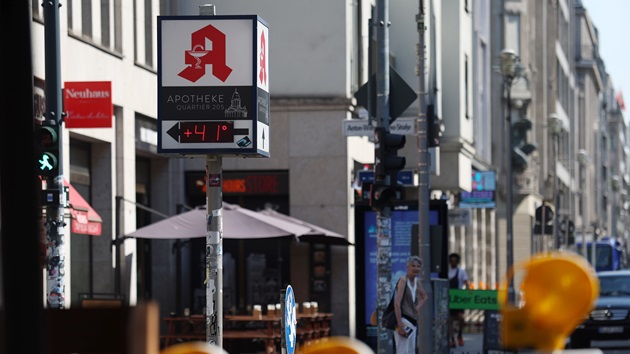
Western Europe just experienced its hottest June on record

A display indicates the temperature of 41 degrees Celsius during a sweltering summer day on June 27, 2026 in Berlin, Germany. (Maryam Majd/Getty Images)

(LONDON) — One of the most brutal heat waves to impact Europe in the last 50 years broke temperature records in multiple countries, according to Copernicus, Europe’s climate change service.

Western Europe, the region most affected by the heat wave during the second half of June, experienced its warmest June on record, the agency said.

The average land temperature in Europe in June 2026 was the second-highest on record, at 19.14 degrees Celsius, or 66.45 degrees Fahrenheit, according to Copernicus. This marks 1.78 degrees Celsius, or 3.2 degrees Fahrenheit, above the 1991 to 2020 average for the month.

Rising atmospheric and ocean temperatures “reflect a climate system continuing to accumulate heat” — resulting in increasingly intense heatwaves, a persistently warm ocean and growing risks for people and ecosystems, Samantha Burgess, strategic lead for climate at the European Centre for Medium-Range Weather Forecasts, said in a statement.

“June 2026 underscored how profoundly the climate is changing,” Burgess said. “Western Europe recorded its warmest June on record, and continued record warmth in the global ocean.”

Many June and some all-time records for daily maximum temperature were broken in several countries, according to Copernicus.

Weather officials in the United Kingdom said temperatures on June 24 rose in some areas to 35.7 degrees Celsius, or about 96.2 degrees Fahrenheit, topping a June 1976 record of 35.6 C.

In France, the country’s national heat index — a daily average — hit 30 degrees Celsius, or about 86 degrees Fahrenheit, on June 24 — the highest-ever temperature recorded, according to weather officials at Meteo-France, the national weather service. High temperatures in Paris were in the triple digits in the days after.

The Louvre and the Eiffel Tower closed early several days in a row as a result of the high temperatures.

The high temperatures also impacted cities like Madrid and Rome, which hit the high 90s during the last week of June.

Reuters reported there were more than 5,000 excess deaths in Germany alone — mostly residents 75 and older — and another 4,700 deaths in France, Belgium, Spain and the Netherlands between June 20 and 28.

“Heat stress is often called the ‘silent killer’ – and European homes, workplaces and schools were not built for these temperatures,” WHO Director-General Dr. Tedros Adhanom Ghebreyesus said in an X post.

Overall, the planet experienced its second-warmest June globally, according to Copernicus.

In addition, much of Western Europe, including Italy, large parts of central and eastern Europe and the southern U.K., experienced drier-than-average conditions, associated with persistent high-pressure and heatwave conditions, according to Copernicus.

River flow was also below average across Europe, consistent with the widespread dry conditions, according to Copernicus. Large parts of France, much of central and eastern Europe and parts of northeastern Europe were especially impacted.

Globally, June 2026 was the second-warmest on record, with an average surface air temperature of 16.5 degrees Celsius, about 61.8 degrees Fahrenheit — about .56 degrees Celsius, or about 1 degree Fahrenheit — above the June average for 1991 to 2020.

Sea surface temperature at extrapolar oceans, or oceans outside the Arctic and Antarctic, was the highest on record for June at 20.86 degrees Celsius, or 69.5 degrees Fahrenheit, according to Copernicus.

Surface sea temperatures also remain “exceptionally high” across a large portion of the tropical Pacific, where El Nino conditions are present and forecast to strengthen in the coming months, the agency said.

Copyright © 2026, ABC Audio. All rights reserved.

After a whisper saved baby and father from rubble, the search is on for mother in collapsed building in Colombia

(CNN) — Emergency teams are racing to find the mother of a baby who was rescued from the rubble of a collapsed building following the deadly 7.4 magnitude earthquake that struck Colombia on Monday.Three-month-old Salomón was pulled alive from the five-story residential building in Cali after a bystander heard his father’s faint voice rising from the debris: “I’m here. I’m with a baby.”Video of the remarkable rescue shows the infant in a dust-covered bodysuit being carefully pulled out of the wreckage. His father, Juan David Gómez, can be seen lying awkwardly on his side with his arm bloodied, still half-trapped beneath a concrete plank.Now, as Salomón and his father recover in hospital, a desperate search is on for the baby’s mother, Valentina Vanegas Galiano, a 29-year-old architect, who remains trapped under the rubble of the same building, the Torres del Limonar, alongside her younger brother.Valentina’s friends and colleagues — including architects, engineers and construction workers — have joined emergency crews and firefighters in the search.“We do not have an exact confirmed location for Valentina, nor any indication that there is life,” her friend Alejandra Montoya told CNN Wednesday.As the critical 72-hour window for rescuing survivors closes, Valentina’s friends are urgently calling for the help of specialist teams, such as the Topos Tlatelolco Rescue Brigade, a Mexican group with extensive experience responding to natural disasters.But Colombia has only just begun receiving international aid and rescuers after initially refusing some offers in the crucial hours following the devastating earthquake, the strongest to hit the country in more than a decade. The delay is considered the first controversy of the country’s new government, led by conservative President Abelardo de la Espriella, who took office only last Friday.The quake struck western Colombia at 7:34 a.m. on Monday, killing at least 265 people and destroying thousands of homes, according to De la Espriella, who said almost 500 people remain missing.Outside the Torres del Limonar, Montoya said she has barely left the site since Monday.She said the baby’s father was able to provide a reference point for where he believes Valentina became trapped, and rescue teams are working with that information and technical analysis of the structure, prioritizing areas where other signs of life have been heard.“Juan David says she was about 3 or 4 meters ahead of him, meaning a little closer to the entrance, so she ended up inside the structure, and it has been very difficult to find her,” Montoya said.Videos Montoya shared with CNN show dozens of volunteers and rescuers working through the rubble. More than 20 people were rescued alive from the complex during the first 12 hours after the earthquake, according to Reuters. Since then, three more people and a dog have also been found alive.An extraordinary rescueBaby Salomón and his father Juan David are stable and under observation. The baby suffered a few scrapes and a minor blow to the head, while his father is recovering after undergoing surgery, Montoya said.They were found under the rubble after bystander Brian Osorio Zuluaga heard Juan David’s call for help.When the deadly quake struck, Osorio ran out of his office in Cali and rushed home on his motorbike. But the sight of the collapsed five-story residential building forced him to stop.“It was a large complex, covering an entire block,” Osorio told CNN.Residents and neighbors of the building had fled into the street, “some in sleepwear or pajamas; some crying, others in shock,” Osorio said.He approached the rubble and began shouting into the wreckage for survivors, despite warnings about a possible gas leak.He suddenly asked those around him for silence, and heard a faint voice rise out of the debris — barely a whisper.Osorio described how he and several others began moving debris with their hands to reach the pair, carefully holding a large concrete slab aloft as other volunteers cleared a path to the baby.“You can see the baby’s little head there — which, at the time, looked sort of purplish because he couldn’t breathe,” Osorio said. “Once we started removing the rubble, the baby began to… breathe, and his color started to come back.”Osorio said he was handed the baby, and gave him to a police officer, who took him to an ambulance. They then turned their attention to freeing the father.In the rubble, Osorio said he saw clothes, shoes, and a stuffed animal covered in dust. He thought about the people who might still be trapped.The bravery of everyone who rushed to help was what saved the lives of both man and baby.“Unity is strength, because no one person alone could have lifted that piece of rubble; it was so large and so heavy,” he said.“It’s better to act than to stand still,” Osorio added. “Every bit helps.”Rescue efforts enter fourth dayThe quake struck at the heart of the country’s coffee-growing region and catapulted communities into a state of national disaster as world leaders offered aid and assistance.In Cali, a woman was pulled from under a mountain of rubble on Tuesday to cheers as firemen carried her out on a stretcher following a complex, multinational rescue operation.And in Pereira, a CNN team on the ground saw rescue workers and volunteers form a human chain to remove debris and help save those trapped from an apartment building.“There’s folks who have jumped in and you can see they’re wearing everything from athleisure wear to shorts, tennis shoes — they’re not prepared for this,” CNN’s senior national correspondent David Culver said from the site. “We have seen scenes like this scattered throughout Pereira. This is one of the hardest-hit areas.”But in the epicenter of Monday’s earthquake, Chocó, an indigenous leader told CNN that help has yet to reach the area, Colombia’s poorest region.Victor Chamapuro, leader of the Wounaan Indigenous Reserve “Buenavista” in Chocó’s Litoral del San Juan, said “all our houses are on the ground.”“Where are we going to sleep now? We have to be alert now, we’re sleeping outside,” he said.Chamapuro called on authorities to send food and medicine, but the “Buenavista” reserve can only be reached by boat on a five-hour journey from the port of Buenaventura, on Colombia’s Pacific coast.Video sent by Chamapuro from the reserve shows flattened buildings that appear to be built from timber and corrugated iron sheets. Others are still standing but with varying levels of damage.The-CNN-Wire™ & © 2026 Cable News Network, Inc., a Warner Bros. Discovery Company. All rights reserved.
Read Next Story