Washington — Victims of Iranian-sponsored terrorism and their families are in Washington this week to urge President Trump to demand Iran pay restitution as part of any potential peace deal.
The delegation of more than 100 people includes those who have successfully sued the Islamic Republic in U.S. federal court for tens of billions of dollars in damages for its role in either orchestrating, financing or providing other material support for major terror attacks around the world, including the 1983 Beirut Marine barracks bombing that killed 241 U.S. service members, and scores of suicide bombings that have killed American citizens in places like Israel.
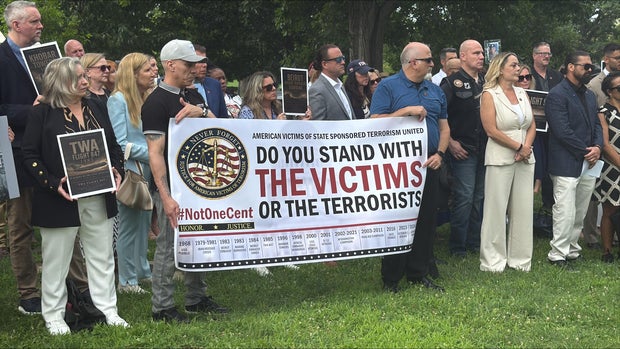
“American victims have been entirely absent from the public and reported negotiating framework,” the group American Victims of State-Sponsored Terrorism United wrote in a letter to Mr. Trump first obtained by CBS News. “Our request is clear and grounded in longstanding U.S. policy: no agreement, interim or long-term, should release, transfer, unfreeze, or return Iranian assets, or lift or relieve sanctions, before the outstanding terrorism judgments owed to American victims are resolved.”
Angela Mistrulli, who spearheaded the two-day gathering in Washington, told CBS News the letter speaks for a coalition of more than 20,000 American victims directly affected by Iran-backed terrorism. She plans to deliver the letter to the president in a meeting at the White House scheduled for Tuesday.
Mistrulli’s father, Joseph, was killed while working at the World Trade Center on Sept. 11, 2001.
“If we can bankrupt terrorists, then there will be less American blood spilled,” Mistrulli asserted. “There should not be any funds returned to the terrorism regime.”
CBS News
In recent days, fighting with Iran has resumed and the initial push toward a peace agreement has largely stalled. But the group’s effort comes at what would be the midway point of the initial 60-day Memorandum of Understanding signed by Mr. Trump and Iran’s leaders on June 17.
The MOU, negotiated in large part by Vice President JD Vance, offered Iran the prospect of receiving hundreds of billions of dollars in frozen assets and sanctions relief if it complied with terms that include opening maritime traffic in the Strait of Hormuz and eliminating any nuclear threat.
“If it doesn’t get done in 60 days, that’s all right. We go back to bombing,” Mr. Trump said after signing the agreement. “I don’t want to do that, because it’s so good, but we might have to, because we’re never going to let them have a nuclear weapon.”
Vance called the MOU “fundamentally a good deal for the American people” and said it offered Iran an opportunity to be “reinvited into the world economy.”
But there has been little progress toward a longer-term agreement, and the U.S. resumed military strikes on Iran more than a week ago.
Iranian terror from October 1983 to Oct. 7, 2023
According to Mistrulli, Iran and other regimes like Syria and North Korea have been ordered to pay up to $156 billion in judgments dating back to the 1990s after Congress passed a law allowing terror victims to sue U.S.-designated state sponsors of terrorism. Iran has been ordered to pay the most of any country since the law was enacted.
Plaintiffs have included victims and families harmed in attacks spanning decades and continents, including 9/11, which a federal judge found Iran liable for in 2018, saying it provided assistance to the hijackers.
In one recent case, a U.S. District Court in Washington awarded $573 million to plaintiffs representing American service members killed or injured by Iranian-supported insurgencies in Iraq from 2003 to 2015.
A current pending case focuses on Iran’s alleged role in the Hamas-led terrorist attacks in Israel on Oct. 7, 2023. Hamas is one of a number of militant groups in the region backed by Iran.
“As a community, the judgments that we pursue are not pursued out of compensation,” Mistrulli added. “The compensation has been the only justice we can receive — and we don’t want another group to lose loved ones like we have.”
Although victims have won billions of dollars in judgments against Iran, collecting those awards has proved far more difficult, as state sponsors of terrorism rarely pay judgments voluntarily. To provide some relief, Congress created the U.S. Victims of State Sponsored Terrorism Fund to provide partial compensation to eligible victims using money from qualifying federal penalties, forfeitures and other congressionally authorized sources.
According to the fund’s website, more than $10 billion has been paid out since its inception in 2015 — less than 10% of what’s been awarded in terrorism cases.
“There has been some relief,” Aryeh Portnoy, an attorney who has represented thousands of victims in terrorism cases and is currently litigating on behalf of Oct. 7 victims, told CBS News. “But even those in the fund that have been in it the longest and have received the most from it have only received pennies on the dollars of their judgments.”
Portnoy also pointed to limited enforcement, legal disputes and chronic underfunding as reasons for the shortfall.
“So there’s more work that needs to be done, but it can be done,” he said. “There’s opportunities for the government, for Congress, for the administration to help these victims, to fill the promise that Congress made when it allowed the victims to come and pursue these terrorist states in court for the horrors that they committed.”
And no country owes more than Iran, Portnoy said. In many of the state-sponsored terrorism cases he has litigated, Iran has repeatedly emerged as the foreign government accused of supporting the terrorist groups responsible for the attacks.
“In each of those cases, the actors themselves could be a terrorist organization,” Portnoy explained to CBS News. “It could be Hezbollah, it could be ISIS, it could be Al Qaeda. But behind those actors is always a state sponsor — and Iran is by far the biggest state sponsor of terrorism and has been for the last four decades.”
A spokesperson for the Iranian Embassy in Washington did not immediately respond to a request for comment.