
Using the ocean to power data centers

▶ Watch Video: Using the ocean to power data centers

There are two global problems you probably don’t like to think about. First, burning gas and coal is still heating up the planet. Second, the thousands of AI data centers popping up all over the country consume enormous amounts of power, which produces even more carbon pollution – and drives up our electric bills. And as Garth Sheldon-Coulson says, this is not going to stop. “We’re still at the beginning of this demand,” he said.

Sheldon-Coulson, the CEO and co-founder of Panthalassa, in Vancouver, Wash., hopes to address both problems at once with wave energy. “The ocean is really unlimited in terms of how much energy is available,” he said. “It will really be the cheapest energy on the planet.”

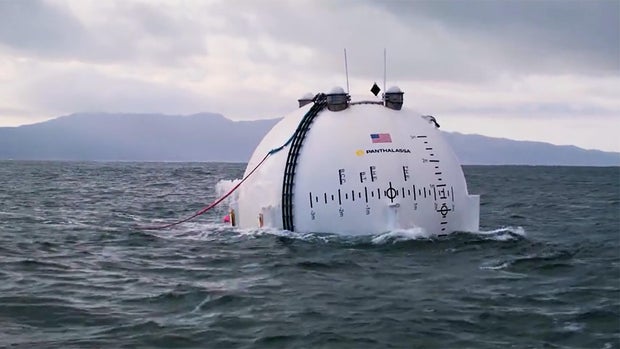
He likened Panthalassa’s test model, the Ocean-2, to a floating hydroelectric dam. “As it goes up and down with the waves, it causes water that’s in that tube to be forced up into the top. Once it’s in the ball, the water is forced through a turbine. The turbine spins, and that’s what makes the electricity.”
wave-energy-panthalassa-ocean-2-1920.jpg
A test of the Panthalassa Ocean-2 wave energy converter, which would generate electricity to power sea-based data centers. 

Panthalassa

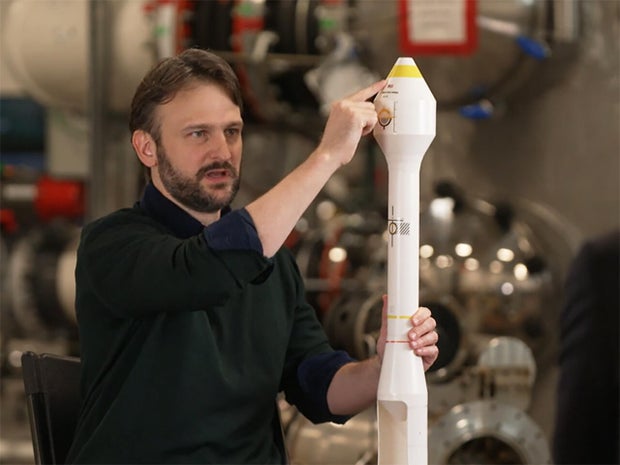
Using a model of Panthalassa’s latest design, the Ocean-3, Sheldon-Coulson explained the most surprising part: there’s no anchor – and no cables. It’s a self-propelled system that is not tethered to the ocean floor. “It’s like a little Roomba, except it’s enormous,” he said.
garth-sheldon-coulson-ceo-and-co-founder-of-panthalassa-with-model-of-ocean-3.jpg
Garth Sheldon-Coulson, CEO and co-founder of Panthalassa, with a model of the Ocean-3.

CBS News

There’s no cable to bring power back to shore, either. In essence, these are floating data centers. They generate power from the waves; process AI computing tasks on the spot; and send us the answers by satellite.

“When you deploy many of our systems, they work together basically as a data center,” Sheldon-Coulson said. “So, we think of it as a really good alternative to data centers on land.”

Panthalassa has all of the private funding it needs, because it offers AI companies a quicker, cleaner way to get power than building data centers on land. Construction of the Ocean-3s is well under way. 

Sheldon-Coulson expects them to be operating off-shore by around August of this year. Their advantages? “Clean, no fuel, no land use, no getting in the way of other activities on land, and very fast to scale,” he said.

Eventually, the company hopes to deploy thousands of them, far out at sea.

“It is really exciting that we’re working on something that is coming along right at the right time, in a way that’s much cleaner, much more sustainable, and quite scalable, so that we can really meet that demand as it comes,” Sheldon-Coulson said.

    
For more info:

    
Story produced by Annie Iezzi. Editor: Emanuele Secci.


See also:

De la Espriella dice que reconstrucción por el terremoto en Colombia costará más de US$ 9.500 millones

El presidente de Colombia, Abelardo de la Espriella, dijo este lunes que la reconstrucción de las zonas afectadas por el terremoto del pasado 10 de agosto costará al menos 30 billones de pesos (unos US$ 9.500 millones), según estimaciones de una empresa privada.“Una firma privada modeló pérdidas físicas directas en Chocó, Valle del Cauca, Risaralda, Quindío y Caldas, cercanas a los 30 billones de pesos”, indicó el mandatario en una alocución al país en la que presentó un balance de acciones de su gobierno tras el terremoto.De la Espriella agregó que la reconstrucción de edificaciones costará alrededor de 24,5 billones de pesos (unos US$ 7.800 millones) y la de la infraestructura 5,5 billones (unos US$ 1.700 millones), y agregó: “Imagínense ustedes la dimensión del desastre”.Durante la alocución, De la Espriella, informó también que el balance de muertos por el sismo era de 289, una cifra inferior a la de 304 divulgada horas antes por el Instituto de Medicina Legal (IML).“Hasta este momento se reportan 289 compatriotas fallecidos, 4.187 heridos y 143 desaparecidos. Más de 120.328 familias han sido registradas como afectadas, hay 26.945 viviendas destruidas y más de 127.557 viviendas averiadas”, expresó el presidente.Según De la Espriella, los datos son preliminares y “por respeto a las víctimas y a sus familias”, su Gobierno “solo comunicará datos debidamente consolidados”.Pese a que en Cali y Pereira, las dos ciudades más afectadas por el temblor, las esperanzas de encontrar personas con vida atrapadas son casi nulas y ya comenzaron las tareas de retirada de los escombros, el presidente de Colombia pidió no abandonar la búsqueda.“He dado la orden desde el primer minuto posterior al devastador evento de que mientras exista una posibilidad de encontrar con vida a un solo compatriota, los equipos de búsqueda y rescate sigan en el terreno”, indicó.De la Espriella agradeció el trabajo de los rescatistas, tanto nacionales como de los llegados de otros países, como Estados Unidos, Ecuador e Israel, así como a las decenas de miles de colombianos que se han movilizado para hacer donaciones en dinero o en productos de primera necesidad para los damnificados.“El país ha hecho un esfuerzo extraordinario para recoger y trasladar ayudas, pero la tarea no termina cuando llegan esas ayudas a una capital departamental. Allí comienza la fase más compleja, llevarlas ordenadamente a cada municipio, corregimiento y vereda”, dijo.“Ninguna carretera averiada, ninguna falla de comunicaciones puede conducirnos a la designación y a permitir que nuestro pueblo pase más trabajo del que ya está pasando”, afirmó.The-CNN-Wire™ & © 2026 Cable News Network, Inc., a Warner Bros. Discovery Company. All rights reserved.
Read Next Story