(WASHINGTON) — President Donald Trump will head to the NATO summit in Ankara, Turkey, this week as an unstable ceasefire between the U.S. and Iran and Trump’s feud with his NATO allies continue.
The summit will be held Tuesday and Wednesday at the Beştepe Presidential Compound and chaired by NATO Secretary General Mark Rutte. The formal opening is scheduled for Tuesday and the event is expected to conclude the following day, when Trump will hold a news conference.
Trump’s trip will be brief. He is expected to leave the White House Monday night and return to the U.S. on Wednesday evening. While in Turkey, the president is expected to take part in a bilateral meetings with Turkish President Recep Tayyip Erdogan and Ukrainian President Volodymyr Zelenskyy and participate in a number of working sessions.
‘Taking stock’ of NATO
Matt Whitaker, the U.S. ambassador to NATO, said Sunday that the summit will measure the progress of NATO allies’ commitment to spend 5% of their GDP on defense and said that the U.S. would also “take stock of our allies’ expanding NATO’s capabilities in support of the burden-shifting going on here on the European continent.”
“Some allies are doing more than others. Poland, the Nordic countries, the Baltic countries lead the way, and Germany is on track for the 5%, reaching it in 2029. But many others are lagging behind,” Whitaker said.
The summit also comes after Trump has repeatedly floated the idea of leaving NATO. As recently as April, Trump expressed frustration with European allies amid the U.S.’s war with Iran, as many members have been reluctant to join military operations in re-opening and patrolling the Strait of Hormuz.
“Oh yes, I would say [it’s] beyond reconsideration. I was never swayed by NATO,” Trump said in April when asked if he would reconsider the U.S.’s membership after the conflict ends. “I always knew they were a paper tiger, and Putin knows that too, by the way.”
More broadly, Trump has been extremely critical of NATO allies over their ability to share the burden of contributing to the post-World War II alliance.
Whitaker said, “The United States remains a proud NATO member,” but “we have responsibilities elsewhere in the world as the world’s only superpower.”
Trump continued his criticism of some NATO allies as recently as last week.
“Ridiculous for the U.S.A. to continue along this one sided path when the relationship is not reciprocal. They were not there for us,” Trump wrote last Thursday on his social media platform.
“The United States spends more money on NATO than any other country, by far, to protect them, without getting any benefit from so doing,” the president also claimed on Thursday in a post on social media.
While Trump claims that allies spend “on NATO,” that’s not how the alliance works. Member states must spend 2% of their GDP on their own national defense budgets. The U.S. is NATO’s largest defense spender by virtue of having the world’s largest defense budget. But taken as a percentage of GDP, the US has hovered around 3% range — less than Poland and Baltic allies.
NATO’s involvement in Iran war
Trump’s requests for allies’ support in the U.S. war against Iran goes beyond NATO’s collective defense agreement, which calls for all to respond to an attack on a member country. Yet Trump has framed it as a test of whether allies reciprocate in return for American security commitments.
A senior U.S. official said Sunday the U.S. believes ensuring freedom of navigation through the Strait of Hormuz would be on the agenda, but that many NATO allies don’t have the capabilities to support those operations.
“I certainly believe that the Strait of Hormuz and the protection of the maritime traffic going through there is going to be a subject that comes up,” the official said.
But, they continued, “Many [NATO allies] don’t have the necessary ships or assets to contribute to a meaningful maritime effort” despite the fact that “we’ve had a lot of allies raise their hand and offer to participate.”
Shifting the burden to NATO allies
Two senior U.S. officials said on Sunday that the U.S. plans to further shift the burden of European defense onto European countries, saying that a force posture review currently underway of the military’s presence in Europe “very well may lead” to changes.
Asked about the potential for a U.S. force reduction in Europe, one senior U.S. official confirmed that Defense Secretary Pete Hegseth attended a meeting of NATO defense ministers weeks ago to announce a “six-month or less” review of the U.S. force posture in Europe.
“The main reason being, we continue to have global demands as the United States of America, and we should always be looking at how we’re deployed to our threats,” the official said, adding that any shift in troop placement would be “based on nonpolitical reasons.”
“There should be no surprise that we’re doing a posture review or surprise if that posture review very well may lead to us adjusting our posture because we’re trying to shift burden to Europe,” another official added.
NATO 3.0
The summit comes fresh off of Rutte’s visit to the White House on June 24, when he said NATO is entering a new phase centered on greater European responsibility while keeping the U.S. engaged in the alliance. Rutte framed the summit as the moment when member countries begin implementing the spending and capability commitments made at last year’s Hague summit.
Rutte said the summit will be the beginning of a transatlantic “defense industrial revolution,” promising announcements of “tens of billions” of dollars in defense-related contracts. He ventured that this year’s summit is “more important” than last year’s in the Hague because of implementation of concrete investments aimed directly at Russia.
“Vladimir, we will defend ourselves,” Rutte addressed Russian President Vladimir Putin in a speech to the Atlantic Council last week.
A ‘big gift bag’ for Turkey
Trump said last Wednesday he would not have attended the summit were it not for his relationship with Turkish President Recep Tayyip Erdogan and suggested he plans to bring a significant offer, or a “big gift bag” for his host — potentially including the sale of dozens of F-35 fighter jets to the country.
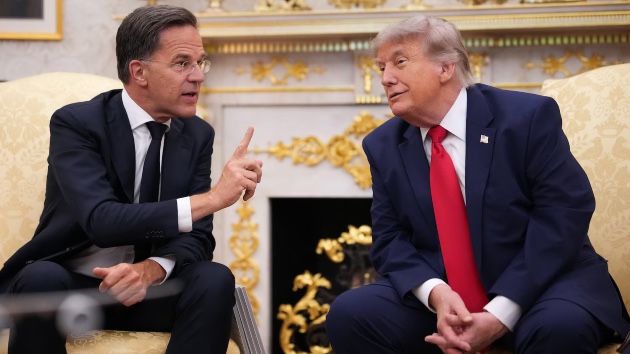
“I am going to the summit out of respect for President Erdogan … Except for the fact that it was being held in Turkey by President Erdogan, I don’t think I would have gone to it,” Trump said before a meeting with Rutte in the Oval Office in June.
Turkey is seeking to join the U.S. F-35 program, but it is prohibited from doing so as long as it possesses Russian-made air defenses.
“I’m probably going to do something that’s going to make him very happy,” Trump said.
Ending the war in Ukraine
As has been the case since the war with Russia began in 2022, the issue of Ukraine is also likely to play a key role in the NATO gathering.
White House spokesperson Anna Kelly said Sunday that Trump will meet separately with Zelenskyy on Wednesday afternoon in addition to other meetings with NATO leaders.
A senior U.S. official said Sunday that Trump planned to speak with Zelenskyy about “how we can end the war.”
“So, there are some small areas where Ukraine has made progress. There’s some small areas where Russia has made progress. But, the line of contact has been frozen over the last couple of months,” the official said.
The official said that Trump was hopeful a meeting with Zelenskyy could bring the war closer to an end.
“We’re hopeful that we can make progress towards doing that when, when the president gets together with President Zelenskyy and I’m sure he’ll follow up with President Putin as well,” the official said.
The conversation with Zelenskyy would come after Trump spoke with Putin on Saturday for nearly an hour and a half, according to a Kremlin readout, which noted that the two touched on Ukraine and that Trump “reiterated his readiness” to find a solution to the conflict.
The White House did not respond to a request for comment on the call.
Copyright © 2026, ABC Audio. All rights reserved.