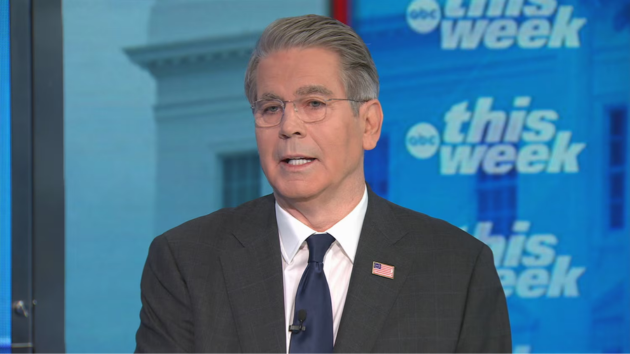
(WASHINGTON) — Treasury Secretary Scott Bessent on Wednesday released a rendering of a commemorative coin featuring President Donald Trump, saying that the U.S. Mint will begin striking the $1 piece to commemorate the 250th anniversary of the signing of the Declaration of Independence.
“As America commemorates 250 years of independence, the [U.S. Mint] will begin striking this new $1 gold coin to honor the enduring legacy of liberty and a lasting symbol of patriotism,” Bessent wrote in a social media post. “Featuring President Trump, it celebrates the strength of American values, and the promise of a nation dedicated to preserving freedom for all.”
The coins — which are not real gold but will feature a gold-like finish — will be available in the fall, a Treasury Department spokesperson said.
The last and only time a living president was featured on hard currency struck by the U.S. Mint was a century ago for the U.S. Sesquicentennial. The half-dollar coin featured then-President Calvin Coolidge silhouetted behind the bust of President George Washington. At the time, the Mint produced a million of the coins with 860,000 of them ultimately returned and melted due to low demand.
While living presidents are generally barred from appearing on U.S. currency, the Trump administration has argued that the Circulating Collectible Coin Redesign Act of 2020 permits the design because it authorizes the Treasury secretary to oversee the minting of special commemorative coins for the nation’s Semiquincentennial. And while the same law bars any person from appearing on the tail side of a commemorative coin, the restriction doesn’t apply to its face.
Federal law also stipulates that coin designs be selected by the Treasury secretary after consultation with the Commission of Fine Arts, which approved the design last March, and review from the bipartisan Citizens Coinage Advisory Committee, an 11-person body established by Congress in 2003 to advise on designs of hard currency.
But the Treasury Department appears to have skipped the latter committee, raising questions about the legality of the coin’s production.
Donald Scarinci, a numismatist and Democrat who’s spent over two decades on the committee, said aside from a last-minute attempt by the Mint to present the proposed coin to the committee in December, the body never had a chance to review the design as required by law.
“We’ve never seen any design with the portrait of Donald Trump on it,” Scarinci told ABC News on Wednesday.
Scarinci said the proposed December meeting ultimately didn’t occur because it was impossible to reach a quorum of members on such short notice.
During the committee’s February meeting, another member of the board, Kellen Hoard, a coin collector who represents the general public, also said that the board received no opportunity to weigh in on the coin, nor did they review the designs ultimately selected for the Semiquincentennial series of quarters.
“I have never reviewed the Semiquincentennial $1 coin portfolio, much less been given an opportunity to review it. Is it legal now for the Mint to move forward with creating the Semiquincentennial $1 coin despite me never having the opportunity to review the piece?” Hoard asked acting Mint Chief Counsel Greg Weinman at the meeting.
Weinman replied that he did not agree with Hoard’s characterization and said that the Mint’s position is the board made the decision to not review the design.
“I think the Mint made a significant effort to request the CCAC to review the portfolio. There was clearly a conscious decision not to do so. The Mint has moved forward accordingly. I am not prepared to discuss more than that at this meeting,” Weinman said.
“I believe the CCAC was given — at least the chair of the CCAC was given a full opportunity to review this portfolio,” Weinman added later. “The Mint, in my opinion, attempted multiple times to find an opportunity for the CCAC to review the portfolio. The CCAC made a decision not to. At least the chair of the CCAC made the decision not to.”
“The concept that the secretary of the Treasury can create his own coin — it’s illegal,” Scarinci said of the move, adding that Congress would have the authority to confiscate and demonetize the coins and that concern about the coin crosses partisan boundaries on the committee.
“This is not a Democrat-Republican issue as far as the coin is concerned,” he said.
A Treasury spokesperson told ABC News, “During the January meeting, Megan Sullivan, the acting chief of the U.S. Mint’s office of design management, assured board members that ‘legal research from both the Mint and the Department of the Treasury determined that the proposed coin would not violate any laws and is legal under the law authorizing the minting of coins for the Sesquicentennial.'”
The coin is not the only piece of currency that the Treasury Department is putting Trump’s imprint on. Paper currency printed this year will also feature Trump’s signature above that of Bessent’s — a first for an American president. Bessent told Fox News earlier this week that, too, would go into circulation this fall.
In May, Trump administration officials pushed the Bureau of Engraving and Printing to move forward with designing a commemorative $250 bill with Trump’s portrait and signature, should legislation to create the new currency pass, according to two people with knowledge of the discussions.
That bill has been stuck in the House Financial Services Committee for more than a year.
Copyright © 2026, ABC Audio. All rights reserved.