
US eliminated from World Cup after 4-1 loss to Belgium, red card controversy

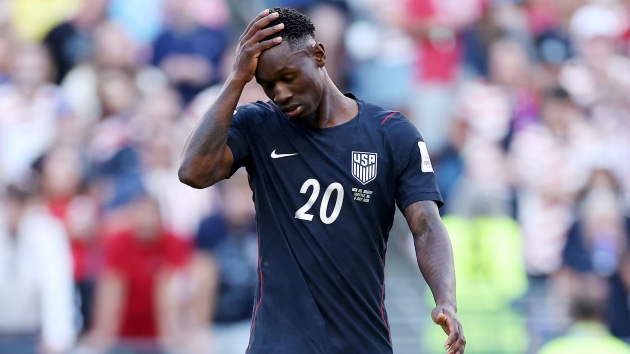
Folarin Balogun of the United States reacts after Belgium’s third goal by Hans Vanaken during their FIFA World Cup 2026 Round of 16 match, July 6, 2026 in Seattle, Washington. (Sarah Stier/Fifa via Getty Images)

(NEW YORK) — The United States’ run in the 2026 World Cup has come to a close after a 4-1 loss to Belgium on Monday.

The loss comes after the U.S. men’s national team’s star striker, Folarin Balogun, was deemed eligible to play in the match after his one-game suspension from a red card was put on hold by FIFA.

While the U.S. team expected a boost from Balogun’s presence on the pitch, it could not recover from a pair of goals in the first half from Belgium’s Charles De Ketelaere, despite a free kick goal from U.S. midfielder Malik Tillman that very briefly tied the game. Two more Belgian goals in the second half put victory out of reach for the Americans.

Belgium will go on to face Spain in the quarterfinals in Los Angeles on Friday.

Balogun was given a red card during the July 1 game against Bosnia-Herzegovina after the U.S. player clashed with an opposing player’s foot in the second half. The penalty automatically landed Balogun a one-game suspension. FIFA told ABC News at the time that the call was final and not able to be overturned or appealed.

FIFA said on Sunday that “the implementation of the match suspension is suspended for a probationary period of one year.”

The football governing body added that if Balogun “commits another infringement of a similar nature and gravity during the probationary period, the suspension shall be revoked and the sanction enforced without prejudice to any additional sanction imposed for the new infringement.”

Ahead of Monday night’s game, the U.S. men’s national team confirmed that Balogun will be in the starting lineup.

The Royal Belgium Football Association (RBFA) released a statement Sunday that said in part that it was “astonished” by FIFA’s decision to allow Balogun to play in Monday’s match against them.

“In order to safeguard the legitimate rights of all participating teams and to protect the fundamental principles of fair play in our sport, both at this FIFA World Cup and at future editions of the tournament, the RBFA is investigating all potential options,” the RBFA statement further said.

European soccer’s governing body, UEFA, said in a statement on Monday that a red card suspension is “a principle embedded in regulations, which cannot be made subject to exceptions, let alone in the middle of a tournament where several other players have been in the same situation and regularly served their suspension.”

“We express our disbelief at such an unprecedented, incomprehensible and unjustifiable decision,” UEFA said.

USMNT head coach Mauricio Pochettino told reporters after last week’s match, which the U.S. won 2-0, that Balogun was “sad” and “disappointed” about the call and that the clash was not intentional, according to ESPN.

The USMNT’s victory over Bosnia-Herzegovina was their first in the World Cup round of 32 since 2002 and only their second knockout round victory in program history.

The American men’s best result at the World Cup was a third-place finish at the inaugural tournament all the way in 1930.

The U.S. team had been impressive in the 2026 tournament, finishing the group stage with a 2-1 record, with wins over Paraguay and Australia before a loss to Turkey, which occurred once the team had already secured a spot in the next round.

ABC News’ Kelly McCarthy and Joe Simonetti contributed to this report.

Copyright © 2026, ABC Audio. All rights reserved.

Trump needs to get tough on China to get tough on Iran’s economy. He’s been reluctant to do that

(CNN) — The Trump administration appears to have landed on a fallback strategy in the Iran war after military strikes and negotiations failed to deliver victory: threats of harsh economic sanctions.Treasury Secretary Scott Bessent has called them the “toughest sanctions in history,” which will “collapse this regime.” He’s even called it an “economic D-Day” for Iran, comparing it to the historic invasion of Nazi-occupied France during World War II.There’s just one problem: Making good on those tough words requires not just getting tough on Iran, but also getting tough on China, which is Tehran’s No. 1 trading partner.And Trump and his administration have proved quite reluctant to do that.When Bessent rolled out the economic strategy Monday, he didn’t name specific countries that would be punished — or lay out timelines — if they don’t cut ties. And the announcement notably did not include secondary sanctions on the large Chinese banks that facilitate Beijing’s purchases from Iran.China buys as much as 90% of Iran’s oil. Economic analysts have told CNN that targeting these banks and Chinese companies would be crucial to exacting a major toll on Iran’s economy.But not for the first time in recent days, Bessent punted on exactly what would be done on that front. He suggested messages were being sent — saying “no one is above the reach of US sanctions” — but didn’t detail what will happen with China.“If they facilitate transactions and are part of the ecosystem that turns Iranian oil into money, into repression, they will be targeted,” Bessent said. “We find that the best way to engage with countries is through quiet diplomacy.”He added: “So when the hammer of US Treasury actions falls upon them, they will have no one to blame but themselves.”But you could be forgiven for thinking this might be lots of sound and fury signifying relatively little.That’s because not only has the administration regularly backed off the threats it’s made in the Iran war, but it has a track record of treading gently around China, whose leader, Xi Jinping, is set to visit the White House next month.While Trump has made a big show about getting tough on China over the years, he backed off his trade war with Beijing in October, agreeing to a one-year truce. That followed shortly after Beijing upped its leverage by restricting access to critical rare-earth minerals and halting purchases of American soybeans.Trump last year also ignored federal law to help save the Chinese-owned video app TikTok, despite his first administration having labeled it a grave national security threat because of its ability to spy on Americans.Fast forward to Trump’s visit to China in May, and rather than pressing Xi publicly on a potential invasion of Taiwan, Trump made some major Taiwan-related rhetorical concessions.He also backed off his previous promises to get China to free Jimmy Lai, a former Hong Kong media tycoon who criticized the Chinese Community Party, as well as to ban Beijing from buying American farmland and to “aggressively” revoke Chinese student visas.By July, Trump delivered a primetime address in which he claimed China effectively interfered in the 2020 US election (which is not what the evidence actually showed). But rather than punish China for this seemingly major purported provocation, Trump downplayed the need for retaliation.The president seemed to prefer to use China to try to substantiate his still-baseless claims of stolen elections, without going to the trouble of holding the alleged thief accountable.And even in the context of the Iran war, Trump has been gentle with China.He has repeatedly shrugged off the idea that Beijing is helping Iran. And on his way back from China in May, he said he was considering lifting sanctions on Chinese companies that buy Iranian oil.Trump at the time was trying to secure a deal with Iran. But it’s telling that he’s been willing to telegraph potential carrots involving China, even as his administration is reluctant to publicly threaten to use the stick against it. In the latter case, it prefers “quiet diplomacy.”Also telling would seem to be Bessent’s comments Monday when CNN asked why the major secondary sanctions he previewed didn’t start immediately.“Well, we are giving everyone the opportunity to remedy bad behavior,” he said. “Why would I want to blow up the global financial system?”The administration appears well aware that getting tough on Iran would entail going after China — a risk that it might decide isn’t worth it.There’s an argument to be made that these topics are best addressed next month, during Xi’s state visit to Washington.But such pomp and circumstance can drain Trump of his resolve to get tough (as seen during his May visit to China) — and that’s if he even wants to get tough on China right now.The-CNN-Wire™ & © 2026 Cable News Network, Inc., a Warner Bros. Discovery Company. All rights reserved.
Read Next Story