Ukraine’s deep strikes mean ‘significant change’ for war, former Russian PM says

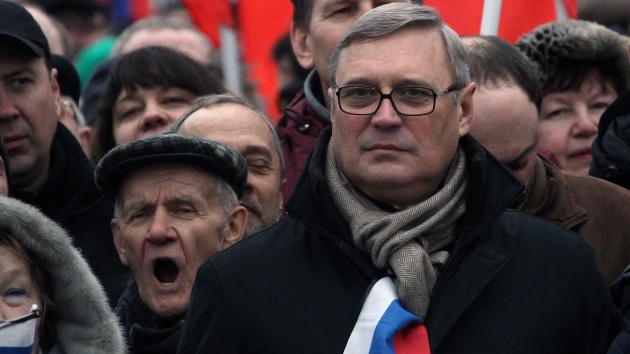
Former Russian Prime Minister Mikhail Kasyanov attends a march in memory of Russian opposition leader and former Deputy Prime Minister Boris Nemtsov on March 1, 2015 in Moscow, Russia. (Sasha Mordovets/Getty Images)

(LONDON) — Once one of the most powerful men in Russia, Mikhail Kasyanov now lives in exile in Latvia, his name on a list of “extremists and terrorists” that the Kremlin alleges are trying to overthrow the state.

Kasyanov first served as Russia’s finance minister before being elevated to prime minister under President Vladimir Putin from May 2000 to February 2004 — the early years of Putin’s time in office when the future strongman was embedding his control and beginning to formulate his vision of a revitalized Russia.

Putin’s decades-long project culminated in the February 2022 full-scale invasion of Ukraine, a gambit now in its fifth year. Kasyanov told ABC News last week that the campaign has achieved none of Putin’s goals and could yet prove an existential challenge to the Kremlin regime.

In recent months, Kasyanov told ABC News on the sidelines of the Chatham House think tank conference in London, “the overall sentiment, overall attitude, to Putin started to change.”

Among the factors applying more pressure to the Kremlin are expanding Ukrainian long-range drone strikes on Russia’s oil production, refining and export facilities — plus on the capital Moscow and the so-called “second capital” St. Petersburg — apparent public concern about spreading fuel shortages, troubling macro-economic indicators and new restrictions on internet usage, Kasyanov said.

Putin, Kasyanov said, built his image around providing both stability and security. “There is nothing on this — no stability and no security,” he said, adding, “The situation now has started to change in the minds of people — not only the ruling group, but also just the middle class, who in fact, could in any country be a driving force for any changes.”

That middle class is a key constituency for the Kremlin. Concentrated in Russia’s largest cities, analysts have watched keenly for any hint of dissent from this social strata.

Putin’s continued refusal to order a general mobilization despite Russia’s enormous battlefield losses and reported manpower strains have been interpreted by some analysts as a tacit acknowledgement that the Kremlin does not want to risk urban, middle class ire. “Putin is very much concerned about this,” Kasyanov suggested.

In cities like Moscow, St. Petersburg and Yekaterinburg, Kasyanov said, it had until recently been possible to continue as if “nothing is happening.”

“But, in the spring and now, of course, Ukraine changed their attitude. They have an advantage in long-range missiles and they have an advantage in drones,” Kasyanov said.

“Gradually, they moved the war from being an ‘accident’ somewhere, an emergency case somewhere in the corner of Russia, to Russia — even to Moscow. And that is quite a significant change.”

‘He needs pressure’

Kayanov said Western powers should seek to exploit the growing pressure on Putin and force him back to the negotiating table with genuine concessions, not the same maximalist demands the Kremlin has long made of Ukraine.

“It could happen by the end of the year if consistent pressure continues,” Kasyanov said. Russia’s growing budget deficit — which as of last month reached 2.5% of GDP, according to preliminary Finance Ministry data — could prove a particular pain point, he added.

So too might international sanctions on — and long-range Ukrainian drone attacks on — Russia’s vital oil industry, Kasyanov added. “By the end of the year, he will face a big problem,” Kasyanov said of Putin.

Kremlin spokesperson Dmitry Peskov this week acknowledged some economic strains, telling reporters that Russia’s rate of growth is currently “insufficient.” But Peskov said the problems facing the country were not critical, but rather a reflection of the “rather dire state” of the global economy.

On the diplomatic front, Kasyanov said Moscow has largely failed to convert apparent diplomatic openings with Washington — for example its success at Putin’s summit with President Donald Trump in Anchorage in August 2025.

“What Putin wanted was to divide the transatlantic unity, dreaming of what they call the ‘Anchorage spirit,'” Kasyanov said, referring to the U.S.-Russian understanding that Moscow said was reached at the Alaska summit, which was widely interpreted as a diplomatic coup for the Kremlin.

Broadly, Kasyanov suggested that Washington had a “wrong understanding of the whole problem.” He added, “All those years, it was a useless undertaking trying to give a carrot to Putin. Because they don’t understand what the Putin regime is about.”

The negotiations, Kasyanov suggested, were interpreted by the Kremlin “as a demonstration of weakness.” Nonetheless, both Moscow and Kyiv have acknowledged that the current conflict can only end with a diplomatic settlement.

Trump has repeatedly said he is the only Western leader capable of pressuring Putin and Ukrainian President Volodymyr Zelenskyy to agree a deal to end the fighting. This week, Trump told Fox News he believes that Putin is “ready to make a deal,” possibly “soon.”

“I tell him the same thing all the time. I don’t want to go into great detail, but I say: ‘Vladimir, it’s time for you to stop. It’s time for this war to end,'” Trump said. “It takes two to tango. But I think he’s ready to make a deal,” Trump added.

Earlier this month, Trump told ABC News of a potential deal, “We’re getting much closer than people realize, and President Putin wants it to end.”

But for all the Russian maneuvers and White House criticism directed toward Kyiv, Western funds and weapons have continued to flow into Ukrainian hands.

Last week, during a warm face-to-face meeting with Zelenskyy, Trump said Ukraine would be allowed to produce key Patriot surface-to-air system interceptors.

“That is, I think, creating a shock in Moscow,” Kasyanov said of the resolute Western backing of Ukraine.

Life after Putin

Putin dismissed Kasyanov and his cabinet in early 2004, weeks before that year’s presidential election. In the years that followed, Kasyanov became a prominent opposition figure, faced fraud charges — which he denied — and was blocked from standing as a candidate in Russia’s 2008 presidential election.

After Putin launched his full-scale invasion of Ukraine In 2022, Kasyanov left Russia. He now leads the People’s Freedom Party from Riga — “temporarily,” according to his business card.

Kasyanov, 68, said he has no concrete political ambitions in a post-Putin Russia. Rather, he suggested that the best case scenario would be a “long process” of political normalization and eventual democratization.

A years-long “gray period,” he said, could see Putin’s successors allow “imitation” or “quasi” elections and the return of a true political opposition, which Kasyanov hopes will eventually give way to a genuine vote that draws real legitimacy from the population.

“If Putin stays in power, it means there will be another period in which Russia will represent a threat and there will continue to be some kind of negotiations and preparations for some kind of revanche, as we saw in previous years,” Kasyanov said.

For the time being, Kasyanov said he expects Putin to simultaneously seek to “destroy unity” within Europe and within the transatlantic system and seek negotiations.

On the domestic front, Putin will continue to keep a tight grip on the narrative, Kasyanov said, lionizing Russian achievements in the war like the retention of Crimea, further territorial gains in southern and eastern Ukraine and a supposed defeat of NATO.

In the long term, Kasyanov said he still hopes for Putin to leave the scene, one way or another. But he doubts Putin will be overthrown from the inside.

“I don’t think there will be a coup, because there are no such people. All those people inside who were capable, with strength, disappeared,” Kasyanov said. There are, he added, people in Russia who are “ready for changes, but they are not ready to fight, because they immediately will be in jail.”

“When the situation starts to change, some of us could come back to participate in quasi-elections, which will happen not in two years after Putin, maybe in three years, maybe in four years. And at that time, real change could start,” he said.

“I hope my country will be a normal European state,” Kasyanov said. “We’ll see.”

Copyright © 2026, ABC Audio. All rights reserved.
Los demócratas aprueban un calendario para 2028 que da prioridad a estados con más votantes latinos y negros

Los demócratas aprobaron este sábado un calendario de primarias presidenciales para 2028 que adelanta las fechas de estados con poblaciones diversas y muy codiciadas, un movimiento que configurará la estrategia del partido para intentar ganar la Casa Blanca.Los miembros del Comité Nacional Demócrata (DNC, por sus siglas en inglés) dieron su aprobación definitiva a seis estados para las votaciones iniciales. Carolina del Sur, que cuenta con una importante población negra, seguirá dando inicio a las contiendas por la candidatura del partido, el 22 de enero de 2028.Nevada, un estado clave en disputa electoral en el oeste del país, le seguirá el 1 de febrero. Los otros cuatro estados con votación anticipada son Nueva Hampshire (8 de febrero), Nuevo México (15 de febrero), Michigan (22 de febrero) y Virginia (29 de febrero). El calendario excluye del grupo inicial a Iowa, estado que tradicionalmente servía de barómetro para los candidatos.Al optar por incluir a Nevada y Nuevo México en las primeras etapas, el partido ha concentrado al inicio del calendario estados con grandes contingentes de votantes latinos, un grupo demográfico en el que el presidente Donald Trump logró avances durante las elecciones presidenciales de 2024.En una entrevista con CNN, el presidente del DNC, Ken Martin, calificó el calendario como “el más diverso” en la historia del partido.“Pondrá a prueba a nuestro candidato ante sectores clave de nuestra coalición y regiones fundamentales del país de una manera que nunca antes habíamos visto”, afirmó.La votación, realizada en la última jornada de la reunión de verano del DNC, se produce en plena temporada de primarias de mitad de mandato, durante la cual los votantes demócratas han oscilado entre candidatos progresistas insurgentes y moderados, en una pugna interna sobre el rumbo del partido que probablemente marcará la concurrida carrera por la Casa Blanca.Martin, quien ha sido objeto de críticas por su liderazgo en el DNC y la gestión de sus finanzas, insistió en que tales diferencias ideológicas no deben dividir a los demócratas mientras avanzan hacia las cruciales elecciones intermedias de este noviembre, que decidirán el control del Congreso.“Somos un partido de gran amplitud ideológica”, declaró el líder del partido ante el grupo de mujeres del DNC durante la jornada inaugural de la reunión, el jueves. “Y mientras yo sea el presidente, seguiremos siéndolo”.“Todo el mundo es bienvenido en este partido”, dijo Martin entre fuertes aplausos y vítores de aprobación de los asistentes reunidos en el salón de baile de un hotel Hilton en el centro de Austin.Antes de la votación, funcionarios del partido en Iowa —que durante mucho tiempo celebró la primera contienda por la candidatura— manifestaron su descontento con el nuevo calendario.“Necesitamos que un estado del Medio Oeste y verdaderamente rural figure entre los cuatro primeros si queremos construir mayorías sostenibles y duraderas que impulsen cambios reales y significativos”, argumentó Rita Hart, presidenta del Partido Demócrata de Iowa, instando a los miembros del DNC a rechazar el calendario.Finalmente, el nuevo calendario fue aprobado mediante una votación a viva voz, lo que suscitó un prolongado aplauso de los asistentes.Además de excluir a Iowa del grupo de estados que votan al inicio del proceso, los miembros del comité retrasaron la fecha de las primarias de Nueva Hampshire, una medida que podría generar tensiones internas en el partido. La legislación de Nueva Hampshire exige que la máxima autoridad electoral del estado programe sus primarias al menos siete días antes de que cualquier otro estado celebre las suyas.Los defensores del nuevo calendario sostienen que esta reorganización ayudará a los demócratas a conectar con los votantes que el partido necesita para ganar las elecciones presidenciales. Tanto Nevada como Michigan cuentan con un gran número de afiliados a sindicatos y una cantidad considerable de votantes negros. Por su parte, la inclusión de Nuevo México incorpora a la ecuación un estado fronterizo, rural y con una importante población latina.“Nuevo México se parece mucho al Estados Unidos que los demócratas necesitan para ganar”, declaró a CNN la representante Teresa Leger Fernández, demócrata de dicho estado, antes de la votación definitiva. “Cuando nuestros candidatos presidenciales vengan a escuchar e inspirar a nuestros votantes latinos, los latinos de todo el país comprenderán que no se les está dando por sentado”.La reunión del DNC tuvo lugar en un momento de tensiones internas para el partido a nivel nacional. Algunos miembros criticaron las decisiones de gestión de Martin y expresaron su preocupación por la salud financiera de la organización.El DNC ha recaudado US$ 207 millones en lo que va de este ciclo electoral, frente a los casi US$ 279 millones recaudados por el Comité Nacional Republicano, según los informes presentados ante la Comisión Federal de Elecciones (FEC). Sin embargo, el comité demócrata está muy por detrás de su homólogo republicano en cuanto a recursos disponibles a menos de tres meses de las elecciones intermedias. El DNC cerró el mes de junio con una deuda de US$ 2 millones, mientras que el RNC contaba con casi US$ 129 millones en el banco, de acuerdo con los datos de la FEC.Martin defendió su gestión. En una entrevista con CNN, señaló una serie de victorias electorales demócratas en todo el país durante los últimos meses como resultado de su decisión de invertir en una infraestructura de campaña permanente.“Según cualquier criterio objetivo para evaluar a un partido y, ciertamente, a su liderazgo, estoy teniendo éxito”, afirmó Martin.Al ser consultado sobre una información publicada en The New York Times según la cual el partido habría pedido a sus proveedores que retrasaran el envío de facturas hasta después de las elecciones intermedias para aliviar la falta de liquidez, Martin declaró a CNN que era una “práctica habitual” renegociar los contratos con proveedores “para garantizar que se pueda gestionar el flujo de caja y mantener intactas esas relaciones”.Martin, elegido presidente a principios del año pasado, cuenta con defensores dentro del DNC, incluidos presidentes de partidos estatales que se han beneficiado de las nuevas inversiones del partido nacional en sus actividades.(El año pasado, el DNC aumentó la cuantía de los fondos destinados a los partidos estatales. Los estados demócratas comenzaron a recibir US$ 5.000 adicionales al mes, alcanzando un total de US$ 17.500, mientras que los estados republicanos recibieron un incremento de US$ 10.000 mensuales, llegando a un total de US$ 22.500).“No hay interés alguno en destituirlo”, afirmó rotundamente Michael Kapp, miembro del DNC por California. “Está haciendo exactamente lo que le pedimos: fortalecer los partidos estatales, invertir en programas de formación y organización, invertir en el registro de votantes partidarios y no acaparar nuestros fondos”. Daniele Monroe-Moreno, presidenta del Partido Demócrata de Nevada, afirmó que la estrategia de inversión de Martin está marcando la diferencia para los demócratas de su estado, quienes esperan ganar la gobernación y un escaño vacante en la Cámara de Representantes este otoño.“Está muy bien tener dinero en el banco”, dijo, “pero prefiero que ese dinero esté sobre el terreno impulsando la organización”.Durante la reunión, destacados líderes demócratas instaron a los miembros a centrarse en ganar las elecciones de este otoño en lugar de en las disputas internas del partido.“Nadie que esté ahora mismo sentado a la mesa de su cocina en Danville, Virginia, preocupado por pagar la factura de la calefacción o la compra se preocupa por lo que sucede en la sede del DNC, se los aseguro a todos”, declaró este sábado ante los asistentes el exgobernador de Virginia Terry McAuliffe, quien también ha presidido el DNC.“Necesitamos estar unidos”, afirmó McAuliffe.The-CNN-Wire™ & © 2026 Cable News Network, Inc., a Warner Bros. Discovery Company. All rights reserved.
Read Next Story