
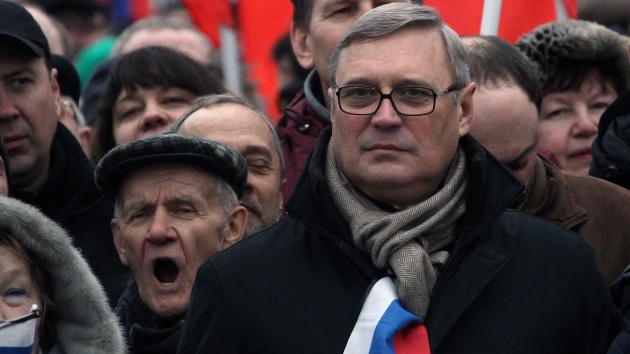
(LONDON) — Once one of the most powerful men in Russia, Mikhail Kasyanov now lives in exile in Latvia, his name on a list of “extremists and terrorists” that the Kremlin alleges are trying to overthrow the state.
Kasyanov first served as Russia’s finance minister before being elevated to prime minister under President Vladimir Putin from May 2000 to February 2004 — the early years of Putin’s time in office when the future strongman was embedding his control and beginning to formulate his vision of a revitalized Russia.
Putin’s decades-long project culminated in the February 2022 full-scale invasion of Ukraine, a gambit now in its fifth year. Kasyanov told ABC News last week that the campaign has achieved none of Putin’s goals and could yet prove an existential challenge to the Kremlin regime.
In recent months, Kasyanov told ABC News on the sidelines of the Chatham House think tank conference in London, “the overall sentiment, overall attitude, to Putin started to change.”
Among the factors applying more pressure to the Kremlin are expanding Ukrainian long-range drone strikes on Russia’s oil production, refining and export facilities — plus on the capital Moscow and the so-called “second capital” St. Petersburg — apparent public concern about spreading fuel shortages, troubling macro-economic indicators and new restrictions on internet usage, Kasyanov said.
Putin, Kasyanov said, built his image around providing both stability and security. “There is nothing on this — no stability and no security,” he said, adding, “The situation now has started to change in the minds of people — not only the ruling group, but also just the middle class, who in fact, could in any country be a driving force for any changes.”
That middle class is a key constituency for the Kremlin. Concentrated in Russia’s largest cities, analysts have watched keenly for any hint of dissent from this social strata.
Putin’s continued refusal to order a general mobilization despite Russia’s enormous battlefield losses and reported manpower strains have been interpreted by some analysts as a tacit acknowledgement that the Kremlin does not want to risk urban, middle class ire. “Putin is very much concerned about this,” Kasyanov suggested.
In cities like Moscow, St. Petersburg and Yekaterinburg, Kasyanov said, it had until recently been possible to continue as if “nothing is happening.”
“But, in the spring and now, of course, Ukraine changed their attitude. They have an advantage in long-range missiles and they have an advantage in drones,” Kasyanov said.
“Gradually, they moved the war from being an ‘accident’ somewhere, an emergency case somewhere in the corner of Russia, to Russia — even to Moscow. And that is quite a significant change.”
‘He needs pressure’
Kayanov said Western powers should seek to exploit the growing pressure on Putin and force him back to the negotiating table with genuine concessions, not the same maximalist demands the Kremlin has long made of Ukraine.
“It could happen by the end of the year if consistent pressure continues,” Kasyanov said. Russia’s growing budget deficit — which as of last month reached 2.5% of GDP, according to preliminary Finance Ministry data — could prove a particular pain point, he added.
So too might international sanctions on — and long-range Ukrainian drone attacks on — Russia’s vital oil industry, Kasyanov added. “By the end of the year, he will face a big problem,” Kasyanov said of Putin.
Kremlin spokesperson Dmitry Peskov this week acknowledged some economic strains, telling reporters that Russia’s rate of growth is currently “insufficient.” But Peskov said the problems facing the country were not critical, but rather a reflection of the “rather dire state” of the global economy.
On the diplomatic front, Kasyanov said Moscow has largely failed to convert apparent diplomatic openings with Washington — for example its success at Putin’s summit with President Donald Trump in Anchorage in August 2025.
“What Putin wanted was to divide the transatlantic unity, dreaming of what they call the ‘Anchorage spirit,'” Kasyanov said, referring to the U.S.-Russian understanding that Moscow said was reached at the Alaska summit, which was widely interpreted as a diplomatic coup for the Kremlin.
Broadly, Kasyanov suggested that Washington had a “wrong understanding of the whole problem.” He added, “All those years, it was a useless undertaking trying to give a carrot to Putin. Because they don’t understand what the Putin regime is about.”
The negotiations, Kasyanov suggested, were interpreted by the Kremlin “as a demonstration of weakness.” Nonetheless, both Moscow and Kyiv have acknowledged that the current conflict can only end with a diplomatic settlement.
Trump has repeatedly said he is the only Western leader capable of pressuring Putin and Ukrainian President Volodymyr Zelenskyy to agree a deal to end the fighting. This week, Trump told Fox News he believes that Putin is “ready to make a deal,” possibly “soon.”
“I tell him the same thing all the time. I don’t want to go into great detail, but I say: ‘Vladimir, it’s time for you to stop. It’s time for this war to end,'” Trump said. “It takes two to tango. But I think he’s ready to make a deal,” Trump added.
Earlier this month, Trump told ABC News of a potential deal, “We’re getting much closer than people realize, and President Putin wants it to end.”
But for all the Russian maneuvers and White House criticism directed toward Kyiv, Western funds and weapons have continued to flow into Ukrainian hands.
Last week, during a warm face-to-face meeting with Zelenskyy, Trump said Ukraine would be allowed to produce key Patriot surface-to-air system interceptors.
“That is, I think, creating a shock in Moscow,” Kasyanov said of the resolute Western backing of Ukraine.
Life after Putin
Putin dismissed Kasyanov and his cabinet in early 2004, weeks before that year’s presidential election. In the years that followed, Kasyanov became a prominent opposition figure, faced fraud charges — which he denied — and was blocked from standing as a candidate in Russia’s 2008 presidential election.
After Putin launched his full-scale invasion of Ukraine In 2022, Kasyanov left Russia. He now leads the People’s Freedom Party from Riga — “temporarily,” according to his business card.
Kasyanov, 68, said he has no concrete political ambitions in a post-Putin Russia. Rather, he suggested that the best case scenario would be a “long process” of political normalization and eventual democratization.
A years-long “gray period,” he said, could see Putin’s successors allow “imitation” or “quasi” elections and the return of a true political opposition, which Kasyanov hopes will eventually give way to a genuine vote that draws real legitimacy from the population.
“If Putin stays in power, it means there will be another period in which Russia will represent a threat and there will continue to be some kind of negotiations and preparations for some kind of revanche, as we saw in previous years,” Kasyanov said.
For the time being, Kasyanov said he expects Putin to simultaneously seek to “destroy unity” within Europe and within the transatlantic system and seek negotiations.
On the domestic front, Putin will continue to keep a tight grip on the narrative, Kasyanov said, lionizing Russian achievements in the war like the retention of Crimea, further territorial gains in southern and eastern Ukraine and a supposed defeat of NATO.
In the long term, Kasyanov said he still hopes for Putin to leave the scene, one way or another. But he doubts Putin will be overthrown from the inside.
“I don’t think there will be a coup, because there are no such people. All those people inside who were capable, with strength, disappeared,” Kasyanov said. There are, he added, people in Russia who are “ready for changes, but they are not ready to fight, because they immediately will be in jail.”
“When the situation starts to change, some of us could come back to participate in quasi-elections, which will happen not in two years after Putin, maybe in three years, maybe in four years. And at that time, real change could start,” he said.
“I hope my country will be a normal European state,” Kasyanov said. “We’ll see.”
Copyright © 2026, ABC Audio. All rights reserved.