Ukraine targets Moscow with 200 drones in large-scale attack, mayor says

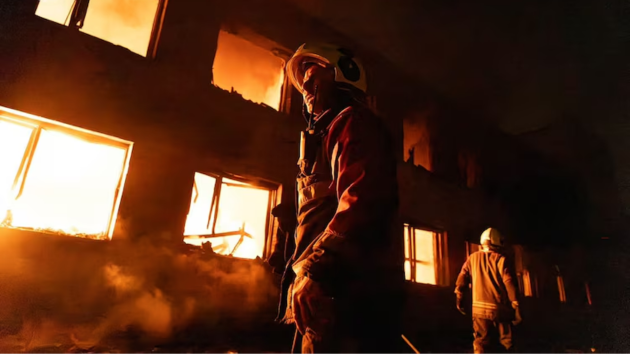
This handout photograph taken and released by the State Emergency Service of Ukraine on July 16, 2026, shows Ukrainian firefighters working to extinguish a fire at the site of a Russian air attack in Kyiv. (Handout/State Emergency Service of Ukrai)

(LONDON) — At least 200 Ukrainian drones were launched toward Moscow overnight into Thursday morning, the city’s Mayor Sergey Sobyanin said, as Kyiv continued its nightly long-range strike campaign deep into Russia.

From Wednesday evening until 9 a.m. local time on Thursday, “More than 200 drones were flying towards the Moscow region. Most of them were neutralized by air defense systems at a distance,” Sobyanin wrote in a post to Telegram. Ten drones “were destroyed as they approached Moscow,” the mayor said.

Russia’s Defense Ministry said its forces downed at least 375 Ukrainian drones overnight. The ministry said in a post to Telegram that drones were intercepted over 18 Russian regions — including Moscow — as well as Crimea, the Black Sea and the Sea of Azov.

Ukraine has been significantly expanding its drone campaign — referred to in Kyiv as “long-range sanctions” — in recent months, targeting major Russian cities, Russian oil infrastructure, military and logistics targets.

Ukraine has been significantly expanding its drone campaign — referred to in Kyiv as “long-range sanctions” — in recent months, targeting major Russian cities, Russian oil infrastructure, military and logistics targets.

The Russian Defense Ministry publishes only the number of Ukrainian drones and other projectiles it claims to have intercepted. Sobyanin releases real time statements when Ukrainian drones are reported shot down while heading toward the capital.

ABC News cannot independently verify the figures from either the ministry or the mayor. But the increasing scale and rate of such reports could be seen as indicative of Ukraine’s growing ability and willingness to target sites within Russia.

So far this year, Sobyanin has reported the downing of 1,420 Ukrainian drones on approach to Moscow, according to his Telegram posts, collated and analyzed by ABC News. Across all of 2025, Sobyanin only reported the downing of 734 Ukrainian drones near the city.

More than four years after Moscow launched its full-scale invasion of Ukraine, Ukrainian President Volodymyr Zelenskyy has made clear Kyiv’s intentions to return the war back to Russian soil. Key targets have included Moscow and the so-called “second capital” St. Petersburg.

“Our responses to Russia’s prolonging of the war and strikes on our cities and communities are completely fair,” Zelenskyy wrote on Telegram in May. “The Moscow region has Russia’s densest concentration of air defenses. But we are getting through,” he added.

Ukraine’s Wednesday night attacks also reportedly targeted the Engels-2 airbase in Saratov — a key hub for Russian long-range aviation, including strategic bombers. Andriy Kovalenko, the head of the Counter-Disinformation Center operating as part of Ukraine’s National Security and Defense Council, said in a post to Telegram, “Engels is on fire.”

Russia’s federal air transport agency, Rosaviatsiya, meanwhile, announced that temporary flight restrictions were introduced at Saratov airport during the overnight attacks. Restrictions were also put in place at airports in Nizhny Novgorod, Penza, Samara, Ivanovo, Yaroslavl, Cherepovets and Gelendzhik.

Flights operating from all four of Moscow’s international airports were also put under temporary flight restrictions overnight, Rosaviatsiya said.

Russia continued its own long-range strike campaign against Ukraine. Ukraine’s air force said in a post to Telegram that Russia launched 18 missiles and 146 drones into the country overnight into Thursday morning, of which 12 missiles and 129 drones were intercepted, suppressed or failed to reach their targets.

Six missiles and 16 drones impacted across 15 locations, the air force said.

Zelenskyy said in a post to Telegram that at least two people were killed by a Russian missile strike in Kyiv, with five other people injured. Other targeted regions included Kharkiv, Sumy, Zaporizhzhia, Vinnytsia, Zhytomyr, Mykolaiv and Donetsk, Zelenskyy said.

“Moscow is relying on terror through ballistic missiles and continues its attacks,” Zelenskyy wrote.

Copyright © 2026, ABC Audio. All rights reserved.
China’s most famous comedian under investigation for joke about communist song

Hong Kong (CNN) — A stand-up comedian, considered one of China’s most influential cultural figures, has been placed under investigation and had performances cancelled after he joked about a communist party song.Guo Degang, China’s best-known comic, was accused of violating public morals after he improvised his own lyrics to a famous Chinese revolutionary song during a performance in Wuhan at the end of July.He was reported to the city’s Culture and Tourism Bureau by a complainant who said he had “not only distorted and vulgarized a classic revolutionary work, but also violated public morals and accepted standards of conduct,” according to a screenshot of the letter published by state-affiliated media thePaper.Guo’s trouble underscores the delicate line comedians must tread in highly censored China, especially as its ruling communist party steps up its ideological drive.The song in question, “Playing my beloved pipa,” is said to capture the resilient spirit of communist guerrilla forces fighting the Japanese during the Sino-Japanese war. It was featured in a famous 1950s Chinese movie called Railroad Guerrillas, and in 2019 was one of 100 songs chosen to celebrate the 70th anniversary of the founding of the People’s Republic of China.The original lyrics are: “The sun is about to set in the west; all is quiet on Weishan lake.” But Guo adapted the second part to instead say “all is quiet in the Forbidden City,” and performed the song in a comedic style.The mention of the Forbidden City –– the sprawling palace complex in the heart of Beijing that served as the seat of power for China’s imperial rulers for hundreds of years –– could be politically sensitive in China because of its close historical association with whoever is in power.The Wuhan Culture and Tourism bureau said, “the adapted portion performed by Guo Degang was not included in the materials submitted for prior approval and is suspected of violating the Regulations on the Administration of Commercial Performances,” reported thePaper.The bureau confirmed to CNN that its investigation into Guo was ongoing, adding that they do not know when the results will be announced.CNN has reached out to Guo for comment.Guo had been on a nationwide tour to celebrate his theatre group’s 10th anniversary, but CNN has learned that some of his later performances have been cancelled.“There is no date or plan for a possible return. Ticket holders will be refunded automatically,” said a worker from Xi’an Chanba Poly Grand Theater, where Guo was scheduled to perform this week.Guo is credited with reviving a type of traditional Chinese comedy called crosstalk and is a household name in China. Along with several renowned Peking opera artists, he founded the Qilin theatre company to help promote lesser-known traditional Chinese art forms to a broader audience.The news the beloved star is under investigation has become one of the most discussed topics in Chinese social media.Some internet users think he should be punished for altering red (communist) songs, with one user saying that “art is to serve the people, if people don’t like it then please do not make such art.” Though some users on China’s tightly censored social media platforms suggested the officials were being “oversensitive.”Limited space for artistic expressionPerformers in China are facing an increasingly limited space for artistic expression, as the communist party aims to bring China’s online, celebrity and media in line with the doctrines of “Xi Jinping’s Thought.”It is not the first time that artists have faced backlash, or even the end of their career, for saying the wrong thing.Three years ago, Chinese stand-up comedian Li Haoshi was fined 14.7 million yuan ($2 million) in 2023 after he used a phrase associated with the People’s Liberation Army (PLA) when he told a story about two stray dogs.After his joke prompted anger from officials, Li apologized. But he was banned from performing indefinitely, and he has not been seen in public since.In 2022, comic Li Bo was fined 50,000 yuan ($7,400) for joking about the Covid-19 pandemic lockdown in Shanghai and teasing teenagers.CNN’s Shuai Zhang contributed to the reporting.The-CNN-Wire™ & © 2026 Cable News Network, Inc., a Warner Bros. Discovery Company. All rights reserved.
Read Next Story