
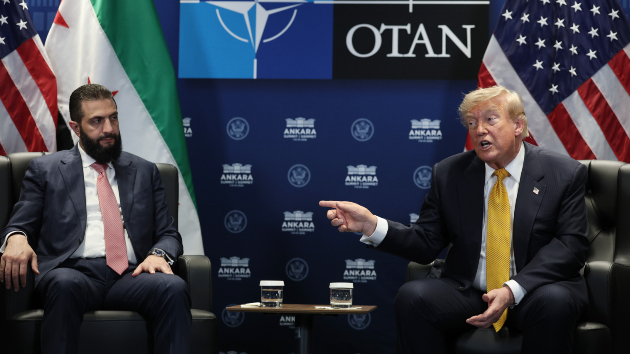
(WASHINGTON) — President Donald Trump, sitting next to Syrian President Ahmed al-Sharaa at the NATO summit in Turkey, said Wednesday that he will remove Syria from the State Department’s State Sponsors of Terrorism list.
“He’s done a great job. Maybe he would have brought that up. That’s a good question. Yeah, any problems with that? I think we should. Yeah, I will,” Trump said of al-Sharaa when asked about removing Syria from the list.
Trump offered high praise for al-Sharaa during their meeting on the sidelines of the NATO summit, a remarkable turnaround for the man who once led an al-Qaeda affiliate in Syria.
Al-Sharaa at one point had a $10 million bounty on his head and served time in the infamous Abu Ghraib prison in Iraq.
He then then led a coalition of Islamist rebel factions in late 2024 to topple former Syrian President Bashar al-Assad.
“He’s done a really fantastic job as president. He’s unified the country in a very short period of time,” Trump said Wednesday, describing the Syrian leader as a “strong person” who is “respected by everybody.”
“We’re proud of the job he’s doing,” Trump said.
Secretary of State Marco Rubio said Trump had alerted Congress Wednesday of the administration’s intent to rescind Syria’s designation following a 45-day period — the amount of time required for congressional review.
In his statement, Rubio referenced an executive order issued by the president last year ordering a review of Syria’s designation and remarks on the “positive changes and counterterrorism actions taken by the Syrian government under President Ahmed al-Sharaa, and formal assurances provided by President al-Sharaa that Syria will not support acts of international terrorism in the future,” two requirements for delisting.
Congress could attempt to block the delisting but the move is not expected to face significant opposition.
What it means for Syria
Trump’s commitment to potentially remove Syria from the State Sponsors of Terrorism list would mark one of the final obstacles blocking the country from fully rejoining the international financial system.
The U.S. designated Syria a state sponsor of terrorism in 1979 — the longest such designation for any country on the list. The other countries on the list are Cuba, Iran and North Korea. Syria was designated as such because of the former al-Assad regime’s historical support for designated terrorist groups.
But U.S. officials have said there are a number of steps needed ahead before the designation can be removed.
U.S. lawmakers are cautiously optimistic.
A bipartisan trio of lawmakers wrote to Trump earlier this month lobbying for Syria’s removal from the list. But they argued al-Sharaa’s government has more work to do to follow through on equal representation for women and minority constituents in Syria and ensuring security in the region.
The new US-Syria relationship
In May 2025, Trump announced he would lift sanctions on Syria to create a new relationship between the two countries.
Last November, the United Nations Security Council formally adopted a U.S.-led resolution that lifted sanctions on al-Sharaa so he could travel to the U.S. to meet with Trump in the Oval office, the first offical visit by a Syrian president.
Congress also approved repealing comprehensive sanctions under the Caesar Syrian Civilian Protection Act. Trump signed it into law in December.
The repeal provided a way for Syria to begin transacting with regional and U.S. businesses, but the state sponsor of terrorism designation blocks it from accessing significant U.S. foreign assistance.
Lifting this designation on Syria could facilitate a whole range of investments in the country, including in oil, banking, technology, and real estate — which could lead to an economic sea change for the country and more overall stability.
ABC News’ Shannon K. Kingston contributed to this report.
Copyright © 2026, ABC Audio. All rights reserved.