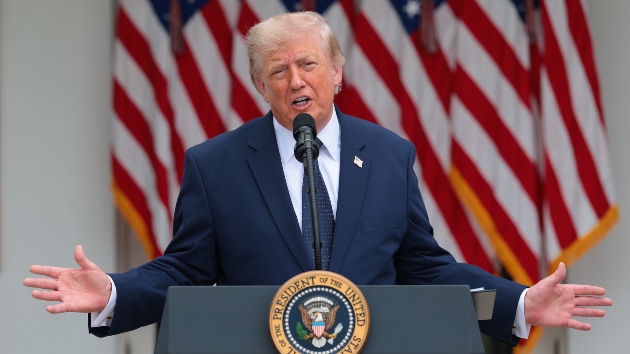
(WASHINGTON) — President Donald Trump said in a social media post Friday morning that he “will not sign” the bipartisan housing reform package, which he abruptly placed into limbo last month after demanding that his unrelated signature election reform law be sent to his desk alongside it.
Trump said he won’t sign the housing bill “in PROTEST” over the Senate’s inability to pass the Save America Act.
The housing bill can still become law overnight without Trump’s signature.
If a president doesn’t sign a bill or veto it, it automatically becomes law after 10 days while Congress is in session, excluding Sundays. The housing bill was presented to Trump on June 29, and the 10-day clock began on June 30. If Trump issues a veto, Congress would need to attempt to override it by a two-thirds vote in both the House and the Senate.
The 21st Century Road to Housing Act aims to address the country’s housing shortage by increasing the supply of homes and overall homeownership by loosening regulations to encourage housing construction and by limiting Wall Street investors from buying homes that could go to families instead.
New data from the National Association of Realtors shows the median home price increased 1.8% in June from a year ago, and is now $440,600 — an all-time high.
The Senate voted 85-5 on passage of the housing measure on June 22 before the House approved the bill by a vote of 358-32 on June 23. Both totals represent sufficient support to overcome a potential presidential veto with a two-thirds majority in both chambers.
Even though the stage was set for the president to sign the bill in a rare ceremony at the U.S. Capitol, the bipartisan breakthrough did not last long, as Trump quickly announced he would not sign the bill unless lawmakers approve the SAVE America Act.
The SAVE America Act would make significant election and voting reforms, including requiring photo ID at polling places and proof of citizenship before a person could register to vote. The legislation has been flatly rejected by Democrats and would require 60 votes to prevail in the Senate.
Trump has pushed Republicans in the Senate to eliminate or modify the filibuster to get the bill through, though Majority Leader John Thune has said Republicans don’t have the votes to do so.
Trump wrote in his social media post Friday that if Democrats “do not allow a positive Vote on SAVE AMERICA, TERMINATE THE FILIBUSTER, and pass this, and every other Bill that true Republicans have ever dreamt of.”
Copyright © 2026, ABC Audio. All rights reserved.