
Trump says documents show voting vulnerabilities, China meddling and fraud

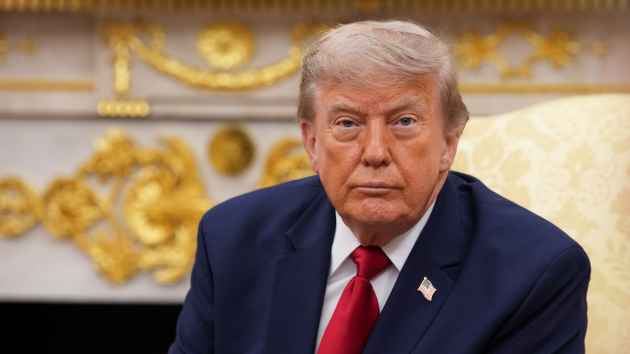
U.S. President Donald Trump looks on during a bilateral meeting with the Prime Minister of Iraq Ali al-Zaidi, in the Oval Office of the White House on July 14, 2026 in Washington, DC. (Photo by Andrew Harnik/Getty Images)

(WASHINGTON) — President Donald Trump, in a primetime address on Thursday, announced he has declassified a slew of documents he claims reveal vulnerabilities in America’s elections systems, election fraud and interference in elections by China, and ordered the Department of Justice to prosecute those believed to be involved.

“America is back and doing really well, but we still have a major challenge that must be urgently addressed because no country can be great without fair and honest elections, you have to trust your country,” Trump said. “Because if there can be no trust, there can be no greatness, and that’s very simple: no trust, no greatness.”

But throughout the more than 20-minute speech, the president did not provide specific evidence that the election outcome, or any votes, were altered in the 2020 election, despite his repeated claims that the election was “stolen” or “rigged.”

Trump has long pushed debunked conspiracy theories to claim that his 2020 election loss was fraudulent.

The president’s speech led to his main argument: he wants Congress to pass the SAVE America Act, his sweeping elections reform bill that Senate Majority Leader John Thune has repeatedly said does not have enough Republican votes to pass.  

In his remarks, the president said that he would immediately declassify the release of “critical intelligence, revealing shocking vulnerabilities in our election infrastructure.”

According to the president, the documents focus on what he said were a number of areas of concern, including claims that China “compromised” election data during the 2020 election, and attempts to downplay the extent of China’s efforts.

Trump argued that the intelligence community suppressed information about China accessing 220 million voter files and trying to turn American opinion against him in the run-up to the 2020 election.

The president also accused the “deep-state” of keeping information about election meddling from him.

Trump claimed that U.S. intelligence agencies learned that tens of millions of voters’ data in 18 states had been “bought, stolen, or hacked” by China, and that the intelligence community deliberately kept this information from him while he was president.

Trump’s remarks asserting that the Chinese undertook a far more ambitious role in attempting to dictate the outcome of the 2020 election goes beyond what U.S. intelligence community has previously assessed.

In March 2021, two months into the Biden administration, a declassified “Intelligence Community Assessment” (ICA)  that was produced at the end of Trump’s first term publicly acknowledged the belief among some intelligence officials that “China took at least some steps to undermine former President Trump’s reelection chances.” But the ICA said any such actions were “primarily through social media and official public statements and media,” not through interference with “election processes.”

Further, the ICA said that while China was “probably” trying “to gather information on U.S. voters and public opinion; political parties, candidates and their staffs; and senior government officials,” the more reliable intelligence indicated that such efforts were not actually intended to undermine Trump but instead to “predict electoral outcomes and to inform its efforts to influence US policy toward China under either election outcome.”

The heavily redacted documents released by the White House on Thursday do not appear to back up Trump’s assertions, instead containing scattershot intelligence that descries efforts to obtain — but not alter — voter records and to conduct social media activity to sow social discord.

One heavily-redacted document titled “200M Voter Records Compromised. repeatedly references personally identifiable information being compromised. This information includes names, phone numbers and addresses — which can also be found from many other sources.

In another series of near-completely redacted memos, words such as “state voter registration data” and “personal identifiable information” appear between large blocks of black redaction markings. It is impossible to surmise the meaning of these records without context, but they appear to point to some Chinese efforts to gather American voter data, much of which is publicly available.

Notably, these memos document Chinese activities ahead of both the 2020 and 2024 presidential elections.

Elsewhere in his remarks, Trump alleged that former Justice Department officials slow-walked an investigation in Michigan that involved the submission of voter registration applications that had forged signatures and other indications of fraudulent applications. Trump called on FBI Director Kash Patel to look into whether any charges can still be brought.

Local media at the time said that a state-level investigation was halted so the FBI could continue with a related investigation. It’s unclear why no federal charges were ever brought or if federal charges were warranted.

At the time, state officials said that the fact that the fraudulent applications were detected shows that the system worked.

The president also said the documents released Thursday include a Department of Homeland Security report he called “stunning,” alleging approximately 278,000 non-citizens were included on voter rolls.

In the documents released by the White House, the DHS report that alleged 250,000 noncitizen voters on the rolls came from a review of “public voter files” that appear to have come from four states: California, New Jersey, Pennsylvania and Nevada. DHS did not provide any methodology about how it reached that number, nor does it specify what “public voter files” it reviewed.

DHS acknowledged it did not have access to those states’ voter rolls, and alleges that in the 10 states that provided the federal government access to their rolls, the agency found 28,000 noncitizen voters.  

Findings from the conservative-leaning Heritage Foundation have found only around 100 verified instances of non-citizen voting going back two decades.

-ABC News’ Lucien Bruggeman and Mike Levine contributed to this report.

Copyright © 2026, ABC Audio. All rights reserved.

Bulldozers rip into Big Bend National Park, driving anger and heartbreak

Big Bend National Park, Texas (CNN) — The towering cliffs, jagged mountain tops, and punishing desert climate of the Big Bend region in Texas have long proved to be the best barrier the United States could have with Mexico. For generations, the idea of needing to build physical structures to stop illegal migration was considered “insane,” as one former superintendent of Big Bend National Park said.But now the expansive reach of President Donald Trump’s southern border plan has stretched into this remote region that sees only about 1% of unauthorized crossing apprehensions. Bulldozers are clearing land in the beloved national park, where wildlife roams and the scenery has been untouched for thousands of years.“We didn’t have to worry about any type of barrier. We had a God-made barrier,” said Sheriff Thaddeus Cleveland of Terrell County, a vast and sparsely populated area northeast of the park. He spent 26 years in the US Border Patrol, hearing little if any talk of needing extra infrastructure in the area where he grew up, he said. “But that’s definitely changed.”US Customs and Border Protection says it’s not planning to build the same kind of 30-foot-high barrier that has appeared across parts of Arizona, California, New Mexico and Texas inside the national park. But critics say the plan that is in the works is no less destructive.Earlier this month, bulldozers were videoed uprooting trees and shoveling dirt as wild animals trotted by. They were doing preliminary work ahead of the budgeted $1.72 billion main construction project designated for the area inside Big Bend National Park, the agency said.It’s part of the bigger plan to finish the border wall — or some form of it — before Trump leaves office, with steel walls and vehicle barriers and hundreds of miles of new roads cutting through wildly remote areas.Those with concerns or outright opposition to the work in this remote desert wilderness run the gamut from a few elected Republicans to young activists, sweeping in a pro-border control sheriff and a retired National Park Service superintendent.Photographer Natalie Newman made a commitment to Big Bend back in February when then-Secretary of Homeland Security Kristi Noem waived certain federal laws related to environmental safety, historic preservation and wildlife protection, among other initiatives, saying there was “an acute and immediate need to construct additional physical barriers and roads” in the Big Bend region.“It started out as just documenting the beauty of it, trying to get people to see why it’s special and what makes it special and what makes it so beautiful and worth protecting. But that has transformed just over the last week,” she told CNN, standing near Santa Elena Canyon, where tall cliffs rise nearly 1,500 feet high from the Rio Grande and where she first saw bulldozers working in the national park.“More than anything else, I feel heartbreak over all of this,” she said. Newman enjoys the wilder parts of this park that’s larger than the state of Rhode Island, where you may see fewer people than javelinas — a mammal that looks like a small wild pig, though it’s an entirely different species. Cacti and wildflowers bloom across the state and federal land around Big Bend, which coupled with even larger nature preserves across the border are part of the Chihuahuan desert, the largest such ecosystem in North America.But these days when her binoculars are trained on something in the distance, she’s more likely to be checking on the progress of road clearing than on any of the hundreds of bird species that frequent the park. She said she will keep sharing that news, doing her part to stand up for the national park.“I’m hopeful every single day that it’ll be the day that someone somewhere does something that puts a stop to it,” she said.If there is no stopping, retired park superintendent Bob Krumenaker said what could happen in Big Bend would rival the flooding of Hetch Hetchy Valley a century ago, an event that changed arguments about preserving the environment. It’s why he labels the whole plan “insane.”“If they continue with this and build most of the things they have talked about, or even a good fraction of those, this will be the biggest desecration of the national park system — not just Big Bend National Park — since they built a dam in a pristine valley in Yosemite National Park more than 100 years ago. This is a story that our children and grandchildren will be telling,” he told CNN.Compounding the natural destruction is the damage being done to people’s trust, Krumenaker added.“It’s just a tremendous erosion, if not violation, of the agreement that Texans and the American people made when they established that national park. The federal government that I worked for for 41 years is disrespecting its citizens in a in a huge way.”Krumenaker, now chairman of the Keep Big Bend Wild advocacy group, spent five years as superintendent of Big Bend National Park and is familiar not only with the multiple studies and approvals needed for any material changes, but also with his federal partners in Border Patrol and the need for security.“I totally support a secure border in Big Bend, but this is the least active place in the country for illegal border crossings,” he said. “This is purely political, and it will, it risks destroying one of the nation’s greatest places. It’s just horrible.”He recalled as superintendent having an annual budget of between $8 million and $9 million and a maintenance to-do list of about $100 million they would chip away at when they could. Those numbers are dwarfed by the $1.72 billion earmarked for the Big Bend work, part of the larger $46.5 billion allocated for border wall construction in Trump’s signature legislation, the “Big Beautiful Bill.”Sheriff Cleveland thought the talk of security construction was “BS” when he first heard of it.His experience in local and national law enforcement tells him a different story than that framed by CBP that Big Bend is “an area of high illegal entry.”What he calls the “God-given barriers” of steep mountains and valleys around the river and an undeveloped landscape without roads would prevent any vehicle getting to his patch. Yet new vehicle barriers are being planned for Terrell County, part of the total $7 billion scheme for the Big Bend sector of the border that includes the national park and land either side.“I believe in border security … but let’s put a barrier where a barrier makes sense,” he told CNN. “Let’s spend money where we need to spend the money.”Cleveland thinks using technology would be better support for him and other rural areas. He points to a solar-powered radar tower with a relatively small footprint that can scan the landscape and identify humans by their gait, triggering cameras to lock on and feed information to agents. Another option would be drones tracking people and helping responders plan a safe interception amid the rugged terrain, he said.“The biggest problem is the people making the decisions out here for the Big Bend sector have never stepped foot out here.”Cleveland ran for sheriff as a Republican but says he may switch to independent — what he sees as the profligate federal spending on something unnecessary does not mesh with his own fiscal conservatism.He signed a letter being carried around the area by former land commissioner Jerry Patterson, praising Trump for closing the border and asking the administration to consider cheaper and less destructive options for the Big Bend region.A similar approach is being taken by others in Texas.US Sen. John Cornyn wrote to DHS Secretary Markwayne Mullin last week urging him to meet with local stakeholders before any more construction proceeds on state or federal property. Some of Mullin’s involvement so far has been to waive another federal law, effectively ending a lawsuit claiming that law was being violated. Land Commissioner Dawn Buckingham was more forthright, sending a cease-and-desist letter warning of possible legal action to Customs and Border Protection after she said a federal contractor was sent to work in the Big Bend Ranch State Park without permission. The accompanying news release was titled “Don’t Tread on Texas.”Gov. Greg Abbott remarked before Trump entered the White House for the first time that he did not want a border wall across the entirety of his state. “There are serpentine regions of the Rio Grande where it would be extremely challenging to build a wall. There are parts like the Big Bend region — we don’t want (to) see a wall in the beautiful Big Bend National Park,” Abbott said in December 2016, as reported by The Associated Press. CNN asked for his current views and was directed to a previous statement from Abbott’s press secretary Andrew Mahaleris: “Rugged, isolated areas like Big Bend are great opportunities to deploy technology to aid in securing the border.”Critics say most statewide elected Republican officials have been too quiet in their condemnation of the border barrier construction projects because they fear the wrath of Trump’s criticism on his signature issue of border security.“The one person who is supposed to stand for Texas right now, our governor, is silent,” resident Jess Bartko said. “What they are doing is actively waging a war against our parks, our public lands, our community and our livelihoods.”On Wednesday, Bartko and about 100 other protesters gathered by the river, whose route gives the area its name and which attracts many of the half-million or so annual visitors to the national park.Tourism is a big deal here — for running the river and watching the night sky. There are worries that both will be impacted. As far as the upheaval, there could be debris in the river, and construction lights from sites and worker camps could pollute some of the darkest sky in the Lower 48, blurring the star-filled views of the cosmos.This week some roads and facilities were closed in the national park because of the construction.Down at the river, beside the entrance to Santa Elena Canyon, one of the “crown jewels” of the park, the demonstrators whooped and hollered, their shouts echoing off the cliff walls as they pledged to keep working to protect Big Bend.“The land remembers, the water remembers, it will remember us and our fight,” Joan Escamilla told her fellow supporters of the national park. “You can bury my heart in the Rio Grande.”The-CNN-Wire™ & © 2026 Cable News Network, Inc., a Warner Bros. Discovery Company. All rights reserved.
Read Next Story