(LONDON) — Ukrainian President Volodymyr Zelenskyy left last week’s NATO summit armed with a valuable commitment from President Donald Trump — that Kyiv would get approval to produce vital interceptor missiles for the Patriot air defense system, which since 2023 has helped defend Ukraine’s skies against Russian aircraft, drones and ballistic missiles.
Zelenskyy and his top officials have long warned that Ukraine needs more air defense systems and far more ammunition to blunt Russia’s daily long-range strikes. In recent weeks and with interceptor missile stocks reportedly running low, those warnings have become more dire.
Trump’s approval for Kyiv to get a production license to produce Patriot interceptors on home soil is “really good news for Ukraine,” Chrystia Freeland, previously Canada’s deputy prime minister and now an economic adviser to Zelenskyy, told ABC News on the sidelines of the Chatham House think tank’s conference in London last week.
“It would be even better if they were getting Patriots right now, because they’re being hammered,” Freeland added. “It’s great to get the licenses. But between getting the licenses and actually being able to make the Patriot [missiles] to defend themselves, it’s going to take time. And during that time, lots of people are going to die.”
As civilian casualties in Ukraine rise, securing more air defense systems and ammunition are a priority for Kyiv, Zelenskyy has said repeatedly. Russian strikes killed at least 265 civilians in Ukraine and injured 1,816 in June, senior United Nations official Rosemary DiCarlo told the body’s Security Council earlier this month.
The combined casualty total for June is the highest recorded since the first months of Russia’s full-scale invasion, DiCarlo said. Moscow’s full-scale invasion in February 2022, a top U.N. official told the Security Council on Thursday.
In a post to X on Monday, Zelenskyy said that he and Trump “have reached an important deal on licenses to produce Patriot systems. Our teams are now working to implement this truly historic political agreement. We worked toward this for a very long time.”
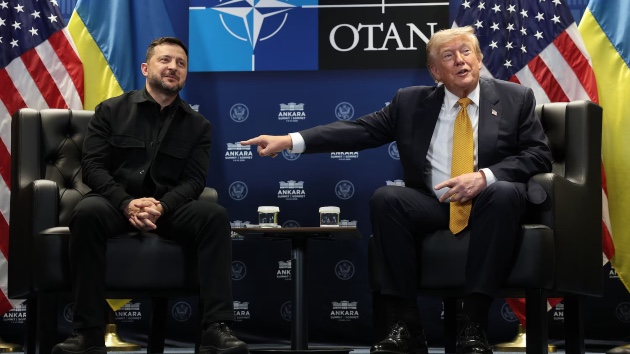
Trump said during his warm meeting with Zelenskyy in the Turkish capital Ankara that the two leaders had developed a “good relationship.” The friendly exchange was a far cry from the infamous bilateral meeting at the White House last year which devolved into a heated public argument, with Trump and Vice President JD Vance openly admonishing Zelenskyy.
Freeland said that while Trump’s backing was welcome in Kyiv, Ukrainian leaders were focused on the bigger strategic picture. “They’re playing 100% to necessity. Ukrainians aren’t fighting to put on a show for Trump. They’re fighting because otherwise they will die,” she said.
“Trump does like a winner. He is not averse to flip flops. And I do think the stronger Ukrainians are the more likely they are to get his support,” Freeland added.
The Ankara declaration — NATO allies traditionally issue a joint communique to mark the end of each summit — said that Ukraine “contributes to transatlantic security” and is in line to receive some $80 billion in allied funding across 2026, with 2027 funding to be “at least equivalent.”
“Allies stand united in our unwavering support for Ukraine in defending its freedom, sovereignty, and territorial integrity,” the statement read.
The outcome was a positive one for Ukraine, Freeland said. “I would emphasize that the Ukrainians are making their own luck. I think the better they do, the more enthusiasm there is for supporting them. I think the Ukrainians recognize,” she said.
European allies, in particular, Freeland said, had shown they “are prepared to hang in there.” She added, “I think neither the Russians nor the Americans thought that Europe could do it.”
Russia’s full-scale invasion of its neighbor is now in its fifth year, the latest round of conflict having followed a lower-intensity conflict which began in 2014 with Russia’s annexation of Crimea and its fomentation of separatist rebellion in Ukraine’s eastern Donbas region.
A campaign that was designed to deliver a rapid Russian victory has now lasted longer than World War One, with Kyiv claiming to have inflicted nearly 1.5 million casualties on the invading forces while Russia’s ongoing offensives in the east of the country remain at a glacial pace.
Ukrainian long-range strikes into Russia, meanwhile, have increased exponentially in scale and intensity, putting particular pressure on the country’s lucrative oil production, refining and export sectors. Ukrainian drones are also increasingly targeting the supply routes into Crimea, seeking to effectively blockade the occupied peninsula from afar.
Ukraine’s foreign partners have been lauding the country’s reported successes. Even Trump, who famously suggested last year that Ukraine did not “have the cards” to play, said last month that Zelenskyy was “doing pretty well” in the showdown with Russian President Vladimir Putin.
Both the Trump administration and former President Joe Biden’s administration had put pressure on Kyiv to refrain from attacking certain targets, with Ukraine’s strikes on Russian oil facilities reportedly a particularly sensitive subject under both administrations.
But Ukraine’s ongoing success on that front, Freeland said, showed it had been “a mistake to ask the Ukrainians to tie one hand behind their back.”
“One of the things that has changed is Ukrainians are now using their own weapons and they’re making their own weapons, and that means they don’t need to ask anyone’s permission for where they strike. And I do think that’s made a big difference,” she added.
Though the wartime narrative appears to be swinging somewhat in Ukraine’s favor, the country’s cities remain under near-constant fire and Kyiv’s forces do not appear able to liberate significant territory still occupied by Russian troops. In his latest casualty update in February, Zelenskyy said Ukraine had lost at least 55,000 soldiers killed since 2022.
Ukraine also still appears to be frozen out of NATO membership in the short term, despite Zelenskyy’s repeated and recent appeals for the alliance to set out a clear roadmap for Ukraine’s accession, which allies have repeatedly said they support in principle.
“I have actually heard, behind closed doors and also in public, more and more European leaders saying Russia shouldn’t have a veto on who is in NATO, and Ukraine now has the strongest army in Europe, we should have them on our team,” Freeland said.
Moscow and Kyiv still appear far apart on the key issues in any future settlement. Though Putin has claimed a willingness to negotiate, he is still refusing to engage directly with Zelenskyy and is still demanding a raft of major Ukrainian concessions in exchange for peace.
“I think it’s impossible to foresee what will happen next,” Freeland said when asked about the war’s outlook. “Where are we right now? We know that the Ukrainians are doing well … We know that Russia is suffering more than it has since the beginning of the war.”
“I think that the view that Ukraine was about to collapse was always overdone. And I think that was a line that Russia pushed in order to get Western allies, particularly the United States, to push Ukraine to surrender. And they were effective, for a while,” she added.
“What I think is important for us to recognize and what is absolutely true, is Ukraine’s success right now is showing us that if we give them the tools, they will finish the job,” Freeland said.
ABC News’ Yulia Drozd contributed to this report.
Copyright © 2026, ABC Audio. All rights reserved.