
Trump building granite helipad on White House South Lawn

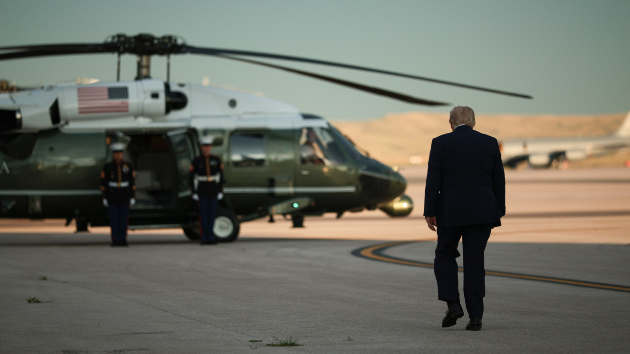
President Donald Trump walks over to Marine One after landing in Air Force One on July 03, 2026 at Ellsworth Air Force Base, South Dakota. (Chip Somodevilla/Getty Images)

(WASHINGTON) — President Donald Trump confirmed on Monday that he is constructing a granite helipad for Marine One on the White House South Lawn, and said it will be paid for by Sikorsky Aircraft, a subsidiary of Lockheed Martin, which makes helicopters that transport the president.

“So, now we’re building a helipad, a beautiful helipad, and it’s got the seal of the White House on it, in granite, in carved granite. It’s really a beautiful thing,” Trump said while taking reporter questions at an event in the Oval Office. 

Trump said Sikorsky would pay for the construction.

“It’s about $5 or $6 million. They’re paying the full cost,” the president said.

A Lockheed Martin spokesperson, in a statement provided to ABC News, said the company “has a long history of supporting projects” in Washington, D.C., and across the country.

“This specific contribution was made to the Trust for the National Mall, the National Park Service’s non-profit organization,” the spokesperson said. “Our engagement with the federal government is guided by rigorous ethics and compliance standards and conducted in full accordance with all applicable laws and regulations.”

Lockheed Martin delivered a new fleet of Sikorsky helicopters to the Air Force in 2024, but the White House has had to keep using an older fleet for South Lawn departures and arrivals because they burn the grass. Trump on Monday said the helicopters not only singed the grass but also “ripped it out.”

The newer helicopters have been used when the president is away on travel.

A spokesperson for Sikorsky said in a statement that the new helicopter, a VH‑92A Patriot, “is a recognizable patriotic asset known around the globe for safety, security and reliability.”

The U.S. Navy awarded Sikorsky Aircraft a $1.24 billion contract to replace the Marine One helicopter fleet. The deal was agreed to under President Barack Obama’s administration.

“It brings increased capabilities for the no‑fail mission supporting the Commander‑in‑Chief around the world. The helicopter delivers increased performance and reduced maintenance costs and time over the current fleet of presidential helicopters,” the Sikorsky spokesperson said.

The helipad will be Trump’s latest construction project at the White House.

The East Wing was demolished last year to make way for construction of Trump’s massive White House ballroom. The ballroom addition has sparked numerous legal challenges.

Trump installed plaques underneath portraits of presidents at the White House — dubbed the “Presidential Walk of Fame” — along the West Wing Colonnade.

He also paved over the grass at the White House Rose Garden to create a patio with tables, and installed two massive flagpoles on the North and South lawns. More recently, scaffolding was erected for restoration work on the building’s stone columns.

Trump commented on the work while hosting a lunch at the new Rose Garden Club.

“A lot of love is being put in the White House,” the president said.

ABC News’ Alexandra Hutzler contributed to this report.

Copyright © 2026, ABC Audio. All rights reserved.

Trump needs to get tough on China to get tough on Iran’s economy. He’s been reluctant to do that

(CNN) — The Trump administration appears to have landed on a fallback strategy in the Iran war after military strikes and negotiations failed to deliver victory: threats of harsh economic sanctions.Treasury Secretary Scott Bessent has called them the “toughest sanctions in history,” which will “collapse this regime.” He’s even called it an “economic D-Day” for Iran, comparing it to the historic invasion of Nazi-occupied France during World War II.There’s just one problem: Making good on those tough words requires not just getting tough on Iran, but also getting tough on China, which is Tehran’s No. 1 trading partner.And Trump and his administration have proved quite reluctant to do that.When Bessent rolled out the economic strategy Monday, he didn’t name specific countries that would be punished — or lay out timelines — if they don’t cut ties. And the announcement notably did not include secondary sanctions on the large Chinese banks that facilitate Beijing’s purchases from Iran.China buys as much as 90% of Iran’s oil. Economic analysts have told CNN that targeting these banks and Chinese companies would be crucial to exacting a major toll on Iran’s economy.But not for the first time in recent days, Bessent punted on exactly what would be done on that front. He suggested messages were being sent — saying “no one is above the reach of US sanctions” — but didn’t detail what will happen with China.“If they facilitate transactions and are part of the ecosystem that turns Iranian oil into money, into repression, they will be targeted,” Bessent said. “We find that the best way to engage with countries is through quiet diplomacy.”He added: “So when the hammer of US Treasury actions falls upon them, they will have no one to blame but themselves.”But you could be forgiven for thinking this might be lots of sound and fury signifying relatively little.That’s because not only has the administration regularly backed off the threats it’s made in the Iran war, but it has a track record of treading gently around China, whose leader, Xi Jinping, is set to visit the White House next month.While Trump has made a big show about getting tough on China over the years, he backed off his trade war with Beijing in October, agreeing to a one-year truce. That followed shortly after Beijing upped its leverage by restricting access to critical rare-earth minerals and halting purchases of American soybeans.Trump last year also ignored federal law to help save the Chinese-owned video app TikTok, despite his first administration having labeled it a grave national security threat because of its ability to spy on Americans.Fast forward to Trump’s visit to China in May, and rather than pressing Xi publicly on a potential invasion of Taiwan, Trump made some major Taiwan-related rhetorical concessions.He also backed off his previous promises to get China to free Jimmy Lai, a former Hong Kong media tycoon who criticized the Chinese Community Party, as well as to ban Beijing from buying American farmland and to “aggressively” revoke Chinese student visas.By July, Trump delivered a primetime address in which he claimed China effectively interfered in the 2020 US election (which is not what the evidence actually showed). But rather than punish China for this seemingly major purported provocation, Trump downplayed the need for retaliation.The president seemed to prefer to use China to try to substantiate his still-baseless claims of stolen elections, without going to the trouble of holding the alleged thief accountable.And even in the context of the Iran war, Trump has been gentle with China.He has repeatedly shrugged off the idea that Beijing is helping Iran. And on his way back from China in May, he said he was considering lifting sanctions on Chinese companies that buy Iranian oil.Trump at the time was trying to secure a deal with Iran. But it’s telling that he’s been willing to telegraph potential carrots involving China, even as his administration is reluctant to publicly threaten to use the stick against it. In the latter case, it prefers “quiet diplomacy.”Also telling would seem to be Bessent’s comments Monday when CNN asked why the major secondary sanctions he previewed didn’t start immediately.“Well, we are giving everyone the opportunity to remedy bad behavior,” he said. “Why would I want to blow up the global financial system?”The administration appears well aware that getting tough on Iran would entail going after China — a risk that it might decide isn’t worth it.There’s an argument to be made that these topics are best addressed next month, during Xi’s state visit to Washington.But such pomp and circumstance can drain Trump of his resolve to get tough (as seen during his May visit to China) — and that’s if he even wants to get tough on China right now.The-CNN-Wire™ & © 2026 Cable News Network, Inc., a Warner Bros. Discovery Company. All rights reserved.
Read Next Story