
Trump admin sent $20.6B in tariff refunds so far: Court filing

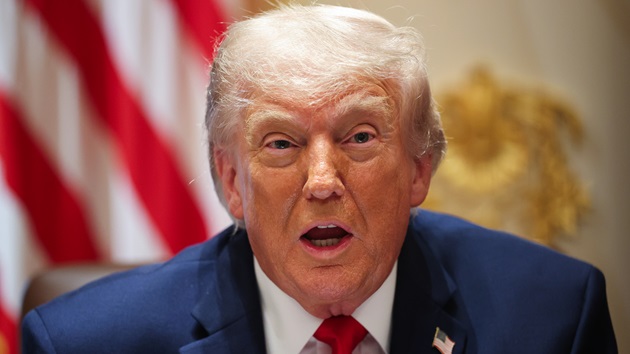
U.S. President Donald Trump speaks during a Cabinet meeting in the Cabinet Room of the White House on May 27, 2026 in Washington, DC. (Win McNamee/Getty Images)

(NEW YORK) — A court filing shows how businesses are getting money back from the U.S. government after the Supreme Court ruled many of President Donald Trump’s tariffs were illegal.

The Trump administration has sent out $20.6 billion in tariff refunds so far, according to a new court filing.

The filing sheds light on how tens of thousands of American businesses are starting to get money back from the federal government after the Supreme Court ruled many of President Donald Trump’s tariffs were illegal in February.

Walmart suggested last week it will cut prices for shoppers using the estimated $2.4 billion in refunds it’s owed.

“On tariffs, we are availing ourselves of the process to get refunds. We would definitely bias and try to prioritize price investment for that … we think the single best return that we can have on a $1 of capital right now is to invest in the customer and invest in price,” Walmart CFO John David Rainey said on the company’s earnings call.

Major companies like Walmart, Costco, Apple, Home Depot and General Motors have all confirmed in recent weeks they’re applying for refunds.

It’s unlikely that most companies will give money directly back to shoppers who already bought products with higher prices because of tariffs. The nonpartisan Tax Foundation estimates the tariffs that were ruled illegal cost the typical American household $700 last year.

UPS, FedEx and DHL said they will directly refund customers. UPS recently updated its website with details on how importers can claim to get money back.

In total, U.S. Customs and Border Protection has said it could owe up to $166 billion to more than 330,000 importers. The new filing notes $85 billion in refunds have been accepted so far, and the $20.6 billion represents money that has successfully gone back to importers who filed for refunds on the government’s online portal.

A U.S. trade official previously overstated the amount of money that had gone out to companies by $10 billion, the filing noted.

Copyright © 2026, ABC Audio. All rights reserved.

How the spike in global bond yields creates more risk for the stock market

New York (CNN) — Never doubt the power of the $30 trillion US Treasury market. It was robust enough to push back on the Treasury Department’s recent intervention while captivating Wall Street. Now investors are wondering whether the bond market’s unease is strong enough to disturb a booming stock market.Bond yields have climbed this year, driven by concerns about government deficits and an increase in supply of corporate bonds to fund the AI buildout. Investors are demanding more compensation to continue funding government spending and companies’ plans for AI.A rise in yields pushes up interest rates across the economy, raising borrowing costs for consumers and the government alike. It matters for stocks, too: Higher yields can affect calculations for companies’ future earnings and stocks’ value. Higher yields on trustworthy government bonds can also draw investors away from riskier assets like stocks.A “disorderly rise in bond yields” is the second biggest risk for stocks after the AI bubble, according to a survey of fund managers conducted by Bank of America this month.Investors are increasingly nervous about the stock market’s over-concentration in artificial intelligence. And a sharp, sustained rise in yields is another risk that could help deflate a bubble.Bond yields are not certain to derail stocks, but it creates a more complicated outlook. After global bond yields hit multi-year highs last week, the S&P 500 ended the week lower and snapped a three-week winning streak.Yields dropped at the start of this week, giving a boost to stocks. But the 30-year yield remains near its highest level in almost two decades. The 10-year US Treasury yield is trading close to its highest level in over a year.Ultimately, the impact on stocks depends on just how fast yields rise, how far they rise and why they are rising.Why stocks are resilientThe S&P 500 is up about 12% this year, on course for its fourth straight year of double-digit gains. Stocks rebounded from an Iran war-related slump in March before clinching a series of all-time highs, putting it at 27 record highs so far this year.Strong corporate earnings, waves of enthusiasm about artificial intelligence and a buy-the-dip mentality led by retail investors contributed to the market’s resilience.Stocks dropped last week as global bond yields hit multi-year highs, but the S&P 500 remains close to all-time highs – down less than 2% since its last record high two weeks ago. The tech-heavy Nasdaq Composite is down less than 4% since its last record high in early June.A strong corporate earnings season has helped keep the stock market afloat. There’s been some volatility for individual stocks, but overall, it’s been another quarter of stellar earnings.The earnings growth rate for companies in the S&P 500 is set be the strongest since 2021, according to FactSet data. The rise in bond yields hasn’t been sharp enough to shake stocks while earnings roll in.Since hitting a record high on August 13, the S&P 500 hasn’t had an up or down of more than 1% on a given day. Wall Street’s fear gauge, the VIX, is trading at 15, well below the 20-point threshold that signals volatility in markets.“We are cautious that the low level of volatility is luring market participants into a false sense of security,” Melissa Brown, global head of investment decision research at SimCorp, told CNN.Why yields could pose trouble for stocksYields matter for investors’ assessment of stocks’ value. A sharp rise in yields or intense volatility in the bond market can irk the stock market. When President Donald Trump announced sweeping tariffs in April 2025, the 10-year yield spiked and the S&P 500 dropped more than 10% in two days.What’s different this time? Bond yields have steadily climbed across the year. Stocks are near record highs. The steady rise in yields may be limiting the impact on stocks, analysts say, but a sustained push higher or bouts of volatility could begin to create more issues for investors.The key threshold is 5% for the 10-year yield, which would be the highest level since October 2023. That’s the psychological “line in the sand” when things become more worrying for stock market investors, said Sam Stovall, chief investment strategist at CFRA Research.“The real question is how long will interest rates be rising, and how far will they go?” Stovall said.The-CNN-Wire™ & © 2026 Cable News Network, Inc., a Warner Bros. Discovery Company. All rights reserved.
Read Next Story