
Telescope spots most distant quasars ever discovered

▶ Watch Video: Europe’s Euclid space telescope launched by SpaceX

The Euclid space telescope has spotted the oldest quasars — the brightest objects in the universe — ever discovered, deepening a cosmic mystery that has been puzzling scientists.

Quasars are powered by supermassive black holes at the heart of early galaxies gobbling up surrounding matter in a colossal feeding frenzy that can shine trillions of times brighter than the sun.

Because they are so incredibly bright — and looking deep into space also means looking back in time — scientists have been hunting for ancient quasars to learn more about the little-understood infancy of the universe.

In a study published on Monday, an international team of astronomers announced they had discovered 31 quasars, including the two oldest observed yet, using the European Space Agency’s Euclid telescope, which is at a stable hovering spot around 1.5 million kilometers from Earth.

The light from the oldest pair comes from when the universe was roughly 670 million years old, just five percent of its current age of 13.8 billion years.  

This beats the team’s previous record for oldest — and therefore most distant — quasar announced in 2021 by around 20 million years.

quasars-discovered-by-euclid.png
This collage shows 15 of the 31 newly discovered quasars by the European Space Agency’s Euclid space telescope. 

European Space Agency

Previous quasar hunts were mostly carried out with ground-based telescopes, but the launch of Euclid in 2023 “has transformed this field,” Daming Yang, the lead author of the study in Astronomy & Astrophysics, told AFP.

In just two years, Euclid has doubled the number of ancient quasars known to science, added Yang, a PhD student at Leiden University in the Netherlands.

“Euclid is a true game-changer,” Yang said in a statement. “Before, we could only find a handful of the very brightest ancient quasars, but Euclid lets us search far more efficiently across huge areas of sky to capture much fainter light. It’s a unique tool for quasar hunting.”

Cosmic quandary

The newly discovered quasars date back to what is known as the epoch of reionization. This when the first stars and galaxies began to form, bringing an end to the cosmic dark ages.

“We can use quasars as a lighthouse to study the gas between us and them, so that we can trace how the universe was reionized through this cosmic history,” Daming Yang said.

The quasars are also the latest example of a problem that has been increasingly baffling scientists.

As more powerful telescopes allow us to see further back in time, galaxies and other cosmic objects have turned out to be far bigger than had been thought possible at such an early age.

“Every step further back in time makes the puzzle more perplexing,” study co-author Joseph Hennawi said in a statement about the newly discovered quasars.

“These monsters — weighing billions of times the mass of our sun — somehow already existed when the universe was in its infancy,” he said. “We don’t yet have a good understanding of how they grew so massive, so fast.”
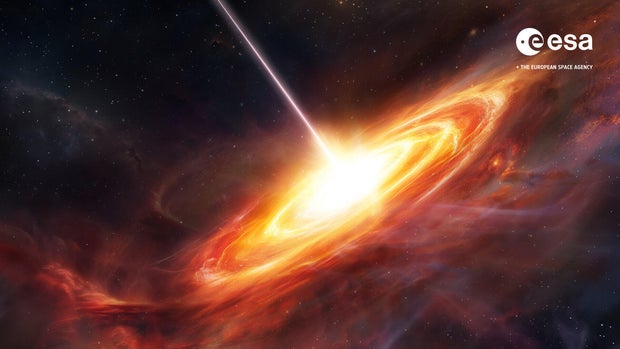
artist-s-concept-of-an-ancient-quasar-pillars.jpg
Artist’s concept of an ancient quasar

European Space Agency

Hoping to find an answer, the scientists are searching for even older quasars.

The far-seeing James Webb space telescope also recently observed the newly announced quasars, Daming said, and the team will soon begin sifting through the data it collected.

The team eventually hope to stitch together “a quasar chronicle of the first billion years,” Hennawi said.

Euclid’s cosmic mission

Euclid launched in 2023 on a mission to chart one-third of the sky in the hopes of shedding light on the enduring mysteries of dark matter and dark energy.

Just last month, scientists announced the Euclid telescope had captured the largest and most detailed photo ever taken of our galaxy’s crowded heart, a dazzling image packed with 60 million stars, the European Space Agency said Wednesday.

In 2024, Euclid captured dazzling photos of the cosmos, including an image of a massive cluster of galaxies called Abell 2390. The image of the cluster, which is 2.7 billion light years away from Earth, encompasses more than 50,000 galaxies.

Another jaw-dropping image, captured in 2023, provides a spectacular wide-angle view of the Perseus galaxy cluster, revealing at least 1,000 gravitationally-bound galaxies with another 100,000 or so sprinkled across the more distant background — many of them never before seen.

Launched from Cape Canaveral on July 1, 2023 atop a SpaceX Falcon 9 rocket, the $1.5 billion Euclid is stationed about a million miles from Earth on the far side of the moon’s orbit.

Over the course of its six-year mission, the observatory will image the entire sky around the Milky Way, monitoring galaxies and galaxy clusters dating back 10 billion years.

JD Vance and the Trump team keep moving the goalposts on Iran

(CNN) — One of the Trump administration’s biggest problems in extracting itself from the Iran war is the list of very absolutist goals that President Donald Trump and his team laid out.The goals have included complete Iranian surrender, regime change, Iran never getting a nuclear weapon and ending Tehran’s support for its Middle East proxy groups like Hezbollah.As the war — now in its sixth month — has dragged on, this list of goals has conspicuously shifted and been pared back. And Vice President JD Vance appears to have pared it back recently in a remarkable way, offering the latest indication that the administration might be preparing to settle for less — maybe even a lot less.Appearing on Fox News on Thursday, Vance was asked how the war might end. And he laid out two goals.“It’s ensuring that the Gulf countries continue to send oil and gas to the world economy so that we have energy price stability,” he said, adding: “That’s goal number one: Keep oil and gas cheap for Americans all over our country.“And then, obviously, goal number two is ensure that Iran never gets a nuclear weapon.”This is not the administration’s old list of goals — and the order Vance placed them in is striking.When asked about Vance’s comments on Friday, White House press secretary Karoline Leavitt maintained that “both goals are equally as important to the president.”The administration has almost always characterized Iran never getting a nuclear weapon as the overriding concern.And even if the goals are truly equal in the administration’s mind, including oil and gas prices at all — and not other items — is a notable shift.In fact, Trump explicitly rejected this as a goal back in May. When asked if he considered Americans’ financial situation when trying to resolve the war, Trump responded, “Not even a little bit.” He signaled that denuclearization was so important that he didn’t factor in anything else.(Trump echoed that line on Friday, saying he would “never apologize” for Americans paying a little more for gas, given the stakes in Iran.)I wrote in March about how the administration frequently listed four goals for the war — but how the four goals frequently differed depending upon who was speaking.Some lists included ending funding for proxy groups, for example, while others did not. Some mentioned destroying Iran’s missile infrastructure, while others omitted that. Some mentioned getting rid of Iran’s air force and navy, but others only mentioned the navy.It was like the administration was workshopping the list in real time.But the key point here is that none of those lists included keeping oil and gas prices low in the United States.And given the Strait of Hormuz was open before the war started, that particular goal could just be read as a return to the pre-war status quo — with denuclearization being the only goal that would represent a new achievement.Indeed, the new emphasis on low gas prices from some in the administration seems like the latest sign of relaxing the goals to prepare for a conclusion to the war that comes up well shy of Trump’s initial aims.By May, it became clear the administration was no longer going to emphasize certain goals.By June, the Trump administration entered into a memorandum of understanding with Iran that barely mentioned previously central US goals.And for the last two-plus months, Trump has been saying things that sounded a lot like he might scale back his nuclear demands.While the administration previously emphasized Iran turning over its enriched uranium, Trump’s spoken about how perhaps enough damage was done to its nuclear program and its nuclear materials are buried too far underground to be accessed. The president has also talked about how the US government could simply monitor from space to make sure Iran didn’t try to retrieve them.He’s even claimed that Iran was already denuclearized.In other words, Trump sounded a lot like a guy who knew he might not be able to cow Iran into accepting a really restrictive nuclear deal.His administration talking about energy prices as “goal number one” — even if Trump isn’t — would fit neatly with this progression away from the hard-and-fast goals that the administration set out to achieve.If a return to the pre-war status quo really is “goal number one” right now, that says a lot about how little this war has accomplished.The-CNN-Wire™ & © 2026 Cable News Network, Inc., a Warner Bros. Discovery Company. All rights reserved.
Read Next Story