
Telescope snaps most detailed photo yet of Milky Way’s heart

▶ Watch Video: Europe’s Euclid space telescope launched by SpaceX

The Euclid space telescope has captured the largest and most detailed photo ever taken of our galaxy’s crowded heart, a dazzling image packed with 60 million stars, the European Space Agency said Wednesday.

The new photo of the Milky Way’s bright center will help in the search for planets beyond our Solar System, the agency said.

At the center of our spiral galaxy “lies the bulge — a large bubble containing billions of stars,” French astronomer Jean-Charles Cuillandre, who works on the Euclid mission, told AFP.

Euclid launched in 2023 on a mission to chart one-third of the sky in the hopes of shedding light on the enduring mysteries of dark matter and dark energy.

“Now we’ve decided to point Euclid at the brightest area of the sky — and it works superbly, it’s extraordinary,” Cuillandre said.

The space agency also released a three-minute video highlighting the new images.

Euclid, which is hovering 930,0000 miles from Earth, captured the image with its visible light camera over 26 hours in March 2025.

The mosaic is composed of nine photographs, each covering an area of the sky larger than the Moon.
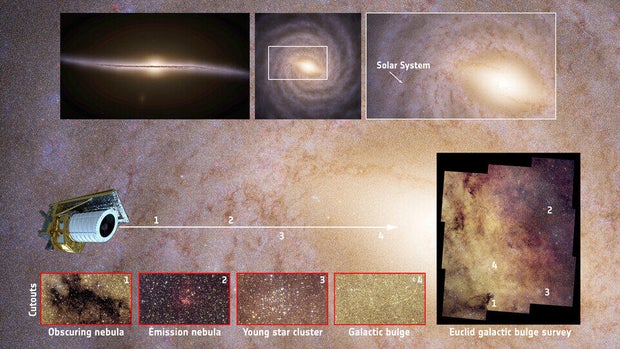
infographic-explaining-euclid-s-galactic-bulge-survey-article.jpg
Infographic explaining Euclid’s survey 

ESA

The original image was captured in black and white, but color was added using observations from the Canada-France-Hawaii Telescope located in Hawaii.

However “we didn’t do this just to produce a beautiful image,” Cuillandre emphasised.

“Cosmic magnifying glass”

In recent decades, scientists have identified thousands of planets outside our Solar System, which are known as exoplanets.

New exoplanets are unlikely to be identified within the Euclid image, but it will help the scientists measure the mass of planets already spotted — and those that will be discovered in the future.

It can do this via a process called microlensing, which happens when one star crosses over another.

The closer star “acts like a cosmic magnifying glass, bending and brightening the background star’s light”, the ESA explained in a statement.

If a planet is orbiting the closer star, its gravity also slightly bends this light. This tiny change in brightness allows scientists to track the planet down.

“During the last 20 years, almost 300 exoplanets have been discovered using this technique, all with ground-based telescopes and all towards the centre of our galaxy,” French astronomer Jean-Philippe Beaulieu said in the statement.

For example, Beaulieu said he led the team that discovered an icy planet “a bit like Hoth from Star Wars” 20 years ago.

The new image from Euclid “includes 51 known planetary systems — and it will assist in studying many more that will be found”, he added.
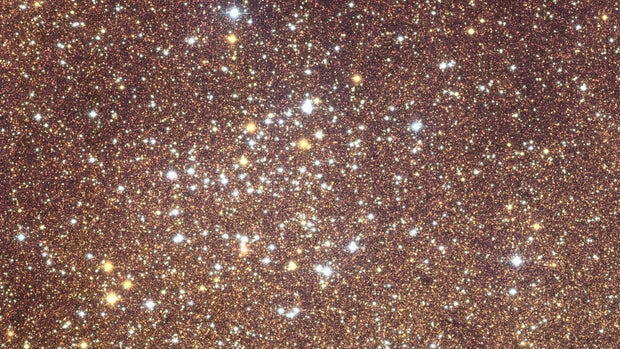
euclid-galactic-bulge-star-cluster-pillars.jpg
Euclid galactic bulge – star cluster

ESA

In 2024, Euclid captured dazzling photos of the cosmos, including an image of a massive cluster of galaxies called Abell 2390. The image of the cluster, which is 2.7 billion light years away from Earth, encompasses more than 50,000 galaxies.

Another jaw-dropping image, captured in 2023, provides a spectacular wide-angle view of the Perseus galaxy cluster, revealing at least 1,000 gravitationally-bound galaxies with another 100,000 or so sprinkled across the more distant background — many of them never before seen.

Launched from Cape Canaveral on July 1, 2023 atop a SpaceX Falcon 9 rocket, the $1.5 billion Euclid is stationed about a million miles from Earth on the far side of the moon’s orbit.

Over the course of its six-year mission, the observatory will image the entire sky around the Milky Way, monitoring galaxies and galaxy clusters dating back 10 billion years.
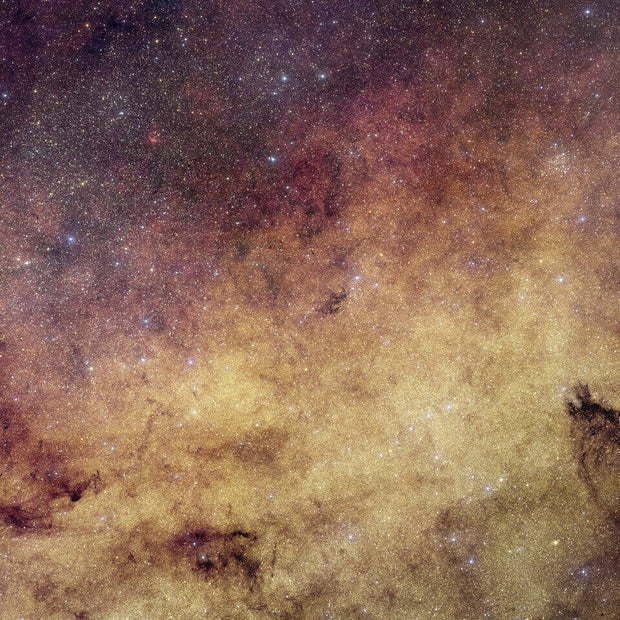
euclid-s-view-of-our-galaxy-s-bulge-article.jpg
Euclid’s view of our galactic bulge

ESA

Western Europe breaks temperature record in summer plagued by heatwaves and wildfires

(CNN) — The first two months of summer in western Europe have been the hottest on record, the European Union’s climate monitor said Monday, as the continent grapples with devastating wildfires and braces for yet another heatwave.The average temperature for June and July was 21.62 degrees Celsius (70.9 Fahrenheit), about 2.79 degrees above the average, and surpassing the previous heat record set in 2022, said the Copernicus climate change service.July was also the hottest month ever logged for the world’s non-polar oceans, Copernicus said, with record high temperatures set along the Atlantic and western Mediterranean, putting sea life and coastal communities at risk. The conditions were partly fueled by the so-called “Super” El Niño weather pattern developing in the pacific.The continent has been hit by a string of deadly heatwaves, with more hot temperatures forecast for this week. Heat has killed more than 25,000 people across Europe this year, according to data compiled by Bloomberg.Europe is the world’s fastest-warming continent but is particularly ill-equipped to withstand heat, due to older infrastructure and a lack of air conditioning.The scorching temperatures and persistent droughts in June and July mutually reinforced each other to create a hot weather spiral, according to Samantha Burgess, strategic lead for climate at the European Centre for Medium-Range Weather Forecasts.“As soils dry out, they lose their ability to provide natural cooling, allowing heat to build more readily,” Burgess said, adding that it was “a clear example of how climate change is intensifying heat extremes.”Surface soil moisture levels across western Europe in July 2026 were also “significantly lower” than in July 2022, the last summer the region saw extreme drought, with “exceptional to record deficits” for rain and soil moisture in France, Spain and parts of Germany and the United Kingdom, the scientists found.The record-breaking summer heat has fostered conditions for Europe’s record-setting wildfires, which have displaced hundreds of thousands of people and burned more than 1.23 million acres of land, mainly in Spain, France and Italy, according to an August 6 report by the EU.Beyond the scorched land, the fires have also had a broader effect across the continent, increasing emissions and disrupting air quality, said Laurence Rouil, director of the Copernicus Atmosphere Monitoring Service.“Larger fires produce more smoke and inject it higher into the atmosphere, meaning it can travel further and impact air quality not only locally, but across the wider region,” Rouil said.Severe droughts have also sucked the water from Europe’s major rivers, particularly the Seine, the Rhine and the Danube, threatening the continent’s energy supply.Hungary and Romania were forced to temporarily shut down nuclear reactors cooled by the Danube, Europe’s second-longest river, which has experienced such low water levels that the crisis can be observed from space.Richard Allan, a climate science professor at the University of Reading in England previously told CNN the these record river lows are likely to be broken again in the future and that this “will only be the top of the iceberg.”“Managing water resources will become progressively more challenging.”The-CNN-Wire™ & © 2026 Cable News Network, Inc., a Warner Bros. Discovery Company. All rights reserved.
Read Next Story