
Telescope snaps most detailed photo yet of Milky Way’s heart

▶ Watch Video: Europe’s Euclid space telescope launched by SpaceX

The Euclid space telescope has captured the largest and most detailed photo ever taken of our galaxy’s crowded heart, a dazzling image packed with 60 million stars, the European Space Agency said Wednesday.

The new photo of the Milky Way’s bright center will help in the search for planets beyond our Solar System, the agency said.

At the center of our spiral galaxy “lies the bulge — a large bubble containing billions of stars,” French astronomer Jean-Charles Cuillandre, who works on the Euclid mission, told AFP.

Euclid launched in 2023 on a mission to chart one-third of the sky in the hopes of shedding light on the enduring mysteries of dark matter and dark energy.

“Now we’ve decided to point Euclid at the brightest area of the sky — and it works superbly, it’s extraordinary,” Cuillandre said.

The space agency also released a three-minute video highlighting the new images.

Euclid, which is hovering 930,0000 miles from Earth, captured the image with its visible light camera over 26 hours in March 2025.

The mosaic is composed of nine photographs, each covering an area of the sky larger than the Moon.
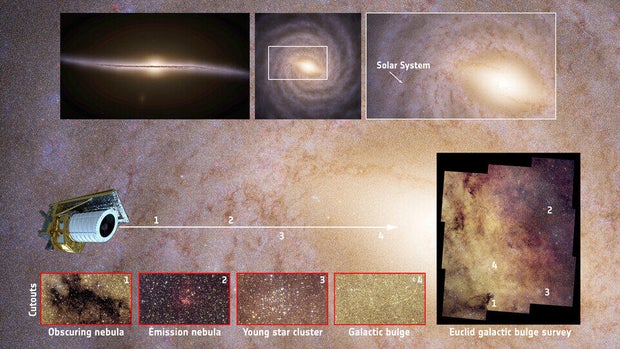
infographic-explaining-euclid-s-galactic-bulge-survey-article.jpg
Infographic explaining Euclid’s survey 

ESA

The original image was captured in black and white, but color was added using observations from the Canada-France-Hawaii Telescope located in Hawaii.

However “we didn’t do this just to produce a beautiful image,” Cuillandre emphasised.

“Cosmic magnifying glass”

In recent decades, scientists have identified thousands of planets outside our Solar System, which are known as exoplanets.

New exoplanets are unlikely to be identified within the Euclid image, but it will help the scientists measure the mass of planets already spotted — and those that will be discovered in the future.

It can do this via a process called microlensing, which happens when one star crosses over another.

The closer star “acts like a cosmic magnifying glass, bending and brightening the background star’s light”, the ESA explained in a statement.

If a planet is orbiting the closer star, its gravity also slightly bends this light. This tiny change in brightness allows scientists to track the planet down.

“During the last 20 years, almost 300 exoplanets have been discovered using this technique, all with ground-based telescopes and all towards the centre of our galaxy,” French astronomer Jean-Philippe Beaulieu said in the statement.

For example, Beaulieu said he led the team that discovered an icy planet “a bit like Hoth from Star Wars” 20 years ago.

The new image from Euclid “includes 51 known planetary systems — and it will assist in studying many more that will be found”, he added.
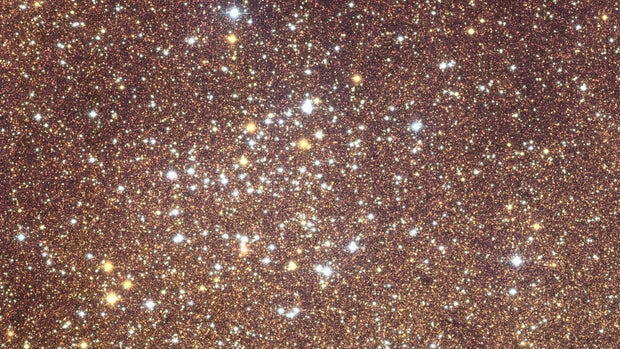
euclid-galactic-bulge-star-cluster-pillars.jpg
Euclid galactic bulge – star cluster

ESA

In 2024, Euclid captured dazzling photos of the cosmos, including an image of a massive cluster of galaxies called Abell 2390. The image of the cluster, which is 2.7 billion light years away from Earth, encompasses more than 50,000 galaxies.

Another jaw-dropping image, captured in 2023, provides a spectacular wide-angle view of the Perseus galaxy cluster, revealing at least 1,000 gravitationally-bound galaxies with another 100,000 or so sprinkled across the more distant background — many of them never before seen.

Launched from Cape Canaveral on July 1, 2023 atop a SpaceX Falcon 9 rocket, the $1.5 billion Euclid is stationed about a million miles from Earth on the far side of the moon’s orbit.

Over the course of its six-year mission, the observatory will image the entire sky around the Milky Way, monitoring galaxies and galaxy clusters dating back 10 billion years.
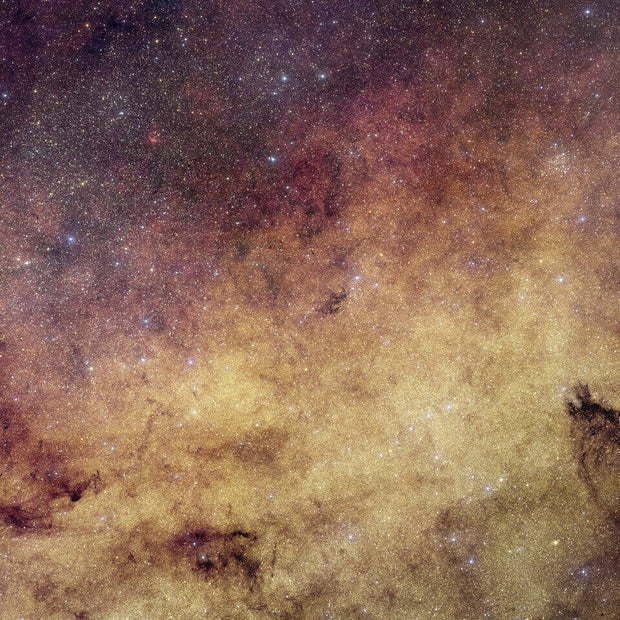
euclid-s-view-of-our-galaxy-s-bulge-article.jpg
Euclid’s view of our galactic bulge

ESA

Congressman Al Green and Alpha Phi Alpha Bring Slavery Remembrance to the U.S. Capitol

Click here for updates on this story    August 12, 2026 (Houston Style Magazine) -- WASHINGTON, D.C. — On Saturday, August 15, 2026, the U.S. Capitol will become more than the nation’s legislative workplace. For a few consequential hours, it will also serve as a classroom of memory, accountability and democratic purpose as Congressman Al Green (TX-09)hosts Alpha Phi Alpha Fraternity, Inc. for a Slavery Remembrance Legislative Update and Assembly at the Capitol Visitor’s Center Auditorium.Beginning at 11:00 a.m. ET, the program will advance Green’s continuing effort to establish August 20 as a National Slavery Remembrance Day — ensuring that the brutality of slavery, the resistance of the enslaved and their foundational contributions to America are never pushed to the margins of public memory. This year’s theme, “Harder Yet May Be the Fight,” feels both historical and unmistakably contemporary. Democracy, after all, is strongest when a nation can examine its entire record — not simply the comfortable chapters.And this movement did not begin yesterday.In July 2022, the U.S. House approved Green’s H.Res. 517, the Original Slavery Remembrance Day Resolution, by a 218–207 vote. In the current 119th Congress, Green introduced H.J.Res. 67, supporting the designation of August as Slavery Remembrance Month and expanding the national conversation about slavery, its continuing effects and those who fought to end it.Saturday’s assembly will also spotlight another consequential proposal: Green’s push to secure a Congressional Gold Medal for enslaved Africans and their descendants.His H.R. 4885, introduced August 5, 2025, seeks to posthumously award a collective Congressional Gold Medal to Africans and their descendants enslaved in America through the abolition of slavery in 1865.The historical contrast is striking. In 1956, Congress awarded Congressional Gold Medals to the four known surviving Civil War veterans, with the authorization explicitly covering veterans who served in either the Union or Confederate forces. Green’s argument raises a powerful question: Should the millions whose uncompensated labor helped build American economic power receive comparable national recognition?Standing alongside Green will be Alpha Phi Alpha General President Brother Lucien J. Metellus, Jr. The partnership itself carries historic weight.photo General President Brother Lucien J. Metellus, Jr. met with Brother Congressman Al Green (D-TX) Founded at Cornell University in 1906, Alpha Phi Alpha became the first intercollegiate Greek-letter fraternity established for African American men. Its legacy of civil rights, civic participation and leadership includes Alpha men such as Dr. Martin Luther King Jr., Thurgood Marshall and Adam Clayton Powell Jr.Metellus has warned against efforts to diminish the sacrifices and contributions of African Americans, saying Alpha Phi Alpha refuses to allow slavery’s evils to be forgotten or its ancestors left without proper honor. Green, himself an Alpha brother, puts the mission plainly: “Remembrance requires more than reflection; it requires us to confront our history.”That makes Saturday’s gathering bigger than a ceremony.It is an exercise in democratic citizenship.A mature democracy does not fear its history. It studies it. It names injustice without surrendering hope. Patriotism is not pretending America has always fulfilled its promises; it is demanding that America continually move closer to them.For Houston, the moment carries particular resonance. A Houston congressman is helping place a national spotlight on the enslaved people whose names too often disappeared while the wealth their labor generated remained.History may be written in books, but remembrance is written in public choices.On August 15, Congressman Al Green and Alpha Phi Alpha will make one choice unmistakably clear: America moves forward best when America remembers.EVENT DETAILS WHO: Congressman Al Green and Alpha Phi Alpha Fraternity and General President Brother Lucien J. Metellus, Jr.
Read Next Story