
Supreme Court pushes Congress for more security: ‘Threats have come very close’

▶ Watch Video: Key points from Supreme Court justices’ push for more security funds

Washington — Supreme Court Justices Elena Kagan and Amy Coney Barrett urged Congress on Tuesday to provide additional funding to enhance protection for the justices as they face a rise in threats, with Kagan warning that the “threats have come very close” for some members of the high court.

Kagan and Barrett made rare back-to-back appearances before House and Senate subcommittees to testify about the Supreme Court’s budget request for the next fiscal year, which begins Oct. 1. Their testimony came just weeks after the Supreme Court finished handing down decisions to wrap its latest term, which included blockbuster rulings on immigration, voting rightsexecutive power and President Trump’s effort to restrict birthright citizenship.

The Supreme Court is seeking more than $228 million from congressional appropriators, an increase of more than $20 million. Part of the court’s funding request includes an additional $14.6 million to expand security for the justices provided by the Supreme Court Police, which would allow for an additional six agents per member of the court, according to budget documents. The money would also be used for travel when the justices are outside of the Washington, D.C., region. 

Each justice is currently assigned between four and eight officers as part of their security details, Barrett and Kagan said, but that may increase if a member of the court is facing a particular threat or is participating in more public events.

Kagan told lawmakers that the recent increases in the court’s budget have been “almost entirely” for security expenses, since the Supreme Court’s in-house police force took over residential security for the justices from the U.S. Marshals Service.

“For some of us, those threats have come very close, and all of us live with the knowledge that they may again materialize,” she said. “But as the chief justice has said, all members of the court continue to do their jobs as they believe legally right, adjudicating cases without fear or favor.”
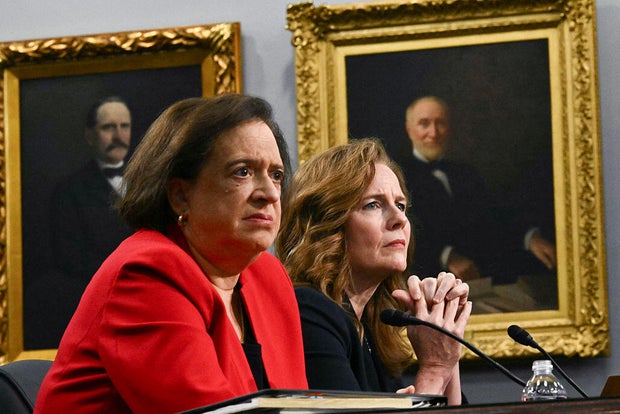
Supreme Court Justices Elena Kagan and Amy Coney Barrett testify before a House subcommittee in Washington, D.C., on July 14, 2026.

Kent NISHIMURA /AFP via Getty Images

The Supreme Court Police is anticipating a 38% increase in threats for 2026, Kagan said. For federal judges, there was a 57% rise in “security incidents of significant concern” in fiscal year 2025, according to the Marshals Service. As of July 1, there have been 370 threats to judges this fiscal year, and the Marshals have conducted 512 investigations, according to agency data. In the last fiscal year, there were 564 total threats to judges, the Marshals Service said.

“It is increasingly dangerous to be a Supreme Court justice these days, and it’s appalling to me that some of the rhetoric is coming from public officials on both sides of the aisle who should know better than to levy personal and political attacks against the judiciary and the court specifically,” Sen. Susan Collins, a Maine Republican who leads the Senate Appropriations Committee, said.

She cited comments from Senate Minority Leader Chuck Schumer in 2020, when he said of Justices Neil Gorsuch and Brett Kavanaugh, “you have released the whirlwind and you will pay the price.” Mr. Trump has also lobbed sharp personal attacks against Supreme Court justices, particularly after the high court struck down his most sweeping tariffs. The president said Gorsuch and Barrett, who were in the majority, are “an embarrassment to their families.” He has also attacked some of the justices as “weak, stupid, and bad,” and called them “fools and lapdogs for the RINOs and the radical left Democrats.”

“Wherever these come from, and whatever political figure says them, whatever party that political figure is a member of, these statements are really unhelpful,” Kagan said. “They’re dangerous in terms of individual justices’ security and they’re not appropriate in the way to treat a coordinate branch of government.”

She said criticism of the court’s rulings are “fair game,” but warned, “intimidation is a different thing entirely. And when political figures of any stripe are trying to intimidate judges and justices to do things that they like rather than the things that they don’t, that’s where we really have crossed the line.”

Sitting judges and members of the Supreme Court have been facing a barrage of threats in recent years. A CBS News analysis found there were 126 prosecutions in 2025 that stemmed from threatening communications and 12 of those cases arose from menacing messages directed at judges.

Following the May 2022 leak of a draft Supreme Court opinion overturning Roe v. Wade, protesters descended outside the homes of several conservative justices, including Barrett’s. That June, an individual from California was arrested outside of Kavanaugh’s Maryland residence with a handgun, knife and tools. 

Prosecutors said the defendant aimed to kill three members of the Supreme Court and had researched their home addresses. The individual, who was arrested as Nicholas Roske but now goes by Sophie Roske, pleaded guilty in April 2025 to attempting to kill or kidnap a Supreme Court justice and was sentenced to more than eight years in prison.

Barrett separately told House and Senate members about being given a bulletproof vest following the leak of the decision reversing Roe v. Wade and having to answer questions from her then-12-year-old son about it.

“I didn’t expect that performing this service was going to put me in the position of explaining to my children what a bulletproof vest was and why I had to wear one,” she said.

The justice also said that she was the victim of a “swatting” incident roughly six weeks ago. Her teenage son opened the door to their home and saw police cars on the street responding to a false report of gunshots and “raised voices,” Barrett said.

The Supreme Court Police, who were stationed outside her house, met with local police and explained it was a “false alarm,” she said.

“Federal judges across the country, throughout the judiciary, including the Supreme Court, continue to do their jobs without fear or favor, but the threat level is really high,” she said.

Several judges, including Barrett, have also been the victims of “pizza doxxing,” where they’ve received anonymous pizza deliveries to their homes, she said. The pizzas are sent in the name of Daniel Anderl, the 20-year-old son of U.S. District Judge Esther Salas who was shot and killed at their New Jersey home by a disgruntled lawyer in 2020.

“They’re designed to intimidate or designed maybe to punish after decisions that the person sending the threat didn’t like, as a warning not to do it in the future,” Barrett told senators of how she views the intent of threats against judges. “It’s hard to interpret, particularly those anonymous deliveries that are sent in the name of Judge Salas’s murdered son, as anything other than an attempt to intimidate and influence decisions.”
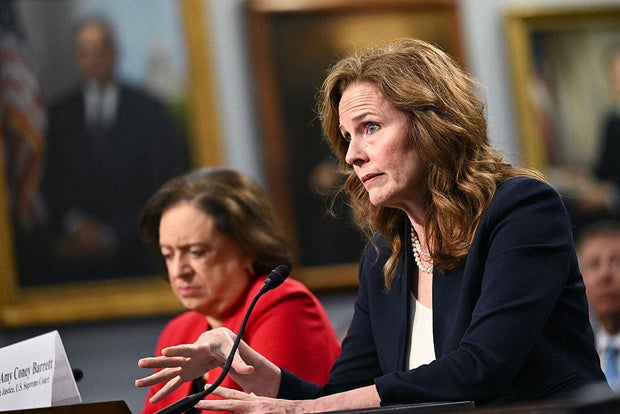
Supreme Court Justices Elena Kagan and Amy Coney Barrett testify during a House subcommittee hearing in Washington, D.C., on July 14, 2026.

Kent NISHIMURA /AFP via Getty Images

Lawmakers appeared ready to provide the resources for the Supreme Court to beef up its security.

Rep. David Joyce, an Ohio Republican who chairs the House subcommittee, said judicial officers “must be able to do their jobs without fear for their safety or their family’s safety.”

Rep. Steny Hoyer of Maryland, the top Democrat on the panel, said, “With a deeply divided country and increasingly violent rhetoric being directed at judges, Congress must provide sufficient funding to ensure the safety of all judicial personnel.”

Beyond protection at the justices’ houses, the Supreme Court is also seeking $6.5 million for a facility to screen visitors to the high court outside of the building, similar to the Visitor Center at the U.S. Capitol. Roughly $2.3 million would go to cybersecurity, according to budget documents.

While the justices were on Capitol Hill to testify about the court’s requested operating budget, Kagan and Barrett fielded questions about the Supreme Court’s code of conduct, which it adopted in 2023, as well as the court’s caseload and requests for temporary relief made on its interim docket, also known as the emergency or “shadow” docket.

The high court has faced scrutiny for its handling of cases on its shadow docket, largely as it faced a slew of requests from the Trump administration last year to enforce the president’s second-term policies, and lower courts indicated they were struggling with how to apply the Supreme Court’s orders.

But Kagan said in the past year or so, the Supreme Court has “gotten more experienced” in handling those requests and providing a more thorough explanation of its decisions. 

“We better recognize that at least sometimes, there is a need for additional information, and we have issued opinions and sometimes majority and dissenting opinions accordingly,” she told lawmakers.

Still, she acknowledged there are still improvements to be made.

Kagan noted that the Supreme Court has “tried to do better in important cases” by soliciting additional briefs and holding oral arguments, such as in the recent dispute over Mr. Trump’s attempt to fire Lisa Cook from the Federal Reserve’s Board of Governors. The Supreme Court heard arguments in the case and ruled last month that Cook can continue in her post while her lawsuit challenging her attempted removal moves forward.  

Asked by Rep. Mark Pocan, a Democrat from Wisconsin, about the shadow docket, Kagan suggested the increase in emergency requests may be because some parties have had success in securing relief while their case proceeds.

“People see that there is at least a potential for us to grant relief, and so why not file a petition,” she said.

Congressional testimony by the justices used to be a common occurrence. Justices appeared before House and Senate panels at least once every year from 1960 through 2011, according to a 2023 report from the Congressional Research Service. But their participation has waned in recent years.

Members of the Supreme Court — Kagan and Justice Samuel Alito — last answered questions from the House in 2019 in a hearing that focused on the court’s budget request. And sitting justices — Justices Stephen Breyer and the late Justice Antonin Scalia — last testified at a Senate hearing in 2011.

While Chief Justice John Roberts was asked to testify on Capitol Hill about ethics rules governing the high court in 2023, he declined to do so. Roberts told Sen. Dick Durbin, an Illinois Democrat who chaired the Senate Judiciary Committee at the time, that testimony by the chief justice is “exceedingly rare” and cited “separation of powers concerns and the importance of preserving judicial independence.”

Un incendio aterrorizó a un vecindario de Los Ángeles. Ahora, el hedor asfixiante lo atormenta

Durante ocho brutales días, los residentes de Boyle Heights vieron cómo el humo se elevaba desde un almacén en llamas y rezaron para que las llamas no alcanzaran sus viviendas.Entonces no había forma de escapar de la contaminación negra que asfixiaba al vecindario, y ahora tampoco hay alivio, incluso cinco semanas después de que se extinguiera el incendio. El olor a plástico quemado ha sido reemplazado por otra cosa: el penetrante hedor de la comida en descomposición y todo lo que viene con él.El hedor ineludible —a partes iguales agrio y empalagoso— se ha instalado como una espesa bruma sobre el vecindario, intensificada por el calor del sur de California.Los residentes de Boyle Heights dicen que el hedor los está enfermando físicamente y que enjambres de moscas y enormes ratas han seguido el olor nocivo hasta su vecindario.Cuando se incendió a mediados de junio, el almacén contenía unos 39,9 millones de kilogramos de alimentos congelados. Una parte se quemó y otra parte se derritió. Esa cantidad de desechos llenaría aproximadamente 440.000 contenedores de basura domésticos. Colocados uno junto a otro, se extenderían por más de 322 kilómetros, aproximadamente la distancia entre Washington y Nueva York.Ahora, los equipos de limpieza corren contra el reloj para retirar lo que dejó el incendio, incluidos residuos tan tóxicos que deben ser sellados en contenedores para materiales peligrosos. La ciudad de Los Ángeles ordenó a Lineage Logistics, el mayor propietario de instalaciones de almacenamiento en frío del mundo y operador del almacén, retirar los residuos antes del 13 de agosto, un plazo que un ejecutivo de la compañía calificó de “muy agresivo” en una reunión comunitaria el mes pasado.Cuando cambia el viento, los olores del almacén llegan a kilómetros de distancia, incluso semanas después de que se extinguiera el incendio.No obstante, en Boyle Heights, el olor pútrido de los alimentos fermentados es una constante fétida. Permanece en el aire y cubre la boca. El 90 % de los residentes de este vecindario predominantemente latino dijo haber notado olores constantes en una encuesta de salud pública del condado publicada recientemente.En un esfuerzo por contener el mal olor, parte de las instalaciones está cubierta con lonas plásticas, mientras grandes ventiladores rocían una neblina para controlar los olores alrededor del almacén. Los residuos de alimentos son rociados con lejía, desodorante y agua antes de ser cubiertos y transportados a un vertedero en el condado de Riverside, al este de Los Ángeles.El olor, casi tangible, ha invadido cada rincón de la casa de Alicia Naranjo, ubicada a seis casas del almacén. Al principio, el olor impregnó las habitaciones y provocó noches de insomnio. Después llegaron la ansiedad y los problemas para respirar, seguidos de dolores de cabeza, congestión, tos y dolor de garganta, dijo con una voz ronca que atribuye a la contaminación del aire.“Y después”, intervino su hermana Elsa Naranjo, “nos infestamos de ratas”.“Las ves saltando alrededor de las paredes”, dijo. “Afuera de nuestra casa, en nuestra propiedad”.En el suelo se pueden ver trampas para ratas, cajas negras de plástico con agujeros a los lados, generalmente colocadas debajo de una trampa para moscas colgante llena de grupos oscuros de moscas muertas y agonizantes, aproximadamente cada tres metros.Hay una justo afuera de la casa de Lisset Navarrete, pero ella no está convencida de que sean efectivas por una razón principal: las ratas que ha visto son más grandes que las trampas colocadas para capturarlas.Navarrete dijo que sus síntomas físicos comenzaron con una presión en el pecho que se desplazó hacia el estómago. Dijo que el olor a descomposición impregna tanto la vida cotidiana que ha perdido el apetito. Su suegra también se enfermó mientras esperaba en la fila en una clínica cercana, dijo.“Simplemente empezó a vomitar, se sentía mareada”, dijo Navarrete mientras espantaba una mosca de su brazo. “Esto nos está alcanzando”.Su familia no puede encender el aire acondicionado porque el aparato introduce el olor en la vivienda. En un día de 32 °C, el intenso sol de Los Ángeles solo hace más denso el hedor que envuelve el vecindario.Lineage ha ayudado a distribuir casi 600 purificadores de aire y más de 650 unidades de aire acondicionado entre los hogares del vecindario inmediato, dijo un portavoz de la compañía a CNN. La empresa también ha ofrecido ayuda para reubicaciones temporales, facturas de servicios públicos y suministros para el control de plagas.“Los esfuerzos de apoyo a la comunidad hasta la fecha ascienden a más de US$ 3,3 millones”, dijo el portavoz en un comunicado.La ciudad de Los Ángeles también se ha sumado a los esfuerzos de ayuda. La alcaldesa Karen Bass declaró el estado de emergencia y envió clínicas móviles de atención médica al vecindario.“Ninguna compañía elige vivir un incendio catastrófico. Pero toda compañía elige cómo responde”, dijo Bass en una carta abierta a los accionistas. “Desafortunadamente, la respuesta de Lineage ha sido insuficiente”.El olor a comida en estado de descomposición sigue a Juan Canil como una segunda sombra. Incluso cuando sale de su casa en Boyle Heights, lo espera en su taller mecánico, ubicado justo frente al almacén de Lineage.Describió los mismos síntomas que los demás: dolores de cabeza, náuseas y malestar. Pero el hedor también está afectando su bolsillo. El fuerte olor y los trabajos de limpieza han seguido obstaculizando el negocio del propietario del taller mecánico.“Como la calle está cerrada, he perdido mucho trabajo”, dijo. “Mucho dinero”.Hasta el jueves, se habían presentado más de 4.200 quejas por el olor ante el organismo regulador de la contaminación atmosférica, el Distrito de Gestión de la Calidad del Aire de la Costa Sur. El organismo emitió infracciones contra Lineage por molestias públicas durante 25 días consecutivos.Los reguladores enviaron a Lineage una carta el mes pasado en la que exigían medidas adicionales para controlar los olores. En su respuesta, la compañía dijo que ya había implementado algunas de esas medidas y que había acordado implementar otras, pero sostuvo que algunas exigencias del Distrito de Gestión de la Calidad del Aire de la Costa Sur (AQMD, por sus siglas en inglés) añadirían “varios meses” a la limpieza y empeorarían los olores.Un portavoz de Lineage dijo que la principal prioridad de la compañía es completar la limpieza de manera rápida y segura y que planea reconstruir el almacén.Con unas elecciones cruciales previstas para este otoño, Bass ha aumentado la presión sobre Lineage y ha ordenado a las agencias de la ciudad bloquear los planes de la compañía.“La solicitud es para obtener un permiso para reparar los daños causados por el incendio, que no fueron provocados por las operaciones de almacenamiento en frío de las instalaciones. Esto es un procedimiento normal en el proceso de reparación y no afectará ni nos distraerá del importante trabajo de limpieza”, dijo el portavoz de Lineage.Las instalaciones de almacenamiento en frío son “infraestructura crítica”, dijo Lineage. “Las comunidades de toda la región han dependido de ellas durante más de 100 años”.El caso de Boyle Heights no es la primera ocasión en que Lineage enfrenta acusaciones de haber perjudicado a una comunidad tras el incendio de uno de sus almacenes. A casi 1.600 kilómetros al norte de Los Ángeles, ya se emprendieron acciones legales contra la empresa por su respuesta a otro incendio.Un almacén de Lineage Logistics se incendió en la pequeña localidad de Finley, Washington, en 2024. Ardió durante casi dos meses, más de seis veces más que el incendio de Boyle Heights. Lineage cree que el incendio de California comenzó cuando contratistas de paneles solares trabajaban en el techo, mientras que la causa del incendio de Washington no ha sido determinada.Los residentes de Finley demandaron a Lineage el 18 de junio —un día después de que comenzara el incendio de Los Ángeles— y alegaron que la compañía tomó atajos en materia de seguridad y no actuó con suficiente rapidez después del catastrófico incendio del almacén, lo que permitió que el humo tóxico y la contaminación devastaran a la comunidad.“Simpatizamos con la comunidad de Kennewick porque enfrentó un incendio que fue único en muchos sentidos”, dijo un portavoz de Lineage en un comunicado. “Aunque no podemos comentar sobre los detalles del litigio en curso, rechazamos enérgicamente la caracterización que hace la demanda de nuestro historial de seguridad”.El portavoz agregó que “no había indicios de que Lineage fuera responsable del incendio”.Los residentes cercanos al incendio de Washington reportaron muchos de los mismos problemas de salud que ahora se describen en Boyle Heights, incluidos ardor en los ojos, irritación de garganta, tos, dificultad para respirar, dolores de cabeza, náuseas y mareos. El abogado Will Sykes dijo que algunos de sus clientes todavía presentan estos síntomas, casi dos años después de que comenzara aquel incendio.Lineage reportó una ganancia neta de US$ 51 millones derivada del incendio de Washington por pagos de seguros, según indicó la compañía en una presentación ante la SEC de 2025. Desde entonces, la página web de la compañía dedicada a la respuesta al incendio fue retirada.Hasta el miércoles, Lineage había retirado aproximadamente el 80 % de los residuos de alimentos del almacén de Boyle Heights. La compañía ha dicho que la limpieza es compleja y requiere paciencia.Pero para las personas que viven alrededor del almacén, la preocupación no es solo cuánto tiempo llevará la limpieza, sino hasta dónde han llegado ya sus efectos: a sus hogares, sus rutinas y el aire que respiran.Durante horas de testimonios públicos el miércoles, decenas de residentes de Boyle Heights hablaron sobre cómo el incendio ha afectado sus vidas ante la junta de audiencias del Distrito de Gestión de la Calidad del Aire de la Costa Sur, que el jueves aprobó una orden de reducción de molestias que obliga a Lineage a adoptar medidas específicas para mitigar los olores.La alcaldesa instó a la junta a utilizar toda su autoridad para hacer cumplir las normas y emitir la orden, incluidas las multas económicas máximas contra Lineage.“Los enormes dolores de cabeza me han impedido llevar una vida cotidiana normal”, declaró Carla Martinez, residente de la zona. “Me han impedido ir a trabajar, ir al supermercado a comprar suministros y, en general, realizar mis actividades diarias. Estar encerrada en casa sin aire acondicionado con este calor es insoportable, sin mencionar el costo de mantener los purificadores de aire encendidos para tener una apariencia de aire fresco”.“Si los dolores de cabeza y el calor no acaban contigo”, continuó, “lo hará el olor pútrido…”.“…el olor a muerte y descomposición”.The-CNN-Wire™ & © 2026 Cable News Network, Inc., a Warner Bros. Discovery Company. All rights reserved.
Read Next Story