
Sullenberger: Boeing crashes ‘should never have happened’

▶ Watch Video: Captain “Sully” Sullenberger blasts Boeing and FAA in op-ed

Captain Chesley B. “Sully” Sullenberger III testified Wednesday before the House Subcommittee on Aviation. The hero pilot answered questions about the Boeing 737 Max 8, the type of aircraft involved in the deadly crashes of Lion Air Flight 610 last October and Ethiopian Airlines Flight 302 in March. 

“These crashes are demonstrable evidence that our current system of aircraft design and certification has failed us. These accidents should never have happened,” Sullenberger said in his prepared remarks, adding that he has 52 years of flying experience. “I know that we must consider all the human factors of these accidents, and how system design determines how many, and what kinds of, errors will be made and how consequential they will be.” 

“These two recent crashes happened in foreign countries, but if we do not address all of the important issues and factors they can and will happen here,” Sullenberger said.  
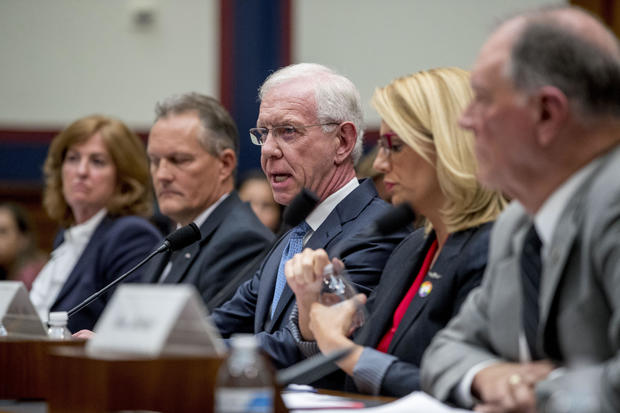
Congress Boeing Plane
Captain Chesley “Sully” Sullenberger speaks during a House Committee on Transportation and Infrastructure hearing on the status of the Boeing 737 MAX on Capitol Hill, June 19, 2019.

Andrew Harnik / AP

Sullenberger rose to worldwide fame on January 15, 2009, when he piloted U.S. Airways Flight 1549 to land safely in the Hudson River after it blew both engines in a bird strike after takeoff from New York’s LaGuardia Airport. All 155 people on board survived because of Sullenberger’s quick thinking and professional actions. It has been dubbed “The Miracle on the Hudson.” 

“I’m one of the relatively small group of people who have experienced such a sudden crisis — and lived to share what we learned about it,” he told House members on Wednesday. “I can tell you firsthand that the startle factor is real and it is huge — it interferes with one’s ability to quickly analyze the crisis and take effective action. Within seconds, these crews would have been fighting for their lives in the fight of their lives.” 

Sullenberger detailed how the failure of a single “angle of attack” sensor on the Boeing 737 Max 8 flights quickly caused “multiple instrument indication anomalies” and “false warnings,” as an automated flight-control system called MCAS overrode pilots’ commands.

He said his own experience in recent 737 Max simulator trainings demonstrated to him the unprecedented difficulties the Lion Air and Ethiopian Airline pilot crews encountered when trying to handle the malfunction.

“Prior to these accidents, I think it is unlikely that any U.S. pilots were confronted with this scenario in simulator training,” Sullenberger said. CBS News correspondent Kris Van Cleave reported last year that U.S. airline pilots were initially given just 56 minutes of training on an iPad about the differences between the new Boeing Max planes and the older 737s.

Others at the hearing agreed with Sullenberger and disputed the FAA’s previous insistence that pilots had been sufficiently trained how to use the MCAS system, as well as Boeing’s insinuation that international pilots did not “completely follow” instructions of how to prevent an MCAS malfunction. 

“Again, the failure was Boeing did not disclose the existence of MCAS to the pilot community around the word,” said Captain Daniel F. Carey, president of the Allied Pilots Association, who testified alongside Sullenberger.  “Therefore robust training was not conducted.” 

Boeing issued a statement in response to the hearing, saying:

“Safety is a shared priority and we are working closely with our industry partners to learn from these tragedies, answer their questions, and take steps to re-earn people’s trust and ensure accidents like these never happen again. Boeing continues to work with global regulators and our airline customers as they determine training requirements.”

In May, CBS News obtained audio from the American Airlines pilots’ union confronting Boeing about new features to the 737 Max that factored into the two deadly crashes

“They didn’t ever tell us the system existed,” Carey said Wednesday, referring to Boeing and MCAS. 

During the hearing, Sullenberger urged Congress to provide the Federal Aviation Administration (FAA) with sufficient funding to conduct necessary oversight. He also testified that the FAA must remain independent from political and economic influence, and asked for protection for whistleblowers.  

“We get what we measure. We get what we reward. And right now, in the important ways, the incentives are not aligned toward consistent public good sufficiently in all our organizations,” Sullenberger said of the aviation industry. 

How the spike in global bond yields creates more risk for the stock market

New York (CNN) — Never doubt the power of the $30 trillion US Treasury market. It was robust enough to push back on the Treasury Department’s recent intervention while captivating Wall Street. Now investors are wondering whether the bond market’s unease is strong enough to disturb a booming stock market.Bond yields have climbed this year, driven by concerns about government deficits and an increase in supply of corporate bonds to fund the AI buildout. Investors are demanding more compensation to continue funding government spending and companies’ plans for AI.A rise in yields pushes up interest rates across the economy, raising borrowing costs for consumers and the government alike. It matters for stocks, too: Higher yields can affect calculations for companies’ future earnings and stocks’ value. Higher yields on trustworthy government bonds can also draw investors away from riskier assets like stocks.A “disorderly rise in bond yields” is the second biggest risk for stocks after the AI bubble, according to a survey of fund managers conducted by Bank of America this month.Investors are increasingly nervous about the stock market’s over-concentration in artificial intelligence. And a sharp, sustained rise in yields is another risk that could help deflate a bubble.Bond yields are not certain to derail stocks, but it creates a more complicated outlook. After global bond yields hit multi-year highs last week, the S&P 500 ended the week lower and snapped a three-week winning streak.Yields dropped at the start of this week, giving a boost to stocks. But the 30-year yield remains near its highest level in almost two decades. The 10-year US Treasury yield is trading close to its highest level in over a year.Ultimately, the impact on stocks depends on just how fast yields rise, how far they rise and why they are rising.Why stocks are resilientThe S&P 500 is up about 12% this year, on course for its fourth straight year of double-digit gains. Stocks rebounded from an Iran war-related slump in March before clinching a series of all-time highs, putting it at 27 record highs so far this year.Strong corporate earnings, waves of enthusiasm about artificial intelligence and a buy-the-dip mentality led by retail investors contributed to the market’s resilience.Stocks dropped last week as global bond yields hit multi-year highs, but the S&P 500 remains close to all-time highs – down less than 2% since its last record high two weeks ago. The tech-heavy Nasdaq Composite is down less than 4% since its last record high in early June.A strong corporate earnings season has helped keep the stock market afloat. There’s been some volatility for individual stocks, but overall, it’s been another quarter of stellar earnings.The earnings growth rate for companies in the S&P 500 is set be the strongest since 2021, according to FactSet data. The rise in bond yields hasn’t been sharp enough to shake stocks while earnings roll in.Since hitting a record high on August 13, the S&P 500 hasn’t had an up or down of more than 1% on a given day. Wall Street’s fear gauge, the VIX, is trading at 15, well below the 20-point threshold that signals volatility in markets.“We are cautious that the low level of volatility is luring market participants into a false sense of security,” Melissa Brown, global head of investment decision research at SimCorp, told CNN.Why yields could pose trouble for stocksYields matter for investors’ assessment of stocks’ value. A sharp rise in yields or intense volatility in the bond market can irk the stock market. When President Donald Trump announced sweeping tariffs in April 2025, the 10-year yield spiked and the S&P 500 dropped more than 10% in two days.What’s different this time? Bond yields have steadily climbed across the year. Stocks are near record highs. The steady rise in yields may be limiting the impact on stocks, analysts say, but a sustained push higher or bouts of volatility could begin to create more issues for investors.The key threshold is 5% for the 10-year yield, which would be the highest level since October 2023. That’s the psychological “line in the sand” when things become more worrying for stock market investors, said Sam Stovall, chief investment strategist at CFRA Research.“The real question is how long will interest rates be rising, and how far will they go?” Stovall said.The-CNN-Wire™ & © 2026 Cable News Network, Inc., a Warner Bros. Discovery Company. All rights reserved.
Read Next Story