Startup company reveals prototype of tsunami survival pod

▶ Watch Video: Designers develop survival pod for range of weather-related disasters

A French startup company has unveiled a prototype for a survival device that it says can save people from tsunamis and severe flooding. 

The prototype was revealed at a technology conference in Paris earlier this month. The company, Lifepods, says it believes the device will help save lives minutes before disaster strikes, when evacuation is no longer a safe option. 

LifePods CEO Cedric Choffat said emotional images of the aftermath of the world’s deadliest tsunamis, such as in the Indian Ocean in 2004 and off the coast of Japan in 2011, prompted him to consider how a purpose-built survival capsule could work. Even as better forecasting and preparedness have led to fewer fatalities from tsunamis and floods over time, extreme weather events like the historic central Texas floods in 2025 have still wreaked destruction. So how could he help save lives? 

“That question became the starting point of LifePods,” Choffat told CBS News. 

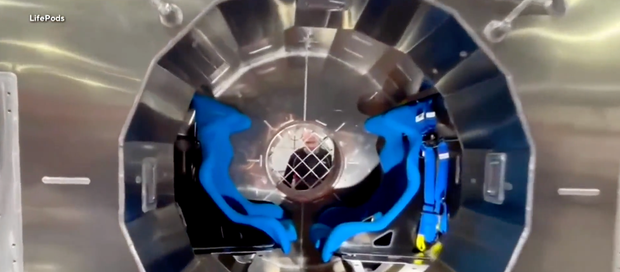
That led to the creation of the W-01. The device is essentially a floating fortress, with enough room for up to four adults and four children to fit inside, albeit snugly. The capsule is equipped with harnesses and can broadcast an emergency distress signal until rescuers arrive. There is room under seats for essential supplies like food, water and medicines. A GPS tracker can be installed to ensure rescuers can find the pod. 
screenshot-2026-07-09-at-9-21-23-am.png
The interior of a LifePod prototype.

CBS Chicago / LifePod

There isn’t room within the capsule to do much but sit and wait. The device is meant to be used short-term, as a last-chance refuge. Unlike traditional bunkers, which are fixed in place, Choffat described the floating capsule as “rapidly deployable,” including by air, and easy to install at scale in high-risk areas.

W-01 relies on what Choffat refers to as a passive hydrodynamic design, in which the capsule’s buoyancy and shape carry it through the water rather than mechanical motors or steering systems. The device is made from a marine-grade double-aluminum shell separated by a foam core. Its makers say this creates a rigid structure that distributes the force of a potential impact throughout the capsule rather than concentrating it in a single spot, protecting the inhabitants from massive floating debris like cars, trees and building materials, which is one of the biggest dangers during flood events. 

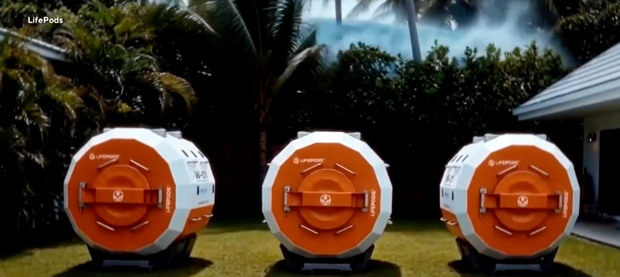
However, the W-01 has yet to undergo real-life testing, which LifePods describes as a process that would start with harbor trials to verify buoyancy under different payloads, move to towing tests at sea to assess how the capsule would cope with waves, and then progress to more demanding conditions. The company did release a dramatic AI-generated video showing how the product could work. 
screenshot-2026-07-09-at-9-20-44-am.png
An AI image of LifePods as a tsunami approaches. 

LifePod / CBS Chicago

The product is expected to become commercially available next year, LifePods says. It will likely have a price tag of $45,000 per pod. Choffat said government agencies, civil protection organizations, and private security companies have shown interest in the device, suggesting the target consumer is institutional rather than individiual. In the U.S., discussions are “still at an early stage,” he said. 

“We believe the market has tremendous potential due to the increasing number of hurricanes, floods, and coastal storm surges affecting many states each year,” said Choffat. 

LifePods isn’t breaking into a flooded market, but it does have a competitor – Seattle-based Survival Capsule LLC.  Their patented spherical pod is already on sale, and for much cheaper, costing $13,500, or less than a third of the expected price of the W-01. 

LifePods is also designing mobile land-based survival pods, including one that can withstand earthquakes and building collapses, and another for protection against armed attack and explosions.
screenshot-2026-07-09-at-9-20-18-am.png
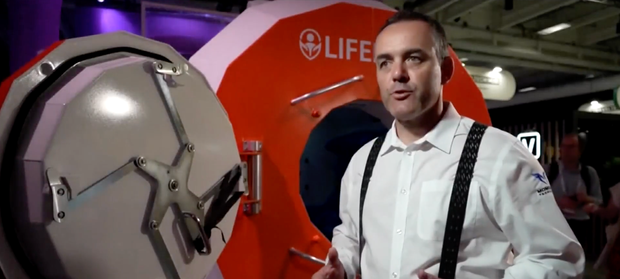
LifePod CEO Cedric Choffat stands in front of a device prototype at a conference in Paris. 

CBS Chicago

SpaceX plans to build the ‘biggest launch site on Earth’ for $100 billion in Louisiana

(CNN) — SpaceX on Tuesday unveiled plans to construct a massive, $100 billion spaceport in Louisiana, where the company plans to launch its gargantuan Starship rocket thousands of times per year.Construction of the spaceport is expected to begin by the end of next year near the southern coast of Louisiana’s Vermilion Parish, with the first launch targeted as soon as 2029, according to an economic development website.Such a development would mark a dramatic shift for SpaceX and the US rocket industry — making Louisiana, which has never before hosted an orbital launch, perhaps the busiest launch hub on the planet.The new SpaceX campus will be dubbed “Starbase, Louisiana” — borrowing the name of SpaceX’s recently incorporated company town in South Texas. Starbase, Texas, is the current home to Starship’s testing and development facilities and the spot from which 13 test flights have launched to varying degrees of success.The Louisiana location, however, would host flights of the Starship rocket once its operational, having proven it can safely haul cargo to orbit. SpaceX also plans to land and recover every piece of its Starship rockets — including the upper spacecraft, which has never been done before — in order to allow the rockets to be rapidly reused and drive down the cost of each launch.That means Louisiana would not only become a hub for launches, but it would become home to numerous towers — standing hundreds of feet tall — that would be used to recapture rockets and spacecraft as they return from space.“Starbase Louisiana will ultimately have over a dozen launch towers, enabling more than 30 Starship flights per day and making it the biggest launch site on Earth!” SpaceX CEO Elon Musk said on his social media platform, X, on Tuesday.During an announcement event in Louisiana Tuesday, SpaceX’s chief operating officer, Gwynne Shotwell, also described the project as “a self-sustaining spaceport with its own propellant production, power generation, deep water shipping capabilities, vehicle processing facilities, and probably an airport.”Louisiana’s ‘worst kept secret’SpaceX had been quietly working on its spaceport plans alongside Louisiana elected officials for months. Company leaders have traveled to the state to scope out potential locations, prompting one local news outlet to refer to the project as the state’s “worst kept secret.”State governor Jeff Landry, a Republican, billed the project as an offer of “a permanent future and lasting prosperity.”“For generations, industries came to Louisiana not to build lasting prosperity, but to extract wealth,” Landry said. “Too often, Louisiana was left with the scars, while others enjoyed the profit. Today, what Elon Musk and his team is offering Louisiana is different.”Much about the plans remain to be seen. Starship is not yet operational. The company is expected to launch its most important test flight to date as soon as September — a mission that could send the rocket to orbit for the first time. Additional testing will be necessary to sort out how the rocket’s upper stage can be landed and flown again.A spaceport of such size and scale as the Louisiana project will also likely face extensive regulatory reviews: “The project will go through all applicable environmental, wetlands, natural resource and launch-related reviews,” a project website confirms.Such reviews related to SpaceX’s facilities in Texas — a far smaller complex than the planned Louisiana site — took nearly a decade to complete. And some local environmental advocacy groups continue to battle the company in Texas courts over the impacts of rocket testing on the community.Shotwell said Tuesday that SpaceX plans to keep “very large portions” of Starbase Louisiana’s 125,000 acres of land “untouched, so that high-value wetlands stay habitat and don’t become infrastructure.”“We will help fund protection, restoration, and stewardship while we build,” Shotwell said.The announcement is the latest in a long list of displays of confidence that Starship will transform SpaceX as a company. Already, SpaceX has said it’s begun to phase out use of its workhorse Falcon 9 rockets, which are currently the most prolific launch vehicles in the world, in favor of using Starship for most missions once it becomes operational.Earlier on Tuesday, SpaceX’s vice president of launch, Kiko Dontchev, said a Falcon 9 rocket that took flight the same morning would be the last ever to carry SpaceX Starlink satellites from Florida — an area due East of Orlando that is currently home to the world’s busiest spaceport across Kennedy Space Center and the Cape Canaveral Space Force Center.“From here on, Starlink missions out of Florida will fly on Starship,” Dontchev said. “The West Coast team will continue regularly launching Starlink from Vandenberg. Super proud of this incredible team. You’ve made Falcon 9 the most reliable launch vehicle in history. You also helped build the largest low-Earth orbit satellite constellation providing connectivity to millions around the world, and you’ve set the foundation for what’s next.”SpaceX’s plans include continuing to fly Starship out of Texas, and it may begin flights from Florida as soon as this year. But the envisioned plans for Louisiana would make it by far the largest base of operations for the rocket.The-CNN-Wire™ & © 2026 Cable News Network, Inc., a Warner Bros. Discovery Company. All rights reserved.
Read Next Story