
SpaceX joins the Nasdaq 100, clearing way for potential investment influx. Here’s what to know

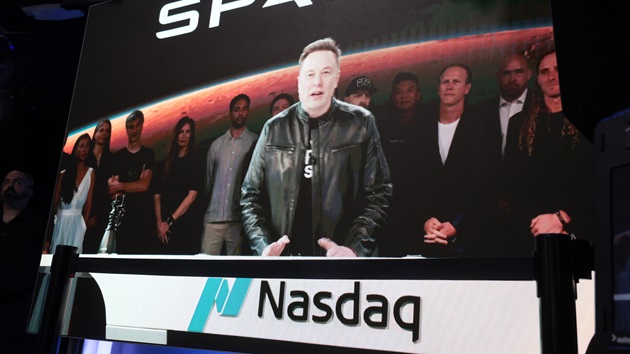
SpaceX founder and CEO Elon Musk speaks via video at the Nasdaq Marketsite in Times Square during the launch of the SpaceX initial public offering (IPO) on the Nasdaq on June 12, 2026, in New York City. (Spencer Platt/Getty Images)

(NEW YORK) — Elon Musk-led rocket and AI company SpaceX joined the Nasdaq 100 on Tuesday, clearing the way for a potential influx of investment as funds pegged to the major index were expected to add the firm.

SpaceX will all but certainly become a part of many individuals’ 401(k) accounts soon. Those accounts often hold index funds, which track indexes like the Nasdaq 100.

Until recently, newly listed companies were barred from major indexes until after an extended waiting period. But the Nasdaq issued a rule change in May permitting “fast entry” to the Nasdaq-100 for some major IPOs. Over the ensuing weeks, some other top exchanges also tweaked their rules.

Entry into the index marked the latest development for SpaceX after a roller coaster in the company’s shares following an initial public offering (IPO) last month. The stock price soared roughly 50% in the initial three days after the public listing on June 12, before shedding just about all of those gains within days.

SpaceX shares dropped nearly 6% in early trading on Tuesday, putting the price at about $151. The SpaceX IPO, the largest ever, opened trading last month at $150 per share.

The IPO made Musk the first trillionaire, vaulting the world’s richest person further ahead of other financial titans. After SpaceX shares tumbled on Tuesday, Musk’s net worth fell to $973 billion, according to Forbes. The second-wealthiest person alive, Google founder Larry Page, holds a net worth of $303 billion, Forbes said.

The IPO pulls in fresh funds for the Texas-based firm, which oversees Musk’s ambitions in the fast-growing but cost-intensive AI industry. The company aims to raise as much as $75 billion from its public listing.

SpaceX builds and operates spacecraft, including thousands of satellites deployed in support of its Starlink satellite internet service. In February, the company merged with xAI, a Musk-led AI company that offers a chatbot in competition with the likes of OpenAI’s ChatGPT and Anthropic’s Claude.

The company’s revenue jumped to $18.7 billion in 2025, soaring 33% compared to the previous year, a financial filing showed. Nearly a quarter of that revenue came from Starlink, which counted millions of subscribers. Still, SpaceX failed to turn a profit, registering a loss of $4.9 billion last year.

Copyright © 2026, ABC Audio. All rights reserved.

Two visions of America are emerging as midterms draw near. Voters must decide which one is real

(CNN) — Two rallies, nearly 1,000 miles and two days apart, laid out the increasingly stark choice confronting midterm election voters and a looming moment of reckoning over the nation’s future course.In Atlanta on Sunday, Georgia Sen. Jon Ossoff delivered an acidic takedown of President Donald Trump; an economy that many voters think is failing them; and a war Trump started and has failed to resolve. Ossoff boiled the election down to a referendum on corruption, costs and failed global leadership.“Under Donald Trump, it costs more than ever to stock your fridge, to power your home, to make a cup of coffee, to buy school supplies for your kid or a tractor for your farm,” the Democrat said. He accused the president of sleeping through meetings and lying about the war, and said that while sailors on the USS Abraham Lincoln aircraft carrier are doing their nation proud during a deployment of over 250 days, Trump spends his time playing golf and buying stocks.On Friday, in Long Island, Trump gave the most explicit version yet of an argument Republicans hope will stave off the midterm curse that haunts incumbent presidents — even as their leader faces headwinds over his personal unpopularity, the Iran war and voter frustration over high prices.He accused Democrats of wanting to turn America into a “communist country” and of declaring war on the police and the rule of law. “The communists want to turn America into a third-world country, into a hellhole of crime and filth,” the president said, seeking to exploit the successes of progressive Democrats.The contrast encapsulates a bitter moment in American history as a deeply unpopular president attempts to dodge lame-duck status by branding Democrats as un-American extremists. But he’s facing opponents keyed into a classic change campaign as they attempt to saddle Republicans with Trump’s failures and to tap into voters’ fury over the state of the nation.Democrats have struggled for years to land disqualifying arguments against Trump. Their past warnings that US democracy was in peril often seemed rather esoteric to people struggling to afford gas and groceries. Ossoff is providing something that the party has lacked: abrasive, robust language and framing that can be borrowed by other candidates to weave Trump’s vulnerabilities into a positive case for their own campaigns.This is one reason a senator with a strong record of winning in the conservative South and among Black voters — a critical Democratic constituency — is drawing talk of a possible 2028 run for president. First, however, he must try to win reelection.Ossoff is also showing how Democrats can pin down their individual opponents by linking them to Trump’s record. He slammed his opponent, Rep. Mike Collins, whom Trump jammed onto the ballot despite the objections of state leaders. “Georgia deserves better — better than pro-war, pro-tariff, pro-cutting your healthcare Trump puppet Mike Collins, and America deserves better than Donald Trump,” Ossoff told his crowd.Amid polls showing the Democratic senator in the lead, Collins told CNN’s Manu Raju in July that his foe was “lying, and the reason is he’s losing and he knows he’s losing.”Trump is already going scorched-earthTrump is laying out a two-pronged campaign: claiming that his presidency is a historic success while branding Democrats as an unacceptable choice. In Long Island, he refused to apologize for a war in which US credibility has been tested by a weaker power as Iran holds the world economy hostage by effectively closing the Strait of Hormuz.Yet Trump’s vulnerable position on Iran was laid bare when he appeared to belittle the pain caused by the conflict at home. He said that it was worth it for people to “pay a tiny little bit more” for gasoline to prevent Iran getting a nuclear weapon. His apparent indifference to affordability issues — which he again mocked as made-up Democratic talking points — also risks undercutting the more positive aspects of his economic message such as larger-than-expected tax refunds under the GOP’s 2025 domestic policy bill and efforts to cut prescription drug prices.Trump’s searing assault on progressive Democrats is apparently designed to shift the narrative from his economic challenges. In addition to his claims about communism, Trump warned last week that “we have jihadists being elected all over the place.” His comment followed the triumph of Abdul El-Sayed, a public health professional and Muslim, over a more centrist candidate in Michigan’s Democratic Senate primary. It should also be placed in the context of his repeated attacks on Rep. Ilhan Omar, a Somali American from Minnesota.But Trump faces a risk that such divisive rhetoric will complicate one of the most important requirements of his reelection campaign: lining up independent and moderate voters in key states that swelled his coalition two years ago.Still, given the difficult terrain of the election, a strategy designed to fire up Trump’s base may make sense. Republicans have tended not to drive out the broader MAGA coalition when Trump is not on the ballot. And incumbent parties in midterm elections often struggle to match the enthusiasm of partisans favoring the party desperate to win back power. In tight races, a high turnout of MAGA voters might be one way to stem GOP losses.The ideological clash that could dampen Democratic hopesWhile the political environment seems challenging for Republicans, there’s a wild card that Trump hopes to exploit and that was also on display over the weekend as the midterm campaign heated up.A blue wave in November may depend on the party agreeing to postpone arguments about ideological splits that have emerged in congressional primary campaigns.On Sunday, Maryland Gov. Wes Moore told CNN’s Jake Tapper that his party must concentrate directly on the plight of voters struggling with the prices of housing, food and healthcare. “Any Democratic policy that’s not focusing on what people are feeling right now and the status quo protection has got to go,” Moore said on “State of the Union.”But Trump’s very unpopularity seems often to fuel Democratic disputes over ideology since it makes the prospect of congressional majorities seem closer.One progressive Democrat, Rep. Ro Khanna, on Sunday backed the Medicare-for-All healthcare system also favored by El-Sayed and other progressive candidates. “(It) is arguably the most important priority. It would save money, and it would save lives,” the California lawmaker said on NBC’s “Meet the Press.”But Rep. Hakeem Jeffries, the Democratic leader in line to be speaker if Democrats win the House, declined to commit to a state-run system, foreshadowing likely splits between emboldened progressives and more moderate Democrats in any majority next year.“It’s not legislation that I currently am co-sponsoring or that I support,” Jeffries said on NBC, adding he doesn’t back many policies attributed by Trump to democratic socialists. “I do not support defunding the police. I do not support open borders. I do not support abolishing the Senate,” he said.Republicans hope such differences inside the Democratic coalition and the presence of some more radical candidates on the party’s more broadly moderate lists will offer Trump a narrow opening.In Long Island, Trump renewed his boast that the United States is the “hottest” country in the world and that Americans are lucky to be living in a “golden age.”Democrats are arguing that high prices, a foreign war with no end in sight and an apparently uninterested president mean he’s selling a fantasy.The midterm elections may hinge on which vision is closer to voters’ lived experience.The-CNN-Wire™ & © 2026 Cable News Network, Inc., a Warner Bros. Discovery Company. All rights reserved.
Read Next Story