
Smithsonian official set to testify before Congress amid sharp White House criticism of museum

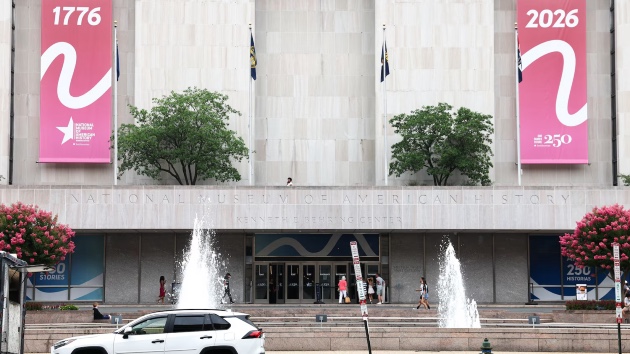
The Smithsonian American History Museum on July 07, 2026 in Washington, DC. (Finn Gomez/Getty Images)

(WASHINGTON) — The director of the Smithsonian’s National Museum of American History (MNAH) is scheduled to testify before two congressional House committees this week amid sharp criticism from the White House over the contents of the Washington, D.C. museum.

Anthea Hartig is set to face grilling by lawmakers on Tuesday morning in a House Subcommittee on Delivering Government Efficiency hearing titled “Rewriting American History: Examining the Smithsonian’s Efforts to Reshape the Past,” according to a committee press release.

She is also expected to testify in a related hearing on Wednesday before the Committee on House Administration, a committee spokesperson confirmed to ABC News. ABC News has reached out to the Smithsonian for confirmation.

Hartig was named in a scathing White House Domestic Policy Council report released on July 4, accusing the MNAH and its leadership of engaging in “extreme political activism” and presenting “a radical view of American history.”

Asked about the report, a spokesperson for the Smithsonian told ABC News on July 5 that the institution remains committed to impartial learning.

“For more than 180 years, the Smithsonian has served the American public with nonpartisan and independent scholarship, and we remain committed to doing so,” the spokesperson said.

Hartig’s testimony this week would mark the first time that a top leader at the Smithsonian gets grilled publicly by Congress after President Donald Trump targeted the institution in his March 27, 2025 executive order, “Restoring Truth and Sanity to American History.”

The executive order directed Vice President J.D. Vance, in consultation with the president’s advisers on domestic policy, “to remove improper ideology” from Smithsonian institutions, arguing that materials that cast America in a “negative light” have no place in federal cultural institutions.

The White House last year launched an investigation into the Smithsonian, which oversees 21 museums, galleries and the national zoo, and released the July 4 report targeting the American history museum as part of this probe.

The report accuses the museum of “anti-White activism,” “illegal alien activism,” and “transgender activism.” It also includes many photos of materials the White House has identified as problematic.

Smithsonian Secretary Lonnie Bunch, who has not addressed the report publicly, disputed its findings in an internal letter to staff that was obtained by ABC News.

Bunch wrote that Smithsonian leadership is “carefully” reviewing the report’s findings, but said that the report’s assessment is “not a fair characterization.

“While there will always be room for improvement, this report is not a fair characterization of the work and totality of the National Museum of American History,” Bunch said in the letter. “At the Smithsonian, our work is driven by scholarship, accuracy, and an uncompromising commitment to tell the fullness of America’s story.”

“As public servants and the keepers of this institution, we are charged with helping a nation find understanding, hope, and clarity and as part of that duty, we are dedicated to excellence, reflection, and growth,” Bunch added.

The report was published by the White House Domestic Policy Council. Vince Haley, the group’s director, said in a statement to ABC News that “No American wants the Smithsonian’s National Museum of American History to be a system of ideological activism.”

“Unfortunately, the report demonstrates that is exactly what the Smithsonian’s flagship museum has become,” he said. “It is our hope and expectation that the Smithsonian will eventually rise once again to that noble obligation — to tell America’s story for our children, the world, and future generations of Americans,” he added.

ABC News’ Mariam Khan contributed to this report.

Copyright © 2026, ABC Audio. All rights reserved.

Once peruanos murieron combatiendo por Rusia y otros 114 están desaparecidos, dicen autoridades de Perú

Once peruanos han muerto, 114 están desaparecidos y tres fueron capturados por el Ejército ucraniano después de enlistarse en las fuerzas armadas rusas, informó el Ministerio de Relaciones Exteriores de Perú. La Cancillería señaló que, oficialmente, 459 ciudadanos peruanos se han enlistado en las fuerzas armadas rusas.El nuevo balance fue difundido mientras el Gobierno anunciaba la repatriación de dos jóvenes peruanos que, según la Cancillería, escaparon del reclutamiento forzado al que fueron sometidos para prestar servicios en la guerra contra Ucrania.El consulado de Perú en Rusia “asistió y gestionó la repatriación de dos jóvenes peruanos en situación de vulnerabilidad, que fugaron del reclutamiento forzado del que fueron víctimas”, señaló la cancillería en un comunicado.“Todos ellos arribaron al Perú y se encuentran con sus familias”, añadió.Los jóvenes se suman a otros dos peruanos atendidos a finales de julio por la sección consular de la Embajada del Perú en Rusia. En total, la Cancillería informó que 31 peruanos han sido evacuados: 28 regresaron al Perú y tres permanecen en Europa por “decisión propia”.El Ministerio también pidió a los ciudadanos tener cuidado con las ofertas de trabajo en el extranjero. “Se alerta a la ciudadanía a no dejarse engañar por falsas ofertas laborales, pues podrían caer en redes delictivas de trata”, señaló la Cancillería. El Gobierno recordó además que prestar servicio militar para un Estado extranjero requiere autorización previa.El anuncio llega después de meses de reclamos de familias que buscan información sobre sus parientes. CNN habló recientemente con 12 familias peruanas que han participado en protestas y vigilias frente a la Embajada de Rusia en Lima y ante el Ministerio de Relaciones Exteriores.Los testimonios recogidos muestran que algunos hombres viajaron a Rusia después de recibir ofertas de trabajo como cocineros, guardias de seguridad u otros empleos de civiles. Sus familiares dijeron que no esperaban que terminaran vinculados a las fuerzas rusas y, en algunos casos, enviados al frente.Pedro Bravo, director de Comunidades Peruanas en el Exterior de la Cancillería, dijo a CNN que muchos de los reclutas provienen de entornos empobrecidos y con una necesidad urgente de dinero, lo que puede hacerlos más vulnerables a este tipo de ofertas. “Es mucho más fácil engañarlos”, dijo.Una de las madres entrevistadas por CNN, identificada como Norma, contó que su hijo de 31 años viajó a Rusia después de aceptar un supuesto trabajo como cocinero para el Ejército ruso. Poco después comenzó a enviarle fotografías y videos en los que aparecía con equipo militar, cavando trincheras y construyendo refugios.A principios de abril dejó de enviar mensajes.“Tengo esta luz de esperanza de que está en algún lugar, escondido en una trinchera, pero realmente no lo sé”, dijo Norma a CNN.Ante las denuncias, la Fiscalía peruana anunció en mayo que investiga el reclutamiento ruso por posibles casos de “trata de personas”.Percy Salinas, un abogado que representa a algunas familias de los reclutas, entregó a CNN una copia de una orden fiscal que describe el alcance del caso judicial.Las autoridades están investigando 36 denuncias de ciudadanos peruanos que afirman que sus familiares o amigos fueron engañados “mediante ofertas de trabajo falsas en el extranjero —específicamente en la Federación Rusa— con el propósito de transportarlos fuera del país y someterlos a… participación forzada en un conflicto armado entre Rusia y Ucrania”, según la orden.La fiscalía declinó hacer comentarios sobre el caso cuando fue contactada por CNN.Bravo, del Ministerio de Relaciones Exteriores de Perú, dijo a CNN que el Gobierno había realizado al menos 247 solicitudes a Moscú para obtener información sobre peruanos incorporados a las fuerzas rusas y ha exigido “el regreso inmediato y seguro de nuestros compatriotas a su país de origen, dado que salieron sin la debida autorización”.Rusia ha dicho que “respeta profundamente la decisión de ciudadanos extranjeros de participar en la defensa de la soberanía y seguridad (rusas)”.“La embajada reafirma su permanente disposición a tomar todas las medidas necesarias para obtener información lo más rápido posible en base a solicitudes presentadas formalmente”, dijo la Embajada de Rusia en Lima en un comunicado de abril sobre las “preocupaciones de las familias peruanas”.The-CNN-Wire™ & © 2026 Cable News Network, Inc., a Warner Bros. Discovery Company. All rights reserved.
Read Next Story