
Sen. Lindsey Graham’s cause of death was aortic dissection, medical examiner says

▶ Watch Video: Sen. Lindsey Graham died of an aortic dissection, preliminary findings show

Republican Sen. Lindsey Graham, 71, died Saturday evening following a “brief and sudden illness,” his office said in a statement. His death came shortly after returning from a trip to Ukraine and ahead of a scheduled appearance on Sunday’s “Meet the Press.”

“Senator Graham’s family appreciates prayers at this time and asks for privacy during this incredibly difficult period,” the South Carolina senator’s office said.

Graham’s spokesperson said Sunday afternoon the cause of death was aortic dissection due to arteriosclerotic cardiovascular disease, according to preliminary findings by the Medical Examiner of the District of Columbia. An aortic dissection is a life-threatening condition involving a tear in the main artery from the heart, due in this case to what is commonly known as hardening of the arteries.

A recording of an emergency phone call on Saturday evening responding to a residence belonging to the senator mentions a dispatch for cardiac arrest. 

President Trump paid tribute to Graham, calling him “one of the greatest people and Senators I have ever known,” in a Truth Social post.

“He was always working, and was a true American Patriot. Lindsey will be greatly missed,” Mr. Trump said.

The president said Sunday on NBC’s “Meet the Press” he spoke with the senator Saturday evening, after he returned from Ukraine. “Other than being tired he was fine,” the president said.
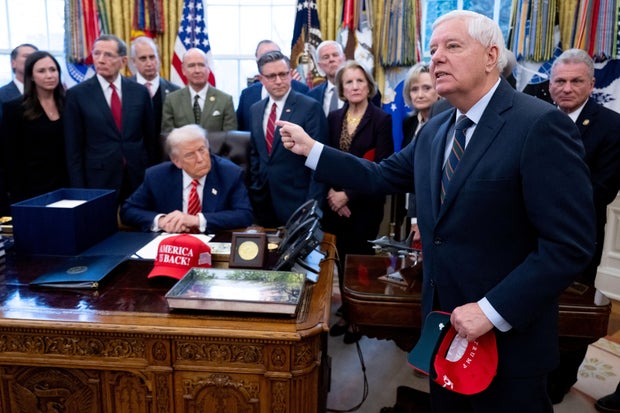
US-POLITICS-TRUMP
Sen. Lindsey Graham speaks to the press alongside President Trump in the Oval Office, surrounded by members of Congress, on Feb. 3, 2026. 

SAUL LOEB /AFP via Getty Images

The prominent senator had been on a visit to Ukraine on Friday where he met with President Zelenskyy, who has since said he was “deeply saddened” by the news. Zelenskyy paid tribute to Graham’s 10 wartime visits to the country and his advocacy for Ukraine’s defense.

Israeli Prime Minister Benjamin Netanyahu paid tribute to Graham. “Sara and I grieve with the American people over the loss of our dear friend,” the prime minister said in a statement.

“Israel has lost one of its greatest friends. America has lost a great patriot. I have lost a beloved friend,” Netanyahu said.

Israel’s President Isaac Herzog said in a social media post he was “shocked and heartbroken to learn of the sudden passing of the great American patriot, a great friend of Israel, and my dear friend.”

Graham was born in Central, South Carolina, on July 9, 1955. Both of his parents died when he was in his early 20s, leaving him to serve as legal guardian for his 13-year-old younger sister, Darline.

He attended University of South Carolina for his undergraduate degree and stayed on for a law degree. After a stint as a military lawyer and a few years of private law practice, he served one term in the South Carolina House of Representatives. Two years later, he was elected to the U.S. House, representing South Carolina’s 3rd District.

He ran for the Senate seat once occupied by Strom Thurmond in 2002, and won reelection three times by fairly robust margins. Even in 2014, when outside conservative groups threatened him with a primary challenge for his role in the 2013 immigration debate, no serious challenger emerged on the Republican stage. In 2020, he defeated Democratic challenger Jaime Harrison by more than 10 points despite his opponent raising $25 million more than him.

Graham was always an outspoken hawk on foreign policy matters, including on Iran, and earlier this month he came out against the initial contours of the memorandum of understanding Mr. Trump signed with the country. He also favored a hardline policy toward Russia, especially after the country’s full-scale invasion of Ukraine. 

His foreign policy views brought him close to two hawkish former giants of Congress, GOP Sen. John McCain of Arizona and Democratic-turned-independent Sen. Joe Lieberman of Connecticut — a trio that was dubbed “the three amigos.” He also counted former President Joe Biden, who served with Graham in the Senate, as a friend at one point though their relationship frayed during Biden’s presidency.

The South Carolina Republican was known in the Senate for working across the aisle, and was a key player in a number of major bipartisan agreements. Democratic Sen. Mark Warner of Virginia paid tribute to Graham Sunday, saying: “Lindsey and I disagreed on plenty over the years, but I never doubted his love for this country or his commitment to serving it. ”

“He was a fierce advocate for the causes he believed in, especially our nation’s security and the men and women of our armed forces,” Warner said.

Graham was initially a staunch critic of Mr. Trump and the ascendant, conservative Tea Party movement. In 2016, after his own short-lived presidential run came to an end, he once warned on social media that if his party nominated Mr. Trump, “we will get destroyed……and we will deserve it.”

But Graham later mended his relationship with Mr. Trump and became a close ally and defender of the president. As a member of the Senate Judiciary Committee, he helped steer Mr. Trump’s first-term Supreme Court picks — Justices Neil Gorsuch, Brett Kavanaugh and Amy Coney Barrett — through contentious Senate confirmation hearings.

Despite briefly breaking with the president after the Jan. 6, 2021, Capitol riots — “count me out, enough is enough,” he said on the Senate floor — he sought to remain in Mr. Trump’s good graces. Once referring to himself as the president’s “north star,” Graham pressed Mr. Trump in recent months to impose more intense sanctions against Russia and maintain a hard line against Iran.

“Let’s try a diplomatic solution. I think it’s going to fail. What happens next?” he said of talks with Iran on “Face the Nation with Margaret Brennan” just three weeks ago, a couple days after spending four and a half hours with the president. “To all the people listening, if this diplomatic effort fails, President Trump is going to take the Strait of Hormuz. We’re going to run it.”

Under South Carolina state law, Republican Gov. Henry McMaster will appoint an interim replacement for Graham’s seat, who will serve until January 3, 2027. Since Graham’s seat was up for reelection this year, the next senator will be elected in the existing midterms on November 3, 2026.

Ayatollah Seyyed Ali Khamenei Fast Facts

(CNN) — Here is a look at the life of the former Iranian Supreme Leader Ayatollah Seyyed Ali Khamenei.PersonalBirth date: July 17, 1939Death date: February 28, 2026Birth place: Mashhad, IranBirth name: Seyyed Ali KhameneiFather: Ayatollah Sayyid Jawad Husaini KhameneiMother: Name unavailable publiclyMarriage: Married in 1964Children: Mostafa, Mojtaba, Massoud, Meysam, Hoda and BoshraEducation: Studied under the future Ayatollah Khomeini at the Islamic seminary in Qom, IranReligion: Islamic, Shiite MuslimOther FactsAlso known as the Supreme Leader.Timeline1962 - Along with Khomeini, begins his involvement with protests, opposing the policies of the Shah of Iran, Mohammad Reza Pahlavi. 1977 - Along with other clerics, forms the Combatant Clerics Association, which becomes the Islamic Republic Party.1980-1987 - Secretary-general and member of the central command of the Islamic Republic Party.June 1981 - Injured when a bomb placed in a tape recorder explodes at a press conference.October 13, 1981-August 3, 1989 - President of Iran.March 1985 - Survives when a suicide bomb detonates nearby. June 4, 1989 - Is provisionally elected supreme leader of the Islamic Republic of Iran after the death of Khomeini.July 28, 1989 - A referendum makes his election official, and a group of religious leaders later confirm his election as supreme leader.May 2011 - Khamenei becomes locked in a public power struggle with Iranian President Mahmoud Ahmadinejad. February 2012 - Issues a statement that Iran will back any nation or group fighting against Israel.March 2012 - Reacts to tensions involving Iran’s nuclear program and welcomes US President Barack Obama’s comment that “it is in the best interest of the United States, Israel and the world” to peacefully resolve Iran’s nuclear crisis.March 2012 - Khamenei’s allies win about 75% of seats in parliamentary elections against rival Ahmadinejad’s opposition movement. March 21, 2013 - Khamenei, in a televised speech, threatens Tel Aviv and Haifa by stating “at times the officials of the Zionist regime (Israel) threaten to launch a military invasion but they themselves know that if they make the slightest mistake the Islamic Republic will raze Tel Aviv and Haifa to the ground.”January 2015 - Khamenei publishes an open letter to his website, directed at Western youths, asking them not to judge Islam based on the Charlie Hebdo terror attacks.October 21, 2015 - Khamenei conditionally approves the nuclear deal signed between his country and six world powers in July. February 7, 2017 - According to his website, Khamenei tells a gathering of Iran’s air force commanders in Tehran, “We however thank this new guy in the White House, since he largely did the job we had been trying to do in the past decades: to divulge the true face of the US. We had been working to show the world the depth of corruption in US government and ranks and files of the ruling elite; [US President Donald] Trump did it in few days after coming to the White House.”January 9, 2018 - Speaking on the anniversary of the Iranian revolution that began in 1978, Khamenei says that Iranians have a right to protest. But he also blames the United States and Israel for the most recent civil unrest.August 13, 2018 - In a speech published on his website, Khamenei says there would be “no war, nor will we negotiate with the United States,” following the Trump administration’s first wave of sanctions reimposed on Iran after the United States announced its withdrawal from the Iran nuclear deal in May. Khamenei seems to contradict Iranian President Hassan Rouhani who previously said that Iran was willing to hold talks with the United States to resolve the matter – something Trump’s national security adviser John Bolton dismissed as possible “propaganda.”June 24, 2019 - Trump announces new sanctions against Iran in part to retaliate after the downing of a US drone, with the punitive measures set to target Khamenei, military officials and Iran’s top diplomat.January 5, 2020 - Following the killing of Gen. Qasem Soleimani in a US drone strike in Baghdad, Khamenei’s military adviser, Hassan Dehghan, says that his country’s “response for sure will be military and against military sites.”January 17, 2020 - For the first time in eight years, Khamenei leads Friday prayers in Tehran, calling US officials “American clowns” in his defiant sermon.November 28, 2020 - A day after the apparent assassination of Iran’s top nuclear scientist Mohsen Fakhrizadeh, Khamenei vows revenge for his killing. Iran has blamed Israel for the attack and said the operation bore the hallmarks of Israel’s foreign intelligence agency, the Mossad. January 8, 2021 - Khamenei bans the import of Covid-19 vaccines from the United States and Britain to Iran. In a state-run television appearance, he calls the vaccines untrustworthy.June 25, 2021 - Iran state television reports that Khamenei has received his first dose of the Iranian-developed Covid-19 vaccine, known as the CovIran Barekat vaccine. It was approved for use mid-June, according to Iranian authorities.March 1, 2022 - In a televised speech, Khamenei accuses the US of causing the conflict in Ukraine, comparing the US government to a “mafia-like regime.”February 9, 2024 - Meta confirms to CNN that Khamenei’s Facebook and Instagram accounts were removed for “repeatedly violating our Dangerous Organizations & Individuals policy.” Though Meta did not give a specific reason, the policy does not allow organizations or individuals that proclaim a violent mission or are engaged in violence to have a presence on Meta.June 26, 2025 - In his first comments since the Iran-Israel conflict that began on June 13 ended in a ceasefire, Khamenei congratulates “the great nation of Iran” for its “victory over the fake Zionist regime.”January 17, 2026 – Khamenei acknowledges that thousands of Iranians were killed during more than two weeks of anti-government protests that broke out in late December 2025 — deaths he blames on Trump, who he says, “openly encouraged” the protesters by promising them US “military support.”March 1, 2026 – Multiple Iranian state media outlets confirm Khamenei’s death, hours after US and Israeli officials declared he had been killed in their joint strikes targeting his regime.July 3-9, 2026 – Iran holds a weeklong funeral for Khamenei, with a procession stretching across five cities in Iran and Iraq.The-CNN-Wire™ & © 2026 Cable News Network, Inc., a Warner Bros. Discovery Company. All rights reserved.
Read Next Story