
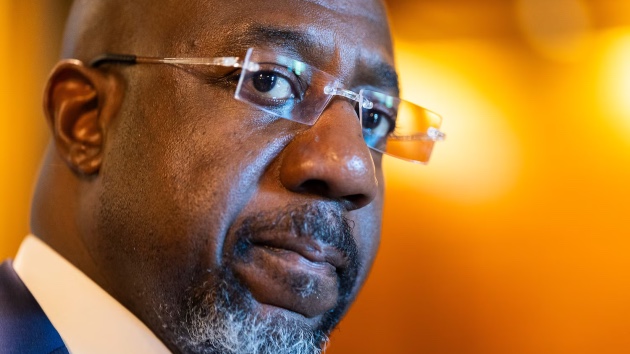
(WASHINGTON) — Senator Raphael Warnock, D-Ga, is calling for Democrats to investigate officials who he says have “manipulated their maps to silence the voices of Black voters,” as soon as they flip the House or Senate in the midterms.
In the plan, first reviewed by ABC News, Warnock said, “Here is what Democrats must do as soon as we regain power: investigate craven politicians, ban partisan gerrymandering, stop billionaires from buying our elections, expand our democracy and guarantee the right to vote for all Americans.”
Warnock has not ruled out a run for the White House in 2028. That possibility comes as roughly a third of the Congressional Black Caucus risks losing its seats before 2028, with GOP-led Southern legislatures redrawing maps after the Supreme Court’s Louisiana v. Callais ruling gutted Section 2 of the Voting Rights Act.
In Louisiana, where Black residents make up roughly one-third of the population, a federal court had found that a post-2020 congressional map with only one majority-Black district likely diluted Black voting power. The legislature responded by drawing a second majority-Black district as courts had required in similar circumstances.
Justice Samuel Alito, who authored the Supreme Court opinion, which said that states only violate the Voting Rights Act when “evidence supports a strong inference that the State intentionally drew its districts to afford minority voters less opportunity because of their race.”
Republicans have argued that they are redrawing congressional maps to comply with the Supreme Court or to remedy unfairly-drawn districts, and that the districts that could be changed may still elect Black representatives to Congress.
Calling for officials who he says have engaged in gerrymandering to decimate minority voices is a position Warnock hasn’t called for until now, and he said in a phone interview with ABC News that the Callais decision was an “inflection point” for him to do so.
“A Democratic majority in either chamber must immediately investigate these officials, including through Congressional hearings, document requests, depositions, testimony, and, if necessary, subpoenas,” Warnock’s plan states. “We must analyze their statements, actions, and contributions to determine if there is any evidence that they broke any laws in their race to gerrymander and silence Black voices.”
Asked whether Democrats who’ve engaged in partisan gerrymandering — in California, for example — should face investigation, Warnock said that the state’s redistricting came in direct response to President Donald Trump pushing Texas to gerrymander five seats.
“There’s a significant difference between that and an open process in which Californians got to vote,” Warnock said. “This was not done in a smoky, dark room. They had a referendum. Again, if I had my druthers, there would be no gerrymandering.”
“There are only 22 districts out of 435 in this country in which a Democrat or a Republican could win the seat. I’m a Democrat. I think that’s a sad state of affairs,” Warnock added.
Warnock said that he’s been pushing his party to prioritize voting rights since he was first elected. In 2021, during negotiations over the Bipartisan Infrastructure Law, Warnock urged then-President Joe Biden in a phone call that legislative action on voting rights should be prioritized alongside the package.
Warnock said he tried to convince former Democratic Sens. Joe Manchin and Kyrsten Sinema to amend the filibuster so the party could pass voting rights legislation four years ago, arguing voting rights mattered more than a procedural rule.
“I said to my caucus then, as the newcomer, that I was afraid that if we don’t do something … we would cross a Rubicon in this country that we wouldn’t be able to get back,” Warnock said. “I said that then, and sadly, it didn’t get done.”
Looking ahead, Warnock said if Democrats flip even just one chamber, the party should break up pieces of the John Lewis Voting Rights Advancement Act, and “force everybody to vote on it.”
Copyright © 2026, ABC Audio. All rights reserved.