
Dr. Céline Gounder: Lindsey Graham died of aorta disease. My husband did too.

▶ Watch Video: Sen. Lindsey Graham died of an aortic dissection, preliminary findings show

Senator Lindsey Graham died on Saturday, July 11th, at 71. The medical examiner’s preliminary finding was an aortic dissection, a tear in the wall of the aorta, the large artery that carries blood out of the heart. The final death certificate is still pending. Most of the coverage called it “sudden.” Aortic disease is usually silent until it tears or bursts.

What can go wrong in the aorta

The aorta is the body’s largest artery, running from the heart down through the chest and abdomen. Three different things can go wrong with it. They’re related but not the same, and they get confused all the time.

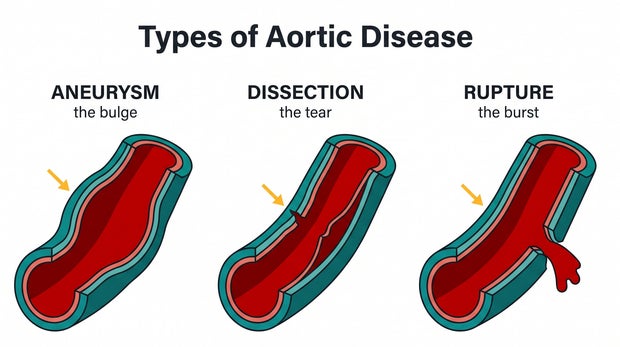
An aneurysm is a bulge. A weak spot in the aortic wall stretches and balloons outward. It happens slowly, over years, and usually causes no symptoms, which is why most aneurysms are found by accident on a scan done for something else. An aneurysm is defined by size. The wider it grows, the thinner and more fragile the wall gets, and the higher the odds that it will eventually fail.
aortic-disease.jpg

Illustration created with Gemini Nano Banana Pro / Dr. Céline Gounder

A dissection is a tear. Blood breaks through the inner lining and forces its way into the wall itself, splitting the layers apart and carving a false channel. This one is sudden and is a true emergency, usually announced by abrupt, tearing chest or back pain. It doesn’t require an aneurysm first. A dissection can strike an aorta that was never enlarged, which is part of why it gets missed.

A rupture is a burst. The wall gives way completely, and blood pulses out where it shouldn’t, into the chest or the sac around the heart. It’s the usually fatal ending that either an aneurysm or a dissection can lead to, and it can kill in minutes.
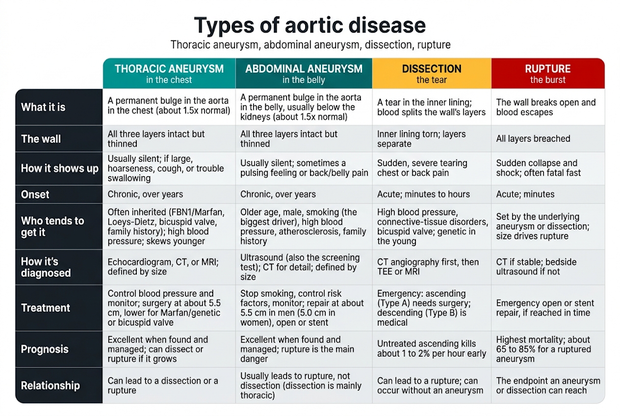
image.png

Table created with Gemini Nano Banana Pro / Dr. Céline Gounder

Bulge, tear, burst. One can set off another, but they aren’t the same. Dissection skews older, driven by high blood pressure and hardened arteries. An aneurysm in a younger person is more likely to be inherited, caused by a weakness in the connective tissue itself.

That difference is what separated Graham from my husband. Graham’s aorta, at 71, tore, a dissection along a wall stiffened by decades of what the medical examiner called arteriosclerotic cardiovascular disease. My husband Grant Wahl‘s bulged and burst, at an age when this disease usually means something inherited.

Graham’s kind is the common one, driven by age, blood pressure, and hardened arteries. For most people, it isn’t a reason to go hunting for an aneurysm. It’s a reason to treat your blood pressure and for emergency rooms to keep a tear in the aorta on their radar, because it still gets mistaken for a heart attack. There is one proven screening test in this whole area: a one-time ultrasound for men 65 to 75 who have ever smoked, which looks for abdominal aneurysms. Beyond that group, almost no one reading this needs a scan tomorrow.

The version that killed my husband is the other one, and it doesn’t play by those rules. It runs in families, it strikes decades earlier, and it usually gives no warning until the artery fails. A routine checkup won’t find it, and no population screening program looks for it. Most families learn they carry it the way mine did, after someone dies. None of this is a reason for everyone to panic. But if aortic disease runs in your family, it can be caught early, with imaging and sometimes genetic testing, long before it turns dangerous.

The aneurysm nobody saw

In December 2022, my husband, the soccer journalist Grant Wahl, collapsed in the press box while covering a World Cup quarterfinal in Qatar. He died that night. He was 49.

The aneurysm was in the first stretch of aorta just above his heart, 6.0 cm across, and when it ruptured it filled the sac around his heart with blood. The autopsy found the wall had been thinning from the inside for a long time, its elastic fibers fragmenting. There was almost no hardening of his arteries at all. His was a bulge that burst in a man under 50, without the decades of arterial wear that killed the senator.

Why I asked for an autopsy

I’m a physician, epidemiologist, and medical journalist. I investigate. I think in terms of mechanisms and evidence, and I don’t accept “he died suddenly” as a stopping point. So I asked the New York City medical examiner for a full autopsy. I wanted to know what had happened, and I wanted an explanation. Had I missed something? Could anything have been done to prevent it or treat it? Could whatever killed him be used to protect the rest of Grant’s family, or help other families? I needed to make sense of it. Grief leaves you turning every ordinary day over, looking for the sign you didn’t catch, and the autopsy gave me answers instead of that loop. It gave me closure. It was therapeutic.

It gave me facts I needed for an uglier reason, too. Within days of Grant’s death, people invested in vaccine disinformation claimed the COVID shot had killed him. The autopsy was unambiguous: he tested negative for the virus, and the report stated that his prior vaccination “neither caused nor contributed” to the rupture. I’ve written about that elsewhere, and I’ll leave it there.

What the autopsy found in his DNA

The New York City medical examiner’s office runs the only molecular genetics laboratory housed inside a medical examiner’s office in the country. It tests the DNA of people who die suddenly, reviewing about 500 cases a year and finding a genetic cause in roughly 100 of them. In Grant’s heart tissue, the lab found a variant in FBN1, the gene behind Marfan syndrome.

Grant did not have Marfan. He was tall, but he didn’t have the syndrome. What he had was a single change in a gene that helps build the connective tissue holding the aortic wall together, in a spot the labs classify as a “variant of uncertain significance.” We don’t know for certain that this variant caused his aneurysm. It’s the most likely explanation, and inherited connective tissue problems are well-established risk factors for ascending aortic aneurysms in people under 60.

Sorting out which of these variants actually cause disease is real, unfinished work. Dr. Dianna Milewicz’s group at UTHealth Houston has spent years mapping the genes behind thoracic aortic disease. Other teams are chasing the opposite question: why some people carry a Marfan mutation and never get sick, hunting “modifier” genes that seem to shield the aorta. Grant’s variant sits inside that uncertainty.

Turning a death into prevention

None of that uncertainty changed what came next. Once the lab identified the variant, Grant’s blood relatives could be tested for that exact change. My brother-in-law Eric, Grant’s brother, carries it. His uncle, a niece and a nephew, and other family members have been tested, too. Eric had echocardiograms as well as MRI and CT scans. His aorta is structurally normal. He now gets regular imaging, and if his aorta ever starts to enlarge, his doctors will see it coming, with years to act.

That’s what the autopsy did. It gave the people who share Grant’s DNA something they could act on.

The same disease killed the actor John Ritter. In 2003, at 54, he died of an aortic dissection that was mistaken for a heart attack. His widow, Amy Yasbeck, started the John Ritter Foundation for Aortic Health, which funds Milewicz’s research program and has enrolled more than 1,500 families. Eric now advocates with them. Twenty-three years after Ritter’s death, aortic dissection is still routinely missed in emergency rooms because it mimics a heart attack and most clinicians aren’t thinking about it.

But it’s not just for patients to advocate for themselves. Clinicians should consider a tear in the aorta before sending someone home, and geneticists can test families after a sudden death. The New York City medical examiner recently launched a program called GIFTS that offers free genetic testing to the living relatives of people who died of inherited conditions, the first time a medical examiner’s office has tested living patients. The lab’s director, Dr. Yingying Tang, told me the program was shaped by families like mine.

Should you get checked?

Two questions I get asked a lot:

What should prompt you to get screened? A first-degree relative, a parent, sibling, or child, with a thoracic aortic aneurysm or dissection, or a sudden unexplained death in the family, especially before 60. Physical features of a connective tissue disorder: being very tall with long limbs, a chest that caves in or juts out, severe nearsightedness, or a dislocated lens. The current cardiology guidelines recommend imaging the aorta in the first-degree relatives of anyone with thoracic aortic disease.

One more, and it has nothing to do with family history: men 65 to 75 who have ever smoked should get a one-time abdominal ultrasound to check for an abdominal aortic aneurysm. If that’s you, ask your doctor for it.

Who should get genetic testing? People with a thoracic aortic aneurysm or dissection who also have features of a connective tissue disease, a family history of aortic disease, or disease before 60. When a disease-causing variant turns up, the rest of the family can be tested for that exact variant. That’s how you find the Eric’s, the ones carrying the risk whose aortas are still normal.

And if an aneurysm is found? A known aneurysm is a manageable condition: blood pressure control, regular imaging, and surgery once it reaches a size threshold, around 5.5 cm for the ascending aorta and lower for people with genetic forms. Grant’s was 6.0 cm, well into repair territory. Nobody knew it was there.

I couldn’t have known. He had no symptoms, and nothing in his life would have pointed a doctor to his aorta. But a lot of families can know. If aortic disease has touched your blood relatives, ask your doctor about imaging and ask whether genetic testing makes sense for you.

This article was originally published in Dr. Céline Gounder’s “Underlying Conditions” newsletter on Substack. Read more and subscribe here.

AOC joins the growing number of women freezing their eggs. Here’s what to know

(CNN) — US Rep. Alexandria Ocasio-Cortez is freezing her eggs to “feel more in control of her life,” she announced on social media Saturday. The 36-year-old has not said whether she plans to have children but said she had been saving up for the process.Egg freezing, formally called oocyte preservation, is one of the clearest ways to extend a woman’s childbearing years. It involves extracting eggs from the ovaries and preserving them until the woman hopes to become pregnant.Elective egg freezing has become much more popular over the past decade as the technique has gotten better and more women have chosen to delay pregnancy. Ocasio-Cortez, a New York Democrat, joins media personality Kourtney Kardashian, actor Rebel Wilson and actor Florence Pugh, among others, in sharing plans to freeze eggs. Here’s what to know about the process.When to freezeEgg freezing is most effective in a woman’s 20s or early 30s, when she typically has more viable eggs.“The answer is typically, the younger the better,” said Dr. Pardis Hosseinzadeh, assistant professor of gynecology and obstetrics at Johns Hopkins Medicine. “Women who do this procedure before the age of 35 typically have better outcomes in terms of the quality and quantity of the eggs that are retrieved. Both the number of eggs and the quality of those eggs decline with age.”Unlike men, who produce new sperm every day, women are born with all the eggs they will ever have. Over time, the number and quality of her eggs decline.A female baby is typically born with about 1 million to 2 million eggs. That number drops by about 10,000 a month before puberty and by about 1,000 a month after puberty.Factors such as smoking and medication use can also affect that supply. By age 30, a woman has about 70,000 eggs left; by 40, about 18,000. After 40, about half are abnormal and unlikely to result in pregnancy. By menopause – which typically happens between the ages of 45 and 55 – the remaining eggs are not fertile.What happens with egg freezingA woman interested in freezing her eggs first has a physical exam to determine whether she is a good candidate. A doctor reviews her medical history, orders blood and hormone tests, and performs a transvaginal ultrasound to estimate egg supply. A poor candidate might be someone who has a low number of eggs, uncontrolled medical issues or a hormone-sensitive cancer.If she qualifies, a doctor prescribes hormones, based mostly on her age and egg reserve, Hosseinzadeh said. The patient injects them for up to two weeks to encourage the ovaries to produce as many healthy eggs as possible.They include follicle-stimulating drugs such as Gonal-F and Follistim, which help ovarian follicles – tiny fluid-filled sacs inside a woman’s overy that each hold one immature egg – grow. FSH and menotropin stimulate egg production in the follicles and prompt the ovaries to release eggs. GnRH antagonists block hormones in the pituitary gland to prevent the patient from ovulating early.Regular blood tests and ultrasounds track the patient’s progress to help signal when the eggs have matured. Then, 36 hours before the eggs are retrieved, the patient takes trigger medication such as Lupron, Ovidrel, Novarel or Pregnyl to initiate final egg maturation.A doctor retrieves the eggs through an ultrasound-guided outpatient procedure under general anesthesia. The procedure takes 10 to 30 minutes, and most women can return to work the next day, said Dr. Mindy Christianson, chief of the Reproductive Endocrinology and Infertility Practice at Cleveland Clinic Fertility Center.An embryologist checks whether the eggs are mature enough to be fertilized later. They then undergo vitrification, a rapid-freezing process that uses liquid nitrogen, and are stored until the patient is ready to use them.How long eggs lastBecause egg freezing is relatively new, it’s not clear exactly how long eggs can be stored, but it’s believed to be decades.Liquid nitrogen storage pauses cellular activity, so the egg should not degrade over time.Risks and side effectsFertility hormone injections can cause some discomfort, but side effects are usually mild. Some people have mood swings, headaches, nausea or hot flashes. Once the hormone shots stop, these symptoms typically go away.In extremely rare cases, hormone injections can trigger a condition called ovarian hyperstimulation syndrome. The ovaries may swell, and fluid can leak into the abdomen. Mild cases can be treated with rest, fluids and electrolytes. Severe cases may require hospitalization and fluid drainage.The cost of egg freezingSome high-profile tech companies, including Meta and Apple, have advertised egg freezing as an employee perk. but most insurance does not cover the cost unless there is a medical reason, such as ahead of cancer treatments that will damage or destroy a woman’s eggs. One 2024 survey of large-company employee benefit plans found that about 21% covered elective egg freezing.Even AOC said she had to save for the procedure because her insurance doesn’t cover it. Prices vary and can climb into the thousands of dollars.“Ballpark, I would say it is around $10,000 to $15,000,” said Dr. Jen Eaton, president of the Society for Assisted Reproductive Technology.Egg storage is typically billed separately and can cost up to about $1,000 a year, depending on the facility. Eaton advises checking local facilities for specific costs and remembering that those costs do not include in-vitro fertilization treatment if the patient later chooses to use the eggs.Why freeze eggsElective egg freezing can offer more flexibility and control over reproductive health. Surveys show that women freeze their eggs for many reasons; they might want to finish school, become more financially stable or advance their careers before having children.“Many times, they don’t have immediate plans to pursue fertility, but they do have this intense desire or dream to become a mother, and it’s something that is weighing on them as they are pursuing other things like career or education, of they haven’t found the right fit [in a relationship], and they don’t want this to be a reason to settle for a relationship that’s not right,” Hosseinzadeh said.A 2026 National Science Foundation survey found what researchers called a “mating gap.”In a commentary about the survey, Marcia Inhorn, a Yale University anthropologist and author of “Motherhood on Ice,” described it this way: “Highly educated, heterosexual, professional women want the three P’s of partnership, pregnancy and parenthood, but are missing the three E’s of eligible, educated and equal male partners. Thus, they turn to egg freezing to preserve and extend their fertility while waiting for a mate who may or may not materialize.”Growing interestEgg freezing has become much more common in the past decade, Eaton said. In 2024, there were more than 39,000 egg retrieval or freezing cycles in the United States, up from 6,090 in 2014.Christianson said she has seen an uptick in interest at her practice in Beachwood, Ohio. About 25% of the patients she sees are people interested in freezing their eggs.“We definitely see when celebrities freeze their eggs, and also when people’s friends start freezing eggs, more people come in, as well,” she said. “When they hear about others doing it, it validates their decision and interest.”People are also having children later, Christianson said, which has increased interest in egg freezing. The average woman with a college degree now has her first child after age 35, a shift from decades ago, when many had children in their 20s.Patients often worry that the process will be daunting, Hosseinzadeh said, but clinics offer support throughout.What happens when someone wants to use their eggsWhen a person wants to use her eggs, they are thawed and fertilized with sperm from a partner or a donor through IVF.So far, relatively few people who freeze their eggs have gone ahead with using them, a February study found. But study co-author Dr. Mabel Lee said more women are doing so as the procedure becomes more common.“Even anecdotally, in my practice, it has become more frequent to have people come in saying, ‘I have eggs frozen from back in the day, and I want to use them now,’ ” said Lee, a reproductive endocrinologist and infertility specialist at HRC Fertility.Elective egg freezing was considered experimental until about 2013, when freezing techniques improved. Earlier attempts often damaged eggs because ice crystals formed during freezing; flash-freezing helps avoid that problem.Managing expectationsDaily injections may sound intimidating or “scary,” Lee said, and it is an intensive two-week period, “but I feel like most of the time, the feedback that I get from patients who are going through this is, ‘oh, that was so much easier than I expected.’ ”Patients should remember that freezing eggs does not guarantee pregnancy, Eaton said.She appreciates that celebrity disclosures have raised awareness about the procedure, but she said they can also send the wrong message if they make egg freezing seem like a simple insurance policy against infertility.”I think increasing awareness around this is great. I would just caution people against thinking that it’s a guarantee. I think a lot of celebrities unfortunately convey it like it is, that now they don’t have to worry about their fertility anymore,” said Eaton, who is also chief of reproductive endocrinology and infertility and director of the Fertility Center at Brown University.Freezing may help preserve eggs, but a person’s uterus still ages, raising their risk of pregnancy complications.Hosseinzadeh said she typically tells patients to think of egg freezing as a kind of insurance plan. If they’re younger, they may not even need to use their frozen eggs, since they may be able to get pregnant the natural way when they’re ready. “On the other hand,” she said, “don’t wait too long.”The-CNN-Wire™ & © 2026 Cable News Network, Inc., a Warner Bros. Discovery Company. All rights reserved.
Read Next Story