
Secret Service urged Trump to depart Turkey on old Air Force One as a security precaution, sources say

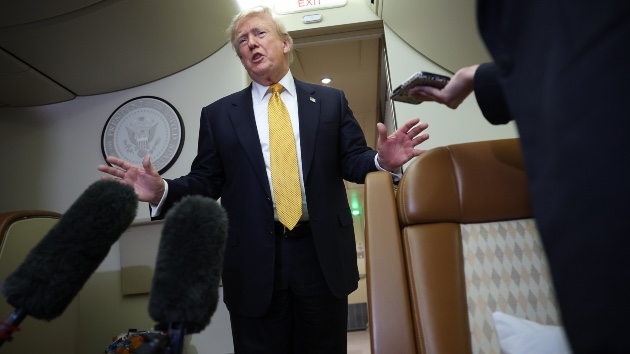
U.S. President Donald Trump speaks to members of the press for the first time aboard the new Air Force One while in flight from RAF Mildenhall AFB to Joint Base Andrews July 8, 2026 after leaving the United Kingdom. (Photo by Win McNamee/Getty Images)

(NEW YORK) — The Secret Service urged President Donald Trump to fly out of Turkey on the old Air Force One instead of the newly retrofitted Qatari-gifted plane out of an abundance of caution amid the escalation with Iran, multiple sources familiar with the plans told ABC News.

The Qatari-gifted plane left the NATO summit in Turkey earlier in the day for Mildenhall Air Force Base in England, a move Trump claimed Wednesday morning was for members of the military to tour the aircraft.

While Trump has said the change in plane had nothing to do with security concerns, he also reiterated, when asked by reporters if security concerns caused the change in flight plans, that he’s “No. 1 on the kill list for Iran.”

The change in plans was not prompted by a specific threat, but influenced in part by differences in the plane security capabilities, two U.S. officials told ABC News.

Mike Centrella, the Secret Service’s former head of field operations, said the law enforcement agency “simply doesn’t take chances when it comes to the president’s safety, whether at home or abroad.”

“Presidential travel is incredibly complex, and every movement and potential risk is carefully considered,” Centrella told ABC News. “The mindset is always the same: plan for what you know, prepare for what you don’t and make sure you’re ready for the unexpected.”

Steven Cheung, the White House communications director, told ABC News on Thursday that “the new Air Force One is a state-of-the-art aircraft that has been fitted with high-level security protocols that ensure the safety of the president and his staff. As the president has said recently, there are many enemies of America who have their sights on him, and we use every tool at our disposal — including distraction and misdirection — to address those threats.”

The New York Times first reported on the Secret Service recommendation.

When the president ultimately left Turkey in the old Air Force One to link up with the new plane in England, passengers on the aircraft were instructed to keep their windows down during the flight. According to flight data, the plane carrying the president did not turn on its tracker until it was over the Black Sea near Istanbul.

Despite continuing to insist there was no security issue that prompted him to change planes for his Turkey departure, Trump suggested that the passengers may have been asked to keep their window shades down because they were “probably on a dangerous flight.”

“Well, yeah, because you’re, you know, probably on a dangerous flight, because of the sleaze bags that we have to deal with,” Trump said, referring to Iran.

While the administration insists that the newly acquired plane meets the safety and security requirements necessary to fly the president, the speed of the retrofitting, which took about one year, has raised questions about whether the Qatari-gifted plane boasts the same defensive security measures as the old plane.

Many of the details of the retrofitting on the new plane are considered classified. The Air Force has said the new plane is “safe, secure and equipped with the most advanced technologies necessary to meet the requirements of the presidential mission. Those requirements were carefully crafted to prioritize mission over aesthetics, leaving much of the previous head of state interior layout minimally changed.”

On Tuesday, a group of Senate Democrats sent a letter to Air Force Secretary Troy Meink demanding transparency into the project from the Air Force and L3Harris, claiming the administration is ignoring national security concerns so in service of delivering Trump a “fancy plane for his personal enjoyment.”

Trump took his first trip in the newly retrofitted plane last week on a trip to North Dakota.

Before the first trip, the U.S. Air Force had been modifying the jet in Texas since September to meet the security, communications and other needs to transport the president. The Air Force had estimated it would cost less than $400 million to retrofit the gift.

The plane is to be used as the new Air Force One until shortly before Trump leaves office, at which time ownership of the plane will be transferred to the Donald J. Trump Presidential Library Foundation, sources familiar with the proposed arrangement have told ABC News.
 

Copyright © 2026, ABC Audio. All rights reserved.

The US Navy’s plan for almost 20 guided-missile subs and why that will matter around China

(CNN) — The US Navy this week announced a “pivotal shift” in its future submarine force, and it’s a move analysts say provides important insights into how Washington would fight any possible conflict in the Pacific, where China is rapidly building up its forces.The Pentagon announced that 19 planned nuclear-powered Virginia-class attack submarines (SSNs) would now be classified as guided-missile submarines (SSGNs) and fitted with the Virginia Payload Module (VPM), an 84-foot-long section which adds 28 missile-launch cells to the 12 on current versions of these subs.Those cells can be loaded with Tomahawk land-attack missiles as well as hypersonic vehicles. Combined with the stealthy abilities of submarines, this will provide the new boats with a crucial ability to get inside China’s missile defenses, analysts say.“Submarines are one of the few capabilities which can loiter forward, near or within the first island chain in relative safety,” said Sidharth Kaushal, senior fellow at the Royal United Services Institute (RUSI) in London, referring to the string of islands from Japan southward through Taiwan and the Philippines, inside of which Beijing can bring the most firepower to bear.“Second, hypersonic missiles represent a capability against which US adversaries – which otherwise enjoy robust air defenses – have more limited defenses,” Kaushal said. And getting the high-speed, maneuverable missiles closer to their targets strains adversary reaction time.Key strike platforms being retiredThe details of the new sub plan come at a critical time for the Navy.This year it is beginning to retire its four Ohio-class guided-missile subs. Those boats were converted to SSGNs 20 years ago from their nuclear deterrent role as ballistic-missile subs, or boomers, after the US and Russia reduced their nuclear forces with the 1993 START II treaty.Once armed with nuclear-tipped Trident ballistic missiles, the four reconfigured Ohio-class subs can carry up to 154 Tomahawks each, and have been prized assets for deterrence and combat missions around the globe.Speaking to CNN in 2021, Bradley Martin, a former Navy captain turned naval researcher at the RAND Corp think tank, called the Ohio-class SSGNs “the platform with the single largest ability to deliver conventional missile payloads.”During the 2025 Operation Midnight Hammer strikes on Iranian nuclear sites, an Ohio-class boat was called upon to augment B-2 bomber strikes.But one of the four Ohio-class SSGNs, the USS Georgia, began its deactivation process last month and the other three are scheduled to do the same over the next several years.Retirement of those boats will reduce the Navy’s undersea strike capability by up to 60%, according to the Washington, DC-based Submarine Industrial Base Council.The first of the Virginia-class SSGNs are not scheduled to join the fleet until 2029, so the Navy is likely to see a shrinkage in its missile strike capabilities in the meantime. The last of the new subs isn’t due to join the fleet until 2038.Current inventory includes at least 24 smaller versions of the Virginia class as well as around 20 older Los Angeles-class subs and three specialized Seawolf-class boats, so the Navy is not without conventional sub-launched missile capability.In the long run, leaders are confident the 19 new boats will prove suitable replacements for the Ohios.“These VPM-equipped SSGNs will ensure the Navy continues to dominate the undersea domain for decades to come. By integrating this additional payload capacity, we will have the ability to surge strike power to assure our allies, deter aggression, outmatch any adversary,” Vice Adm. Rob Gaucher, director of submarine programs, said in a statement.“Georgia and her sister ships proved the enduring value of combining undersea stealth with unmatched clandestine strike capability,” the chief of naval operations, Adm. Daryl Caudle, said.“The next generation of Virginia-class SSGNs builds on that legacy with greater survivability, adaptability, and sustained combat power,” Caudle added.Not a one-for-one swapAnalysts caution that the move from the Ohio class to the Virginia class is not a one-for-one trade, as a single Virginia-class sub will carry only about 26% of the missiles of an Ohio-class one. That means it will take four future boats to equal the firepower of one currently.Analyst Bryan Clark, a Hudson Institute senior fellow and former Navy officer, notes another key difference between the two – the Ohio class has two rotating crews while the Virgina class has only one, meaning the former could spend twice as long actually on patrol.But being able to disperse missiles over a greater number of platforms has its advantages, says Alessio Patalano, professor of war and strategy at King’s College, London.“They expand the number of platforms that can bring the fight deep into an enemy’s territory, and as such opponents will have to contend with more assets they have to track, or at least try to,” Patalano said.It’s a key point in any possible conflict over Taiwan, the democratically governed island that the Chinese Communist Party claims as sovereign territory despite never having controlled it.China has been in the midst of an aggressive submarine-building program in recent years.According to a February report from the International Institute for Strategic Studies, the PLA Navy ramped up its production of nuclear-powered submarines over the past five years to the point where it is launching subs faster than the US, threatening to negate a sea-power advantage that has long belonged to Washington.From 2021 to 2025, China’s submarine building surpassed that of the US in both numbers of subs launched – 10 to 7 – and tonnage – 79,000 to 55,500, says the report.In an attack sub configuration, that’s more hunters of US subs in regional waters.Beijing has been rapidly building its missile forces, too.In December 2024, the Pentagon estimated that China’s rocket force had boosted its missile supply by 50% in the preceding four years.The People’s Liberation Army wants “to set the conditions for the invasion of Taiwan,” Decker Eveleth, an associate research analyst at the non-profit national security group CNA and an expert on China’s missile forces, told CNN last year. “So that’s shooting at ports, shooting at helicopter bases, shooting at supply bases … shooting at anything that can theoretically let you bring support to Taiwan.”“They want to destroy things in theater and keep everything else out,” Eveleth said.This buildup comes at a time when the US military’s own munitions stockpiles have seen significant depletion since President Donald Trump’s decision to join Israel and bomb Iran.Close-in operationsAnalysts said the new Virginia-class subs help negate China’s missile advantage, especially in the early days of any conflict.US subs that can get inside that first island chain would be in prime position to take out radars and command posts that would be coordinating defenses and helping Chinese missile targeting, analysts said.That could “degrade an adversary’s anti-surface capabilities to a level sufficient to enable other platforms such as surface ships to be moved forward at less risk, thus setting the conditions for aircraft carriers to provide follow-on strikes,” RUSI’s Kaushal said.Hypersonic launch capabilities enhance the new Virginia class further, analysts said, noting that testing of a hypersonic glide vehicle is well underway.They help give the newest Virginia class “a genuine uplift in the strike function,” said Patalano at King’s College.“That’s what gives an adversary an extra moment of pause,” he said.What can’t be forgotten, however, is that China won’t be standing still.At a military parade in Beijing last fall, China showed off a dizzying amount of new missiles, including a range of hypersonic vehicles, that many analysts say put the PLA at the forefront of that technology.Also in the parade ranks were new uncrewed submersible vehicles – underwater drones, stealthy in their own right, that could pose a threat to any of Beijing’s adversaries.The realities of that are surely obvious to the US Navy. But its leadership retains confidence in an area where it has been unmatched since World War II.“Armed with state-of-the-art sensors, unmatched stealth, and advanced automation, these reclassified SSGNs will operate with impunity in contested waters, ensuring the United States Navy maintains absolute undersea supremacy,” a Navy statement said.The-CNN-Wire™ & © 2026 Cable News Network, Inc., a Warner Bros. Discovery Company. All rights reserved.
Read Next Story