
Russian Soyuz rocket launches fresh crew to space station

Physician-astronaut Anil Menon, a former flight surgeon with NASA and then SpaceX who rejoined NASA as an astronaut along with his wife Anna, rocketed into space Tuesday with two Russian cosmonauts for an eight-month stay aboard the International Space Station.

Soyuz MS-29/75S commander Pyotr Dubrov, flanked on his left by cosmonaut Anna Kikina and on the right by Menon, blasted off from the Baikonur Cosmodrome in Kazakhstan at 10:47 a.m. EDT. Eight minutes and 46 seconds later, the Soyuz was released to fly on its own, catching up with the station after just two orbits and moving in for docking at 1:52 p.m.
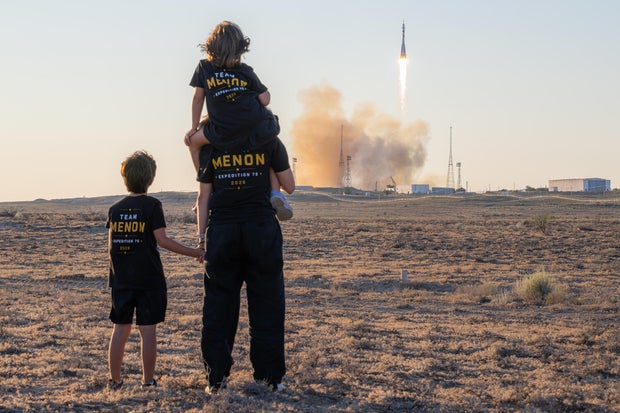
team-menon.jpg
NASA astronaut-in-training Anna Menon, married to fellow astronaut Anil Menon, watches with the couple’s two children as her husband blast soff from the Baikonur Cosmodrome in Kazakhstan for an eight-month visit to the International Space Station.

NASA/John Kraus

While Menon is a space rookie, he’s no stranger to space operations. He met his wife, Anna, while both were working for NASA at the Johnson Space Center in Houston, he as a flight surgeon and she as a biomedical engineer and flight controller. Both left NASA in 2018 and went to work for SpaceX.

Menon was the company’s first flight surgeon, helping establish astronaut medical protocols for commercial space flights. His wife worked as a senior engineer and was one of two SpaceX employees who flew to space in 2024 on a five-day Crew Dragon flight chartered by billionaire Jared Isaacman, now NASA’s administrator.

Menon left SpaceX and returned to NASA after applying and being selected to join the agency’s astronaut corps in 2021. Anna was selected to join the corps in 2025 and will be available for flight assignment after she completes two years of initial training.
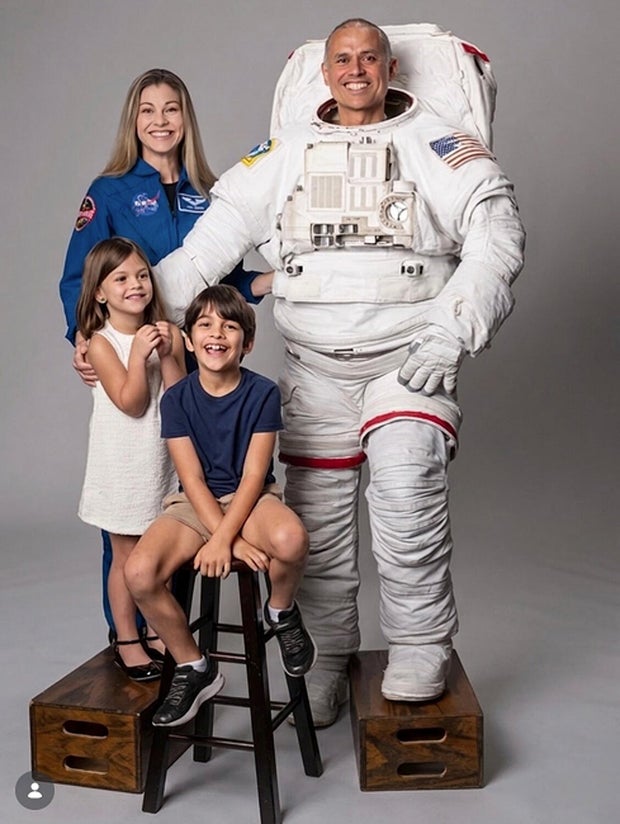
menon-family.jpg
NASA astronauts Anna and Anil Menon, posing with their two children.

NASA

Menon’s family flew to Kazakhstan to attend the Soyuz launch as did Isaacman, his first visit to the complex since taking the reigns at NASA.

“In terms of me and Anna, I would say there was a zero percent chance we thought this would happen, but it does go to show that if you keep working at something, you should never count yourself out,” Anil Menon said. 

“It also goes to show that if you’re interested in being a part of NASA, going to space, there’s a lot of different ways this could work out. There isn’t a set course. Sometimes … if you work hard and consistently over time, the results can be completely shocking. We’ve been absolutely shocked by this.”

Dubrov monitored the Soyuz spacecraft’s automated approach to the station, ready to take over manual control if needed. But the ship flew itself in for a picture-perfect docking at Russia’s Earth-facing Prichal module as the two spacecraft sailed 260 miles above the Mediterranean Sea.

Before the hatches were opened, Russian flight controllers radioed congratulations to the crew as did Isaacman.

“Congratulations, crew, on a impressive three-hour (rendezvous),” he radioed from Baikonur. “And to my friend Anil, how are you enjoying space flight?”

“Hello, it’s great to hear from you,” Menon replied. “An incredibly fast ride! I’m feeling great.”

“I know you all have a lot of work to do right now, so just passing on to you (that) all your friends here, your family, your nation are proud of you,” Isaacman said. “Godspeed and God bless on the expedition ahead.”

“Thank you very much for those kind words,” Menon said. “The station is a sight to behold and a monument to all the hard work we are able to do together and what we’re able to achieve when we do it.

crew-at-pad.jpg
The crew pauses for a traditional farewell wave to support crews before boarding their Soyuz rocket for launch. Top to bottom: Anna Kikina, NASA astronaut Anil Menon and commander Pyotr Dubrov.

NASA/Bill Ingalls

After post-docking leak checks were complete, the new crew members were welcomed aboard the ISS by Soyuz MS-28/74S commander Sergey Kud-Sverchkov, Andrey Mikaev and NASA astronaut Chris Williams, along with crew 12 commander Jessica Meir, pilot Jack Hathaway, European Space Agency astronaut Sophie Adenot and cosmonaut Andrey Fedyaev.

They gathered in the Russian Zvezda module for a brief welcome aboard ceremony with flight controllers, managers and friends back on Earth.

“It’s a great tradition when the arriving crew is welcomed by the smiley faces of our crewmates,” Dubrov said through an interpreter. “We passed a lot of time together during our training, and now we are here all together on the station. And also, those traditional hugs. It’s so amazing, it’s very warm and comes from the heart.”

Menon, Dubrov and Kikina are replacing the Soyuz MS-28/74S crew, who were launched to the space station last November. NASA plans to launch a replacement crew for Meir and her crewmates in September.
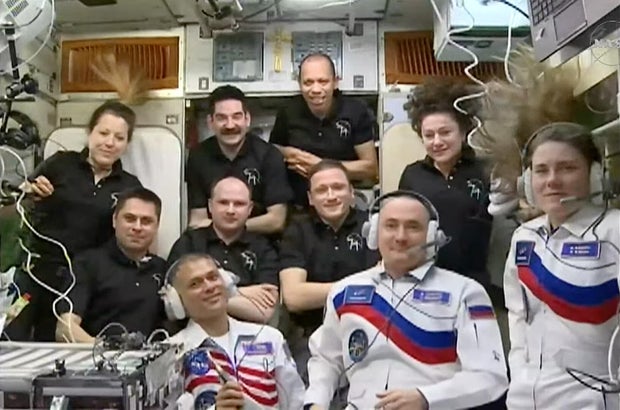
071426-iss-crew.jpg
The combined 10-member ISS crew during a brief welcome aboard ceremony for newly arrived crewmates (in white, left to right): NASA astronaut Anil Menon, Soyuz MS-29/75S commander Pyotr Dubrov and cosmonaut Anna Kikina.

NASA TV

The fresh Soyuz crew is expected to remain aboard the station for about 260 days, returning to Earth next April. With a few exceptions, station flights have typically lasted for five to six months, but the Russians are now extending visits to eight months to reduce the amount of cargo that has to be shipped up.

In an interview with CBS News, Menon said staying at home with the kids while his wife flew in space was more difficult than he expected. Now that their roles are reversed, both are gaining a better understanding of the challenges faced by both.

“When we talk about what it was like for her to launch and me to be on the ground, I think that was the harder job, and I found it really stressful,” he said. “I was worried about her and the kids, and there were certain challenges related to that.

“I’m able to share that perspective with her, so I’m like, hey, heads up, like it’s going to be a lot easier for me to do this launch.”

For her part, he added, “she’s got insight into what that’s like (to fly in space) and what the launch might be like, and how to make it meaningful. … We’ve talked a lot about that. I think, like, either side of this, my side and her side, hopefully we’re better off, and we understand each other a bit better.”
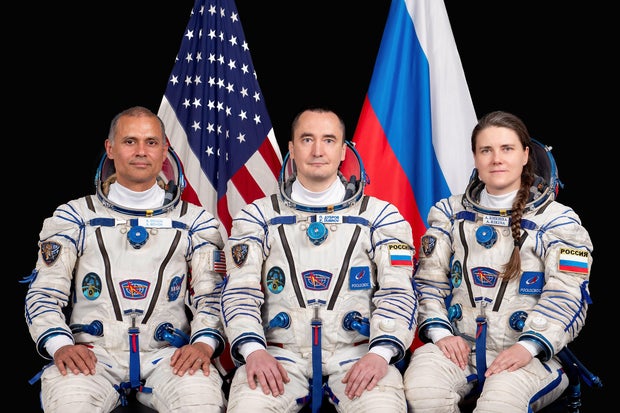
crew-portrait.jpg
The Soyuz MS-29/75S crew poses for an official portrait. Left to right: NASA astronaut Anil Menon, Soyuz commander Pyotr Dubrov and cosmonaut Anna Kikina.

NASA/Roscosmos

Menon is part of the Soyuz crew under an agreement between NASA and Roscosmos, the Russian federal space agency, that calls for at least one NASA astronaut to launch aboard each Soyuz and one cosmonaut to go up aboard each SpaceX Crew Dragon.

The agreement ensures at least one American and at least one Russian are always aboard the station to operate their respective systems in case a Soyuz or Dragon has to depart early because of a medical emergency or some other major problem.

Menon said he was lucky to be flying with space veterans like Dubrov and Kikina. He described his Soyuz commander as “kind of on the quieter side, really intellectual, really sharp.”

“He speaks incredibly good English, and he’s into Rubik’s cubes and esoteric science fiction. He’s read the Foundation series (by) Isaac Asimov, and Murderbot before the TV shows made those things popular. We really hit it off, because I love science fiction, too, and that’s super cool.”

As for Kikina, who first flew to space aboard a Crew Dragon in 2022, Menon described her as “100 percent full on energy, and really adds a lot to our team because me and Pyotr are a bit more quiet, and so it’s really cool to have her just like keep the engine running and moving us along.

“And she’s an athlete, like a rafter boater, she was on the Russian version of American Gladiator — it’s called Titan — and won that easily. And so it’s a cool crew, an interesting, fun crew to be a part of as well. They’ve also flown to space, so I got a lot to learn and pick up from them, and it’s a good spot to be in.”

Lindsay Clancy pidió varias veces cambiar su medicación, declara la enfermera psiquiátrica que la trataba

Una enfermera especializada en psiquiatría que trató a Lindsay Clancy declaró este martes que la madre de Massachusetts pidió repetidamente cambiar sus medicamentos, pese a las preocupaciones sobre su apego al plan de tratamiento.Rebecca Jollotta, enfermera especializada en psiquiatría del programa de salud conductual perinatal del Hospital South Shore, tuvo una consulta virtual con Clancy a finales de noviembre de 2022 y ambas acordaron un tratamiento para su ansiedad y su insomnio.Sin embargo, Clancy envió mensajes durante los días siguientes en los que pedía modificar los medicamentos y decía que le estaban provocando pensamientos intrusivos, insomnio e insensibilidad emocional, declaró Jollotta. Clancy también escribió que le preocupaba volverse dependiente del Ativan, una benzodiazepina.“Es un momento muy aterrador y estresante para mí, y comenzar nuevos medicamentos con efectos secundarios me da mucho miedo”, escribió Clancy en una de las notas.Jollotta respondió que entendía sus preocupaciones, pero le explicó que el medicamento tardaba varias semanas en hacer efecto y le dijo a Clancy que creía que sus problemas se debían más probablemente a una depresión posparto que a efectos secundarios de los medicamentos.“Todo esto parece una depresión posparto”, escribió Jollotta.El testimonio se produce tres semanas después del inicio del juicio de Clancy por tres cargos de asesinato por la muerte de sus hijos Cora, de 5 años; Dawson, de 3 años; y Callan, de 8 meses. El juicio ha incluido testimonios sobre lo ocurrido antes de las muertes y sobre las dificultades de Clancy con la ansiedad, la depresión y el insomnio posparto, y ha generado una conversación a nivel nacional sobre estos problemas.Los fiscales han argumentado que Clancy “actuó de manera intencional, racional y rápida” cuando estranguló mortalmente a sus tres hijos e intentó suicidarse en su casa de Duxbury el 24 de enero de 2023.Sus abogados defensores han planteado lo que se conoce como la “defensa por demencia”, al sostener que no es penalmente responsable porque se encontraba en medio de un episodio psicótico derivado de una enfermedad mental posparto.Familiares, amigos y profesionales de la salud mental han dicho que Clancy no mostró signos de psicosis antes ni después de las muertes y que no creían que representara un peligro para sí misma o para sus hijos. Sin embargo, quienes la conocían dijeron unánimemente que era una madre afectuosa cuya salud mental se estaba deteriorando. Una amiga declaró que Clancy le dijo en enero de 2023 que un medicamento le había provocado “algunos pensamientos oscuros”.El testimonio comenzó hace dos semanas con los argumentos iniciales y el emotivo relato de su esposo, Patrick Clancy. El testimonio de la semana pasada se centró en el estado de salud mental de Clancy antes y después de las muertes, las lesiones físicas que sufrió durante su intento de suicidio y las preocupaciones de sus amigos y familiares.El martes también se cumple el cumpleaños número 36 de Clancy.Se espera que el juicio dure entre seis y ocho semanas. Clancy enfrenta cadena perpetua si es declarada culpable de asesinato. Se encuentra recluida en el Hospital Público Tewksbury, en Massachusetts, especializado en el tratamiento de personas con enfermedades mentales.Jollotta dijo que uno de los principales objetivos de su plan de tratamiento era lograr que Clancy pudiera dormir toda la noche.Durante una consulta presencial el 6 de diciembre, Clancy dijo que sus problemas de insomnio comenzaron después de tomar Zoloft, que la mantuvo despierta durante 48 horas seguidas. Jollotta describió esto como una reacción “inusual” al medicamento y dijo que sugería que Clancy podría tener un trastorno bipolar subyacente.Jollotta estaba preocupada de que Clancy se encontrara en un estado maníaco o hipomaníaco mixto, es decir, una combinación de síntomas de manía, como la falta de sueño, junto con depresión. Para la semana siguiente, Clancy había vuelto a dormir con normalidad, pero aún se sentía desesperanzada e insensible emocionalmente, declaró Jollotta.El 15 de diciembre, Clancy informó que tenía pensamientos intrusivos y persistentes de suicidio y acudió a la sala de emergencias del Hospital General de Massachusetts, declaró Jollotta. Clancy también acudió al Hospital Women & Infants de Rhode Island para recibir tratamiento, pero fue dada de alta.El último contacto de Jollotta con Clancy fue el 21 de diciembre de 2022.El lunes, el abogado defensor de Clancy, Kevin Reddington, interrogó de manera incisiva a la Dra. Jennifer Tufts, la psiquiatra principal de Clancy, sobre su plan de tratamiento y su experiencia profesional.Tufts atendió a Clancy 14 veces entre septiembre de 2022 y enero de 2023 y ajustó repetidamente sus recetas mientras Clancy lidiaba con ansiedad, depresión e insomnio. También le brindó apoyo mediante terapia.“La escuché, escuché sus preocupaciones, le brindé apoyo e intenté darle esperanza de que las cosas mejorarían”, dijo Tufts.Reddington cuestionó las credenciales y la experiencia de Tufts, su uso de la telemedicina, las numerosas recetas que extendió y sus notas. Interrumpió repetidamente sus respuestas con preguntas de seguimiento, lo que provocó objeciones de la Fiscalía y llamados de atención del juez.“Si le hago una pregunta, respetuosamente, ¿puede simplemente no divagar? Responda sí o no, eso es todo”, dijo Reddington.“A veces es imposible hacerlo”, respondió Tufts.Tufts terminó su residencia en agosto de 2022 y atendió a Clancy por primera vez un mes después. Declaró que había tratado al menos a 50 personas con problemas posparto durante su residencia.Las 14 consultas entre Tufts y Clancy se realizaron por telemedicina, y este juicio es la primera vez que ambas han estado en la misma habitación, declaró Tufts. Reddington cuestionó su uso de la telemedicina y señaló que ni siquiera podía darle un abrazo a Clancy a través de la computadora.“No podía darle un abrazo, pero eso no es algo que los psiquiatras hagan habitualmente con sus pacientes”, respondió Tufts.Tufts dijo que se basó casi exclusivamente en las propias declaraciones de Clancy para evaluar su salud mental. No habló con los padres de Clancy y solo conversó con su esposo durante una sesión en diciembre de 2022.El lunes por la tarde, Julie Paul, una enfermera especializada en psiquiatría, declaró que en noviembre de 2022 Clancy tenía ansiedad, se sentía abrumada y tenía pensamientos acelerados, condiciones que son “muy habituales” entre las pacientes en el período posparto.Paul le recetó Prozac a Clancy y le explicó que el medicamento tardaría algún tiempo en mostrar beneficios, pero días después Clancy dijo que quería cambiar a otro medicamento.Esta historia fue actualizada con información adicional.The-CNN-Wire™ & © 2026 Cable News Network, Inc., a Warner Bros. Discovery Company. All rights reserved.
Read Next Story