(LONDON) — A large Russian drone and missile strike on Kyiv killed at least 18 people and injured dozens in the Ukrainian capital and surrounding region overnight, local officials said, with Ukrainian President Volodymyr Zelenskyy again appealing to foreign partners to ramp up the delivery of key anti-missile ammunition.
The Ukrainian air force said in posts to Telegram that Russia launched 68 missiles — among them 23 ballistic missiles — and 351 drones into the country overnight.
The air force said that 37 missiles and 326 drones were shot down or otherwise suppressed, with impacts of 29 missiles and 18 drones reported across 34 locations.
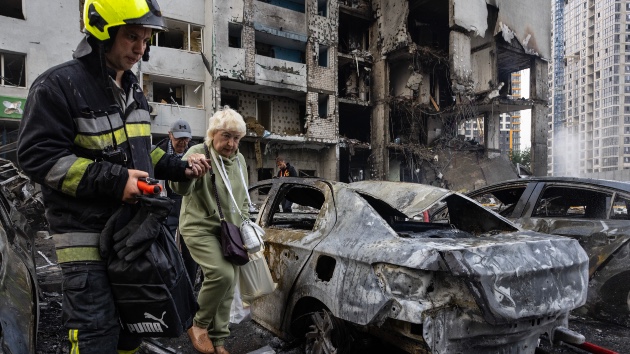
The capital bore the brunt of Russia’s latest overnight strike, officials said. Kyiv Mayor Vitali Klitschko said in posts to Telegram that at least 12 people were killed and 46 people were injured, of which at least 26 were hospitalized.
A further six people were killed and 26 people injured across the wider Kyiv region, according to regional governor Mykola Kalashnyk.
Klitschko reported damage in the Obolonskyi, Holosiivskyi, Podilskyi and Darnytskyi districts of the capital. In Podilskyi and Darnytskyi, the mayor said that rescue teams were searching for additional victims under the rubble of destroyed residential buildings.
Zelenskyy said in posts to social media that Ukrainian forces defending against the “massive Russian attack” intercepted many drones and cruise missiles, but not the more advanced ballistic weapons.
“The reason for this is precisely the insufficient supply of interceptor missiles. It is very important that the world, especially America and our European partners, come out of the NATO summit in Ankara with strong decisions to support our defense of the sky, and hence, the protection of ordinary people’s lives,” Zelenskyy wrote.
“As long as the missiles for the Patriots remain in the warehouses of allies, this only encourages Russia to continue destroying residential buildings,” the Ukrainian president added, referring to the American-made Patriot surface-to-air missile system which Kyiv often uses to intercept Russian missiles.
“The U.S. and Europe have enough power to stop this terror,” he added.
Russia’s Defense Ministry, meanwhile, described the overnight attack in a post to Telegram as “a massive strike with high-precision long-range weapons of land, air and sea-based systems, as well as with strike drones.”
The ministry claimed to have targeted military-industrial and energy facilities in Kyiv, plus military airfield infrastructure.
The Defense Ministry also reported that its forces intercepted at least 625 Ukrainian drones overnight and into Monday.
Moscow was among the targets of the latest wave of Ukrainian long-range attacks, the city’s Mayor Sergey Sobyanin said in posts to Telegram. The mayor said that at least 15 Ukrainian drones were shot down en route to the capital since midnight on Sunday.
ABC News’ Natalia Popova, Natalia Kushnir and Tanya Stukalova contributed to this report.
Copyright © 2026, ABC Audio. All rights reserved.