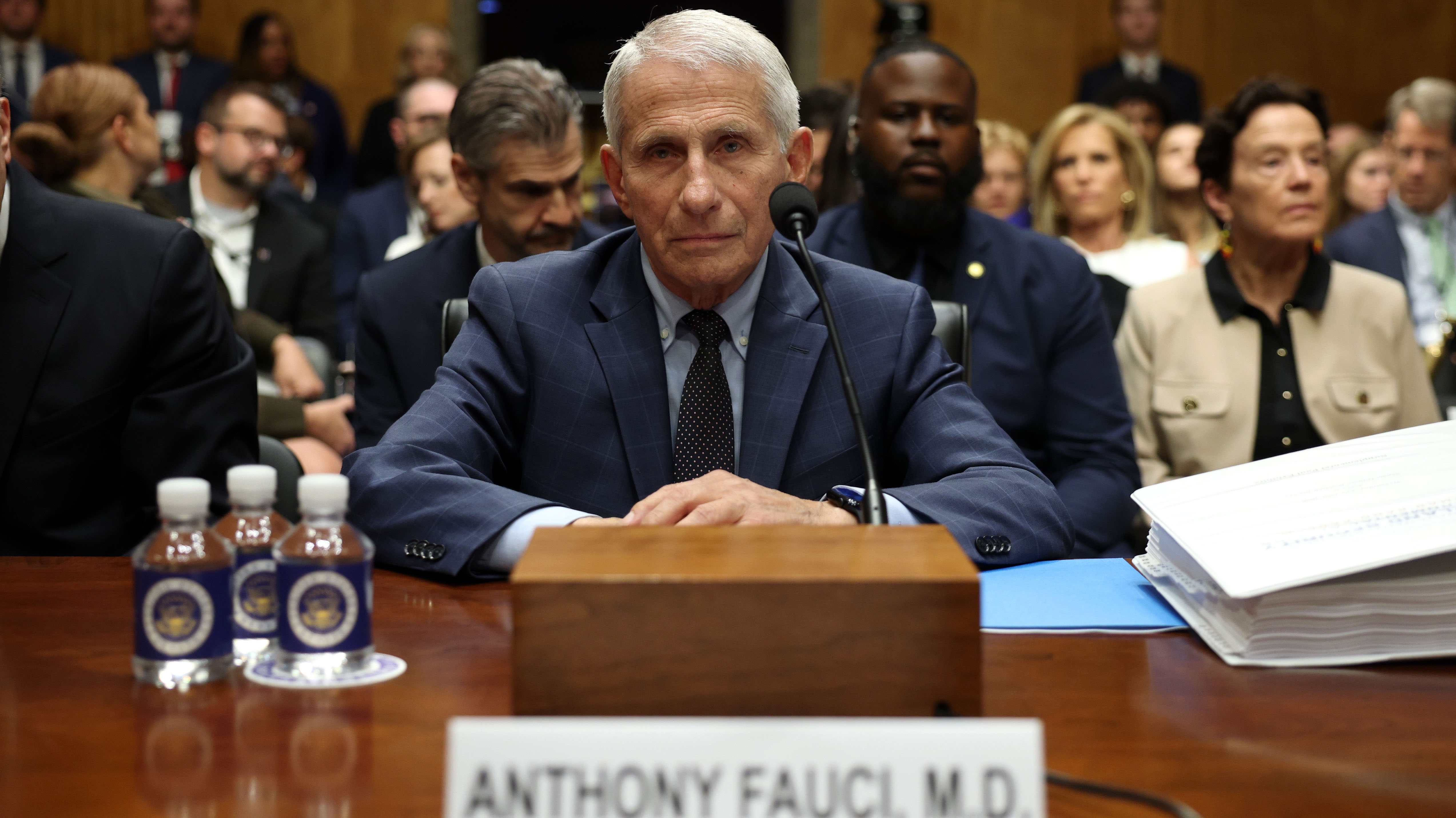
(WASHINGTON) — Republican senators vowed to vote next week on holding Dr. Anthony Fauci in contempt of Congress after he declined to answer a barrage of questions at a hearing Wednesday about his role in handling the COVID-19 pandemic.
Fauci, the former director of the National Institute of Allergy and Infectious Diseases (NIAID), repeatedly invoked the Fifth Amendment during the hearing before the Senate’s Homeland Security and Governmental Affairs Committee (HSGAC).
Sen. Rand Paul, R-Ky., the committee chairman who has led investigations into Fauci, said after the hearing that he wanted courts to assess whether Fauci could plead the Fifth Amendment given he was pre-emptively pardoned by President Joe Biden out of fear of political prosecution.
Paul has long accused Fauci of deceiving Americans about the origins of the COVID-19 pandemic.
Fauci said in his opening statement that he would refrain from answering questions under the advice of his attorneys. “It pains me to do so because of the respect that I have for the legislative branch of government and my decades-long record of cooperating with Congress,” he said.
Fauci said he testified before or briefed congressional committees over 200 times in his 38 years as director of the National Institute of Allergy and Infectious Diseases.
“Given Sen. Paul’s obvious obsession with calling for my prosecution, his repeated slanderous comments about me, and recently his publicly releasing my unredacted personal diary aimed at embarrassing and intimidating me, the only conclusion I can reach is that the sole reason he is calling me before this Committee is to get me to say something, anything that could vindicate his repeated public pledges that I end up, in his words, ‘behind bars,'” Fauci said.
Paul focused his questioning on Fauci’s personal journal entries between December 2019 and December 2022, as well as the origins of COVID-19, but Fauci declined to answer the questions.
Over the weekend, Paul released a tranche of Fauci’s journal entries — a more than 1,100-page document — revealing his inner thoughts about the origins of COVID, a detailed log of events within the White House situation and press briefing rooms, and his myriad media appearances about the response to COVID-19 and other health outbreaks.
One of Fauci’s attorneys, David Schertler, who was sitting next to him, attempted to speak several times after Paul’s questioning was over, but the senator shut him down, saying the attorney wasn’t recognized.
“You were told not to sit at the table, you insist on sitting at the table, and we told you you would not be recognized,” Paul said to the attorney. “You are not invited here for testimony, sir. … Would you behave this way in a courtroom? No, ’cause the judge would put you in jail. I can’t do that today, but I can have you escorted from the premises.”
After about another minute, Paul called for security and Capitol Police had Schertler escorted from the room.
Republicans on the committee hammered Fauci over entries in his journal that they claim show he contradicted himself and sought personal fame.
Sen. Ron Johnson, R-Wis., sounding incredulous, said that Fauci lied to his own diary when Fauci wrote that he was never shown a March 2020 re-opening plan sent to governors by President Donald Trump.
“So I’m just simply asking you: Is that true? Did you literally lie to your own diary? Did you know of that letter sent out to governors about reopening county by county?” Johnson said.
Fauci again invoked his Fifth Amendment rights.
Other Republican senators, including James Lankford of Oklahoma, asked Fauci about the theory that the COVID-19 virus originated in a laboratory, but the doctor declined to answer questions.
In a December 2024 letter to the staff director for the House Select Subcommittee on the Coronavirus Pandemic, Schertler said Fauci has never characterized the lab-leak theory as a conspiracy theory but that the discussion around the lab-leak theory has been “rife” with conspiracy theories.
Democrats on the committee defended Fauci’s right to plead the Fifth and thanked him for his years of service. They used their time to condemn the hearing as a fishing expedition — and one that distracted the committee from more pressing public health concerns like the current U.S. measles outbreak and affordable health care.
“That’s what I wish we were trying to address in a bipartisan way,” Sen. Maggie Hassan, D-N.H., said. “But instead we are here in an attempt to entrap you, because you had a distinguished career trying to put Americans’ public health first.”
Ranking member Sen. Gary Peters, D-Mich., decried the hearing as counterproductive, saying the attacks on Fauci would deter others from engaging in the work necessary to protect from public health crises.
“I think today’s hearing, unfortunately, does real damage,” Peters said. “It’s tempting to turn one person into the scapegoat for a crisis that hundreds of officials across both the Trump and the Biden administration were responsible for handling.”
Sen. Richard Blumenthal, D-Conn., referred to the pandemic as some of the “darkest days or times in our history” and said Republicans were attempting to “rebrand” Fauci as a “villain.”
“Dr. Fauci is just one part of this larger campaign against science and facts — a campaign that has made Americans less safe,” Blumenthal said. “It is shameful that a dedicated public servant like Dr. Fauci has experienced persistent threats to his life since the pandemic because of the lies that are told about him.”
ABC News’ Sony Salzman contributed to this report.
Copyright © 2026, ABC Audio. All rights reserved.