
Prince Harry loses long legal battle against U.K. tabloid publisher

▶ Watch Video: Why Prince Harry isn’t staying at Buckingham Palace during U.K. visit

London — Britain’s Prince Harry has lost his long-running legal battle against the publisher of the Daily Mail and Mail on Sunday tabloid newspapers, according to court documents seen by CBS News on Tuesday. All claims were thrown out by the court in what is widely expected to be the last of the prince’s courtroom battles against British media outlets.

Harry, the Duke of Sussex, was among several claimants in the case — along with pop star Elton John and actor Elizabeth Hurley — who accused the publisher of the popular tabloids, Associated Newspapers (ANL), of unlawfully gathering information about them through methods such as phone tapping, intercepting voicemails and impersonating people to obtain personal information.
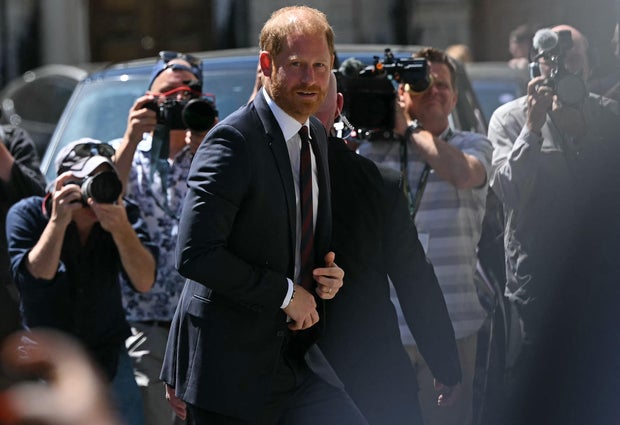
TOPSHOT-BRITAIN-ROYALS-INVICTUS GAMES
Britain’s Prince Harry, Duke of Sussex, arrives at Chatham House in London, England, July 7, 2026.

JUSTIN TALLIS/AFP/Getty

In its ruling on Tuesday, the U.K. High Court dismissed the claims, saying they could not be proven.

Lawyers for Harry and the other claimants said the alleged acts took place between 1993 and 2011, but that the behavior continued into 2018.

ANL had previously denied wrongdoing by its journalists, calling the allegations “preposterous” and saying the 50 or so articles cited in the lawsuit were all based on information gathered lawfully through people close to the claimants. ANL had argued for the case to be thrown out because of the amount of time that had passed since the alleged transgressions.

At the beginning of the lawsuit in January, Harry said press snooping had made him “paranoid beyond belief.” 

Last year, the publisher of The Sun newspaper paid the duke “substantial damages” in an out-of-court settlement and profusely apologized for the methods it had used.

In 2023, Harry won 15 of 33 claims of phone hacking in a lawsuit against Mirror Group Newspapers. The judge awarded Harry around $180,000 in damages, and the following year the publisher paid him a further $370,000 to settle his other claims against the group.

Tuesday’s ruling came during a rare visit by Harry to the U.K., after intense speculation about whether he would bring his wife Meghan and their two children, Archie and Lilibet, who did not end up traveling with him. The prince engaged in a public back-and-forth with Buckingham Palace over where he stays in his home country and the level of security that would be afforded to him and his family, if they were to join him on British soil.

Harry has long blamed the news media for the death of his mother Princess Diana, who died in a car crash in a Paris tunnel in 1997 while being chased by press photographers.

He has also cited media attacks on Meghan as one of the main reasons behind their decision to abandon their roles as senior, working members of the royal family and move to the U.S. in 2020.

Trump needs to get tough on China to get tough on Iran’s economy. He’s been reluctant to do that

(CNN) — The Trump administration appears to have landed on a fallback strategy in the Iran war after military strikes and negotiations failed to deliver victory: threats of harsh economic sanctions.Treasury Secretary Scott Bessent has called them the “toughest sanctions in history,” which will “collapse this regime.” He’s even called it an “economic D-Day” for Iran, comparing it to the historic invasion of Nazi-occupied France during World War II.There’s just one problem: Making good on those tough words requires not just getting tough on Iran, but also getting tough on China, which is Tehran’s No. 1 trading partner.And Trump and his administration have proved quite reluctant to do that.When Bessent rolled out the economic strategy Monday, he didn’t name specific countries that would be punished — or lay out timelines — if they don’t cut ties. And the announcement notably did not include secondary sanctions on the large Chinese banks that facilitate Beijing’s purchases from Iran.China buys as much as 90% of Iran’s oil. Economic analysts have told CNN that targeting these banks and Chinese companies would be crucial to exacting a major toll on Iran’s economy.But not for the first time in recent days, Bessent punted on exactly what would be done on that front. He suggested messages were being sent — saying “no one is above the reach of US sanctions” — but didn’t detail what will happen with China.“If they facilitate transactions and are part of the ecosystem that turns Iranian oil into money, into repression, they will be targeted,” Bessent said. “We find that the best way to engage with countries is through quiet diplomacy.”He added: “So when the hammer of US Treasury actions falls upon them, they will have no one to blame but themselves.”But you could be forgiven for thinking this might be lots of sound and fury signifying relatively little.That’s because not only has the administration regularly backed off the threats it’s made in the Iran war, but it has a track record of treading gently around China, whose leader, Xi Jinping, is set to visit the White House next month.While Trump has made a big show about getting tough on China over the years, he backed off his trade war with Beijing in October, agreeing to a one-year truce. That followed shortly after Beijing upped its leverage by restricting access to critical rare-earth minerals and halting purchases of American soybeans.Trump last year also ignored federal law to help save the Chinese-owned video app TikTok, despite his first administration having labeled it a grave national security threat because of its ability to spy on Americans.Fast forward to Trump’s visit to China in May, and rather than pressing Xi publicly on a potential invasion of Taiwan, Trump made some major Taiwan-related rhetorical concessions.He also backed off his previous promises to get China to free Jimmy Lai, a former Hong Kong media tycoon who criticized the Chinese Community Party, as well as to ban Beijing from buying American farmland and to “aggressively” revoke Chinese student visas.By July, Trump delivered a primetime address in which he claimed China effectively interfered in the 2020 US election (which is not what the evidence actually showed). But rather than punish China for this seemingly major purported provocation, Trump downplayed the need for retaliation.The president seemed to prefer to use China to try to substantiate his still-baseless claims of stolen elections, without going to the trouble of holding the alleged thief accountable.And even in the context of the Iran war, Trump has been gentle with China.He has repeatedly shrugged off the idea that Beijing is helping Iran. And on his way back from China in May, he said he was considering lifting sanctions on Chinese companies that buy Iranian oil.Trump at the time was trying to secure a deal with Iran. But it’s telling that he’s been willing to telegraph potential carrots involving China, even as his administration is reluctant to publicly threaten to use the stick against it. In the latter case, it prefers “quiet diplomacy.”Also telling would seem to be Bessent’s comments Monday when CNN asked why the major secondary sanctions he previewed didn’t start immediately.“Well, we are giving everyone the opportunity to remedy bad behavior,” he said. “Why would I want to blow up the global financial system?”The administration appears well aware that getting tough on Iran would entail going after China — a risk that it might decide isn’t worth it.There’s an argument to be made that these topics are best addressed next month, during Xi’s state visit to Washington.But such pomp and circumstance can drain Trump of his resolve to get tough (as seen during his May visit to China) — and that’s if he even wants to get tough on China right now.The-CNN-Wire™ & © 2026 Cable News Network, Inc., a Warner Bros. Discovery Company. All rights reserved.
Read Next Story