
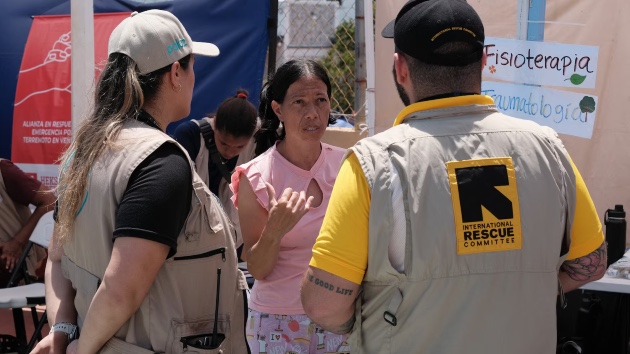
(NEW YORK) — As Venezuela continues to recover from powerful twin earthquakes that rocked the north-central part of the country in late June, humanitarian organizations are warning of a “dire” situation on the ground.
The earthquakes, which officials say killed more than 4,400 people and injured more than 16,000, have displaced thousands of Venezuelans.
Aid workers told ABC News that countless people are in need of psychosocial support, in addition to those recovering from earthquake injuries.
Many Venezuelans are also suffering from chronic conditions — such as diabetes and hypertension — and are struggling to get care in the aftermath of the natural disaster.
Additionally, there has been a rise in reports of skin conditions and gastrointestinal diseases due to a lack of clean water and poor sanitation conditions, the workers said.
“The situation on the ground is pretty dire in terms of humanitarian needs,” Aisha Majid, a media manager at the international NGO Save the Children who is currently based in Caracas, told ABC News. “I’ve been here for a week, and there are thousands of families who are displaced on the streets.”
Mobile clinics treating wide range of conditions
Aid workers told ABC News that hospitals in Venezuela are currently overwhelmed treating people injured by the earthquakes, adding that some of the backlog predates the earthquakes.
“There are thousands of patients seeking help, and there aren’t enough doctors or hospitals or primary healthcare facilities,” Claudia Manresa, a regional compliance legal manager for the humanitarian organization Project HOPE in Latin America who is based in Venezuela, told ABC News. “There also aren’t enough medications, so this crisis joins a system that was already overwhelmed.”
Mobile clinics have been helping to fill some of the gaps. Manresa said Project HOPE has two mobile medical units running every day and, as of July 9, they have treated about 2,000 patients.
Save the Children is running a mobile clinic treating both patients with earthquake-related injuries, as well as other health needs including infections and chronic conditions. Majid said the organization is hoping to set up several mobile clinics across the capital of Caracas and the city of La Guaira, which was hit hard by the earthquakes.
Majid recalled that she visited a mobile clinic earlier in the month that Save the Children ran on the northeastern outskirts of Caracas through a local partner, which treated about 150 patients in around four hours.
“The second the clinic opened, there was a queue of people waiting to receive services, which just tells you how much in need people are, and the doctors in the clinic were working nonstop all day, just seeing patient after patient,” she said.
Everardo Esquivel, associate director for communications for the International Rescue Committee (IRC), told ABC News that many healthcare facilities were damaged in the earthquakes. As a result, he said people lost access to primary care and follow-up care.
Thirty-eight hospitals were damaged by the earthquakes, with the main referral hospital in La Guaira exceeding capacity within one day, according to the IRC.
The IRC’s mobile medical unit has been trying to help manage the increase in patient care, providing medicine for those with chronic conditions, including hypertension and diabetes, as well as antibiotics for certain conditions, he said.
Esquivel explained that there’s been a rise in skin conditions and diarrheal diseases due to the lack of clean water in the aftermath of the earthquake. Many shelters have virtually no access to toilets or showers, he said.
“People don’t have access to clean water and to properly clean wounds every day, so they get infections,” he said. “So, it’s two cases [at the mobile clinics]: it’s people with chronic diseases or in need of regular treatment and people who got new diseases related to the situation after the earthquakes.”
Need for psychosocial support
Humanitarian workers told ABC News there are also mental health issues that may arise after the earthquakes.
The World Health Organization said almost all people affected by emergencies experience psychological distress, which generally improves over time, but a fraction of people will go on to develop mental health conditions.
Manresa said Project HOPE is providing what aid workers refer to as psychological first aid, with a psychologist team deployed in La Guaira, offering different activities for kids and for adults.
She said the organization also has several phone lines that people can contact if they need help.
Children are particularly vulnerable. After a disaster, they may develop mental health symptoms including anxiety, depression and post-traumatic stress disorder (PTSD), according to the Centers for Disease Control and Prevention (CDC).
A 2017 review of eight studies of children following natural disasters found that 4% to 23% experienced chronic symptoms, with persistently elevated PTSD over time.
Majid, with Save the Children, said she’s met several children who are experiencing trauma after the earthquake.
Majid recalled meeting an 11-year-old boy who told her he’s scared when he sees cracks in the ground because he thinks it means the Earth will open again. She noted that another boy told her he’s scared to use the bathroom nearby because there is a crack in it.
“What we’re seeing is that there is a huge need for psychological support for children, and this is something that we provide through safe spaces that we run in affected areas,” Majid said. “And this is a place where children can come, they can play for a while.”
She noted that the organization has psychologists and specialists in mental health working with the young people there.
“It’s so important that children not only have a place where they can play but a place where they can also safely express their emotions and find a way to connect with the trauma and the grief that so many of them have been through,” she said.
Copyright © 2026, ABC Audio. All rights reserved.