Powerful earthquake rocks Japan, damaging buildings and mall in south

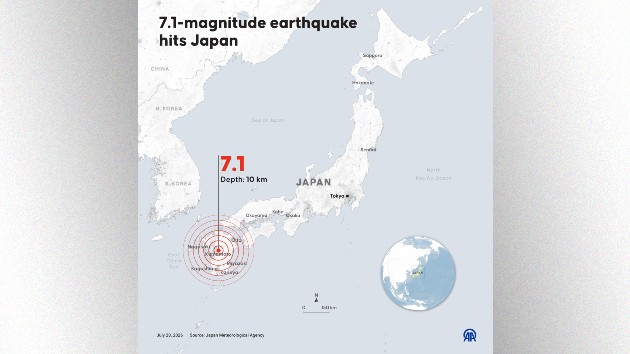
An infographic titled “7.1-magnitude earthquake hits Japan” created in Ankara, Turkiye on July 28, 2026. (Photo by Mehmet Yaren Bozgun/Anadolu via Getty Images)

(TOKYO and LONDON) — A powerful earthquake rocked southern Japan on Tuesday, damaging buildings, causing injuries and prompting warnings from officials, according to local authorities and broadcasts.

The U.S. Geological Survey said the quake measured at a magnitude of 6.8 after initially reporting a preliminary magnitude of 7.1.

It struck Kyushu Island, in the Kumamoto Prefecture, shortly before 4:30 p.m. local time, according to the U.S. Geological Survey, where a large shopping mall has been damaged.

The shopping mall was evacuated when the quake struck, Japan’s NHK News reported, adding that there appeared to have been an explosion in the earthquake’s aftermath and that injuries were reported in the area.

Twenty to 30 mall employees have not yet been reached, and rescue operations are continuing, according to police.

Aerials taken above the shopping mall appeared to show that several walls, as well as the roof, partially collapsed. NHK reported that the fire department said the building’s second floor collapsed.

The Fire and Disaster Management Agency said many people could be trapped inside the mall, NHK reported.

The quake struck about 6 miles beneath the island, which is the southernmost of the main Japanese islands, according to local and U.S. weather officials.

The quake prompted the Japan Meteorological Agency to issue and later lift a tsunami advisory for the coasts of the Ariake Sea and the Yatsushiro Sea.

The agency warned that further quakes may strike the area in the coming days, with an official saying, “As the place where the latest earthquake occurred is shallow, this shows that many earthquakes have occurred.”

“We have already confirmed extensive damage, including casualties, collapsed buildings, damaged roads and fires,” Japanese Prime Minister Sanae Takaichi said during a task force emergency response meeting in Tokyo on Tuesday.

The rumbling on Tuesday afternoon lasted for about a minute, according to Japan’s NHK News, which broadcast images of apparent smoke or fire nearby.

The prefecture’s airport, Kumamoto Airport, in Mashiki, suspended all flights shortly after the quake, according to a notice posted on its website.

A task force for emergency disaster response was created Tuesday, headed by Takaichi, she said. Self-defense forces with approximately 3,600 personnel began operations in affected areas, according to the prime minister.

Japan’s Nuclear Regulation Authority said in an emergency update that it had not recorded “abnormalities” at nearby facilities in Ikata, Genkai and Satsumasendai City.

Several thousand homes were without power following the quake, NHK reported.

Officials urged people to stay away from the ocean and the seashore. They also warned residents to watch for possible landslides.

Takaichi said strong shaking could be felt in both city of Uki and the town of Hikawa. She warned of potential tsunamis of about a meter, or just over 3 feet, near the Ariake and Yatsushiro seas.

“To those in areas that experienced strong shaking, the risk of building collapses and landslides remains high,” Takaichi said. “Please avoid entering dangerous areas and take all precautions to ensure your safety.”

The prime minister urged residents to remain alert for possible earthquakes over the next week or so, which she said could reach a seismic intensity of 7.

ABC News’ Joe Simonetti contributed to this report.

Copyright © 2026, ABC Audio. All rights reserved.
A Los Angeles neighborhood was terrorized by a raging warehouse inferno. Now it’s tormented by the suffocating stench

Los Angeles (CNN) — For eight brutal days, residents of Boyle Heights watched smoke billow from a burning warehouse and prayed the flames would spare their homes.There was no escaping the black pollution that choked the neighborhood then, and no reprieve now, even five weeks after the fire was extinguished. The smell of burning plastic has been replaced by something else: the pungent odor of rotting food, and everything that comes with it.The inescapable stench – equal parts sour and cloying – has settled like a thick haze over the neighborhood, baked by the Southern California heat.Boyle Heights locals say the stink is making them physically sick, and that swarms of flies and giant rats have followed the noxious odor into their neighborhood.When it went up in flames in mid-June, the warehouse contained 88 million pounds of frozen food, some of which burned in the blaze and some liquified. That amount of waste would fill roughly 440,000 curbside trash bins. Lined up wheel-to-wheel, they would stretch more than 200 miles, roughly the distance between Washington, DC and New York City.Now, cleanup crews are racing against the clock to remove what the fire left behind, including waste so toxic it needs to be sealed in hazmat containers. The City of Los Angeles has directed Lineage Logistics, the largest owner of cold-storage facilities in the world and operator of the repository, to clear the waste by August 13 — a timeline one company executive called “very aggressive” at a town hall last month.When the wind shifts, the smells from the warehouse waft miles away, even weeks after the fire was extinguished.But in Boyle Heights, the putrid scent of fermented food is a fetid constant. It lingers in the air and coats the mouth. 90% of residents in the predominantly Latino neighborhood said they noticed constant odors in a recently released county public health survey.In an effort to stymie the foul smell, part of the facility is wrapped in plastic sheeting while large fans spray odor-control mist around the warehouse. The food waste is sprayed with bleach, deodorizer and water before it’s covered and hauled to a landfill in Riverside County, east of Los Angeles.The near-tangible odor has infiltrated every corner of Alicia Naranjo’s home, which is six houses down from the warehouse. At first, the smell permeated the bedrooms, bringing with it sleepless nights. Then came anxiety and trouble breathing, followed by headaches, congestion, coughing and throat pain, she said in a raspy voice she attributes to the pollution in the air.“And then,” her sister Elsa Naranjo chimed in, “we got infested with rats.”“You see them jumping around from the walls,” she said. “Outside our house, in our property.”Rat traps, black plastic boxes with holes in the side, can be seen almost every ten feet along the ground, usually sitting underneath a hanging fly trap filled with dark clusters of dead and drowning flies.There’s one right outside Lisset Navarrete’s house, but she’s not convinced they’re effective for one main reason: the rats she’s seen are bigger than the traps laid for them.Navarrete said her physical symptoms began with pressure on her chest that moved to her stomach. She said the rotting scent permeates so much of daily life she loses her appetite. Her mother-in-law also fell ill while waiting in line at a nearby clinic, she said.“She just started throwing up, feeling dizzy,” Navarrete said, as she swatted a fly off her arm. “It’s just catching up to us.”Her family can’t turn on the air conditioning without it sucking in the odor, but on a 90-degree day, the aggressive Los Angeles sun only serves to thicken the stench enveloping the neighborhood.Lineage has helped to distribute almost 600 air purifiers and over 650 air conditioning units to households in the immediate neighborhood, a spokesperson told CNN. The company has also offered assistance for temporary relocation, utility bills and pest-control supplies.“Community support efforts to date total more than $3.3 million,” the spokesperson said in a statement.The City of Los Angeles has also pitched in to relief efforts, with Mayor Karen Bass declaring a state of emergency and sending mobile health care clinics to the neighborhood.“No company chooses to experience a catastrophic fire. But every company chooses how it responds,” Bass said in an open letter to shareholders. “Unfortunately, Lineage’s response has fallen short.”The smell of rotting food follows Juan Canil like a second shadow. Even when he leaves his home in Boyle Heights, it’s waiting for him at his auto shop located directly across from the Lineage warehouse.He described the same symptoms as the others: headaches, nausea, discomfort. But the stench is also seeping into his pocketbook. The strong smell and remediation work has continued to stall business for the auto shop owner.“Since the street is closed, I’ve lost a lot of work,” he said. “A lot of money.”As of Thursday, over 4,200 complaints about the odor have been reported to the air pollution regulatory agency, South Coast Air Quality Management District. The agency issued Lineage public nuisance violations for 25 days in a row.The regulators sent Lineage a letter last month, demanding additional odor control measures. In its response, the company said it had already implemented some of the measures and agreed to implement others but argued some AQMD demands would add “several months” to cleanup and worsen the odors.A Lineage spokesperson said the company’s top priority is completing the cleanup quickly and safely and it plans to rebuild the warehouse.With a pivotal election looming this fall, Bass has turned up the pressure on Lineage, directing city agencies to block the company’s plans.“The application is for a permit to repair the damage from the fire, which was not caused by the cold storage operations at the facility. This is normal course in the repair process and will not impact or distract us from the important work of cleanup,” the Lineage spokesperson said.Cold storage facilities are “critical infrastructure,” Lineage said. “Communities around the region have depended on them for over 100 years.”Boyle Heights is not the first time Lineage has faced allegations of community harm after a warehouse fire. Nearly 1,000 miles north of Los Angeles, legal action has already been taken against the company for its response to a different blaze.A Lineage Logistics warehouse caught fire in the small town of Finley, Washington, in 2024. It burned for nearly two months, more than six times longer than in Boyle Heights. Lineage believes the California fire began when solar panel contractors were working on the roof, while the Washington fire’s cause is undetermined.Finley residents sued Lineage on June 18 – one day after the Los Angeles fire broke out – alleging the company cut corners on safety and failed to act quickly enough after the catastrophic warehouse fire, allowing toxic smoke and contamination to devastate the community.“We are sympathetic that the Kennewick community faced a fire that was unique in many ways,” a Lineage spokesperson said in a statement. “While we cannot comment on the specifics of ongoing litigation, we vigorously dispute the lawsuit’s characterization of our safety record.”The spokesperson added, “there was no indication Lineage was at fault for the fire.”Residents near the Washington fire reported many of the same ailments now being described in Boyle Heights, including burning eyes, throat irritation, coughing, difficulty breathing, headaches, nausea and dizziness – symptoms attorney Will Sykes said persist for many of his clients today, some two years after that fire first broke out.Lineage reported a $51 million net gain from the Washington fire from insurance payouts, the company noted in a 2025 SEC filing. The company’s webpage dedicated to the fire response has since been taken down.As of Wednesday, Lineage has removed approximately 80% of the food waste from the Boyle Heights warehouse. The company has said the cleanup is complex and requires patience.But for people living around the warehouse, the concern is not just how long the cleanup will take, but how far its effects have already reached: into their homes, their routines and the air they breathe.During hours of public testimony Wednesday, dozens of Boyle Heights residents spoke about how the fire has affected their lives in front of the South Coast AQMD hearing board, which approved an abatement order Thursday requiring Lineage to conduct specific odor mitigation actions.The mayor urged the board to leverage its full enforcement authority to issue the order, including maximum financial fines against Lineage.“Massive headaches have impeded me from living my daily normal life,” Carla Martinez, a local, testified. “It has prevented me from going to work, going to the grocery store for supplies, and just overall daily activities. Being stuck inside with no A/C in this heat is unbearable, not to mention the cost of having the air purifiers running for a semblance of fresh air.”“If the headaches and the heat don’t get you,” she continued, “It’s the putrid smell…”“…the smell of death and decay that’ll get you.”The-CNN-Wire™ & © 2026 Cable News Network, Inc., a Warner Bros. Discovery Company. All rights reserved.
Read Next Story