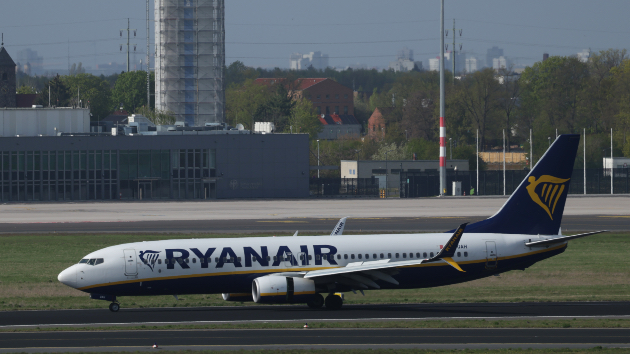
(THESSALONIKI, Greece) — A passenger window on a Ryanair flight dislodged shortly after takeoff from Thessaloniki, Greece, partially sucking out a passenger on Friday.
A 61-year-old male passenger in the window seat was partially sucked out, according to a Greek doctor who treated the passenger on the tarmac once the plane safely landed.
The doctor said the passenger’s wife was holding her husband’s feet to stop him from being completely sucked out of the aircraft. The passenger is currently in the hospital.
The aircraft declared an emergency with oxygen masks dropping in the cabin. The plane returned to Thessaloniki, landing safely on Friday morning, according to a senior Greek aviation official.
The official told ABC News that the Ryanair Boeing 737 suffered an uncontained engine failure. Parts from the engine hit the plane, damaging the fuselage and breaking a passenger window, according to the official.
Greek authorities are in contact with Ryanair’s chief pilot in Malta and with the head of Ryanair’s safety department, who will share more details when available, the official said.
“Ryanair flight from Thessaloniki to Memmingen on Friday morning (10 July) returned to Thessaloniki shortly after takeoff when a passenger window dislodged inflight. The aircraft landed normally and passengers returned to the terminal,” Ryanair said in a statement to ABC News.
Adding, “One passenger requested and received medical assistance on the ground in Thessaloniki. In order to minimize any delay, a replacement aircraft was arranged to bring passengers to Memmingen, which departed Thessaloniki at 9:53 local this morning.”
Boeing told ABC News in a statement that it is aware of the incident and is in contact with the airline.
The National Transportation Safety Board said it was notified that the aircraft “did an air turnback to LGTS due to a right engine issue and cabin decompression on July 10, 2026.”
“Under the provisions of the International Civil Aviation Organization’s Annex 13, the Republic of North Macedonia, as the country of occurrence, will lead the investigation and determine the composition of the investigative team and any international participation,” the NTSB said in a statement.
The 737 Next Generation aircraft involved in this incident was delivered by Boeing in 2008.
ABC News has reached out to the engine maker for comment.
Copyright © 2026, ABC Audio. All rights reserved.