
New Jersey accidentally registered 6,600 noncitizens to vote years ago, governor says

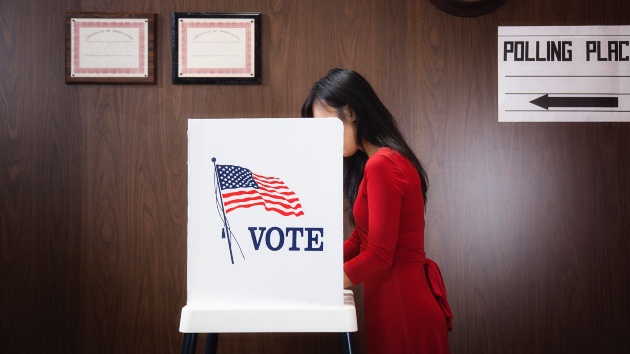
Person voting (Hill Street Studios/Getty Images)

(NEW YORK) — About 6,600 people in New Jersey who said they were not U.S. citizens had been incorrectly registered to vote due to a technical error during the previous gubernatorial administration, Gov. Mikie Sherrill, who took office this year, said Tuesday. She added that fewer than 400 were found to have actually voted and that the state is taking action to remove them from its voter rolls.

The admission came less than a week after Department of Homeland Security Secretary Markwayne Mullin sent letters to New Jersey and three other states alleging that those states might have tens of thousands of noncitizens registered to vote, although Mullin did not explain how precisely DHS got those numbers.

Mullin and DHS had alleged that New Jersey could have “as many as … 35,152 non-citizens registered to vote in New Jersey.”

Sherrill said in a statement on Tuesday, “Last week I learned that a serious software error in New Jersey’s Motor Vehicle System led to the registration of roughly 6,600 people who indicated that they were not U.S. citizens between June 2023 and June 2024, almost three years prior to my taking office. These individuals answered ‘no’ when asked on a keypad whether they were a U.S. citizen when applying for drivers’ licenses and identification cards, but through no fault of their own, the system registered them anyway.”

The governor’s statement said that the state’s “preliminary analysis” found that less than 400 people who were erroneously registered to vote had voted in elections and were not tied to just one party; they were registered as Democrats, Republicans, or unaffiliated voters.

During a press conference on Tuesday, Sherrill said those voters could have potentially voted in any election since being registered, but the state has “no evidence at this time that any elections were swayed” because of those voters

Sherrill said that she has ordered an independent investigation about what happened, the removal of any New Jersey residents from the state’s voter rolls who should not have been registered to vote, and that the new administrator of New Jersey’s Motor Vehicle Commission is starting to replace the vendor tasked with running the faulty system.

The governor also said she will present the state’s findings after it investigates, and that the state is taking care to protect the identities of noncitizens who were registered inadvertently so that their immigration status does not get imperiled.

In a statement, IDEMIA, the company that runs the system faulted by the governor, said: “IDEMIA works with the New Jersey Motor Vehicle Commission, and has for more than 40 years, to support the process through which eligible individuals may indicate their interest in registering to vote when applying for or renewing a driver’s license or state-issued identification card. IDEMIA’s role is to transmit information through the motor vehicle system. The voter registration information is transmitted to the New Jersey Department of State, Division of Elections, which is ultimately responsible for verifying eligibility to vote. Information submitted by IDEMIA must still be validated and adjudicated by the Division of Elections.”

At her press conference, Sherill pushed back against any insinuation that the finding validates claims the Trump administration has made about New Jersey’s voter rolls.

“Let me be clear: Donald Trump has zero credibility on the issue of election integrity. For the past 10 years, he’s cried wolf and peddled bizarre conspiracy theories about fraud with no evidence,” she told reporters during the press conference.

Sherrill also briefly referenced the DHS letter, saying that the number of alleged noncitizen voters appears to be unrelated to the number of noncitizen voters New Jersey uncovered. She confirmed New Jersey received the DHS letter, but said the state asked the administration for any evidence of there being that many noncitizen voters and has not gotten anything back yet.

Meanwhile, the Department of Justice said Tuesday that is investigating the matter.

In a letter to Sherrill shared on social media, Assistant Attorney General Harmeet Dhillon, wrote: “Ensuring that U.S. citizens’ votes are not illegally diluted by noncitizens votes is of paramount importance. We therefore write to formally request additional information to assess New Jersey’s compliance with various federal statutes.” Dhillon asked for the state to provide within five business days personal information on the registered noncitizens the state identified and details on the around 400 who voted.

The White House said Tuesday’s announcement from Sherrill bolsters the need for Congress to pass the president’s signature SAVE America Act, which would significantly retool the administration of American elections.

“Democrats and their media allies have repeatedly said it is impossible for noncitizens to register to vote, let alone cast a ballot,” White House spokesperson Abigail Jackson said in a statement.

“As President Trump has said, there is nothing more important than the integrity of our elections. And this latest incident underscores the absolute necessity of the SAVE America Act,” she added. “American voters deserve to have confidence that our elections are safe and secure — President Trump will never stop fighting to make that happen and all patriotic Americans should join in his effort.”

Copyright © 2026, ABC Audio. All rights reserved.

‘Aura farming’ began as a meme. Latin American youth have turned it into a competitive sport

(CNN) — A group of rowdy spectators gathers in a public square, encircling two young men facing each other with intense looks in their eyes. The crowd points their phones at the pair, who are alternating between short dances, rhythmic movements, and striking poses.This is not a scene from “Zoolander;” the crowd is attending a championship of “aura” in Costa Rica’s capital, San Jose, according to videos posted to TikTok and Instagram.Tuesday’s event at the University of Costa Rica is one of many so-called “aura battles” that have taken off in Latin American countries, including Mexico, Argentina, and Brazil. The contests appear to be designed for virality, with young competitors often demonstrating exaggerated versions of popular TikTok dance moves for the audience.Outrageousness seems to be the point of these battles, which have no apparent criteria, judges, or rules. Instead, contestants compete for crowd reaction and are rewarded with attention and, in some cases, small cash prizes.The phenomenon may have a special appeal to youth in the region due to a culture of assembling in public areas, Frederick Luis Aldama, a humanities professor at the University of Texas at Austin, told CNN.“These are definitely collective and public and person to person, and because in Latin America, we have a long history of the plaza, of the courtyard, of the gathering in the parks,” Aldama explained.They also provide a free, nonviolent space for youth to seek human connection among their peers and may reflect a desire to disconnect from technology and be present, he said.Aldama happened to witness one such “aura battle” in Mexico City’s Parque México.“What I noticed was completely against what I had been trained to think would be the winner, which is someone who was doing a more high-intensity kind of move,” he said. “I realized that the one that won was the one who just brought the kind of aura, the glow of absolute total composure.”Taking inspiration from ‘aura farming’The battle’s precursor comes from “aura farming,” a term that has taken renewed meaning online in recent years.“Aura farming” is described by the Merriam Webster dictionary as “the act of doing something to look cool, impressive, stylish, etc., especially — and importantly — without trying too hard.”The phrase first surfaced in early 2024 and has grown in popularity since, according to Know Your Meme. It reached a wider audience the following year through viral videos featuring an 11-year-old Indonesian boy named Rayyan Arkan Dikha, dancing at the front of a boat.With a steely disposition, Dikha is seen in the videos standing at the very front of a thin boat, executing a repetitive series of dance moves as a line of rowers propel them through a river. As the videos quickly gained traction, commenters and other social media users remarked on the high levels of “aura” possessed by Dikha.Since then, Dikha has accrued thousands of followers on Instagram and was named a tourism ambassador for his home province of Riau.As his performance amassed millions of views, the term “aura farming” began frequently appearing across the internet: from video edits glorifying anime characters to X posts celebrating athletes or celebrities.‘They become a character’“Aura battles” have begun appearing in public spaces across Latin American countries, often organized by local content creators and engineered for maximum virality. Videos of the competitions have received hundreds of thousands of views on social media.Victor Gabriel Tourinho Camargo, a Brazilian content creator known as Uvitinho, organized several tournaments in the city of Suzano.More than 200 people participated, Uvitinho said. Videos showed the participants packed into a park, including one dressed as a sheikh with a briefcase full of Brazilian reais.“The aura farming championship was something created with the focus of taking something popular on the internet and bringing it to reality, mixing it with childhood games and showing people and children that there is still hope for a more real life with genuine moments,” Uvitinho told CNN.“There was a mix of shy, antisocial and extroverted people… and in that moment, they all put aside all that, played together, and made friends,” he added.Mexican YouTuber Alex Crashers described encountering an aura battle in Mexico in a video shared this week. “Even though it seems silly, I got hyped every time someone pulled off a new move,” he said.Argentinian content creator Cielo, known as Cieloween, helped organize an “aura battle” in Chinatown in Buenos Aires scheduled for this Saturday after watching viral videos of a previous battle in the coastal city of Mar del Plata just days before. “The concept of ‘aura farming’ has been around for a while, but now the competition aspect has started to take off,” she told CNN.In many ways, the events resemble past versions of youth “battles” in which competitors were equipped with Pokémon cards, Beyblades or rap verses.Cieloween explained that the moves shown by participants vary widely. “It depends on the person and what they want to show. Some are more serious, while others are more humorous and entertaining. It depends on the person and the character they want to portray, because ultimately, they become a character,” she said.Cieloween said she doesn’t know how many people will attend Saturday’s event, but that the goal is to build community. “That’s what it’s all about: meeting people, being together, connecting with people who share your interests. Making friends, laughing. That’s what we’re going for,” she said.But the showcase has also attracted skeptics.The battle at the University of Costa Rica gained significant attention, with some viewers leaving comments on the videos over the spectacle.In the Brazilian city of Cuiabá, the mayor, Abílio Brunini, prohibited one such championship from taking place in the city’s main public space. “I believe that, in the future, the people who participate in this game will feel very ashamed,” he said.Still, social media videos showed individuals defiantly competing in front of the City Hall building in July.Despite some derision, the competitions have continued as participants embrace the absurdity and young people seek connection. “All this stuff that’s thrown at them, having gone through lockdown, having been like pulled away from these so-called third spaces, these plazas, these places of engagement. No wonder it’s coming back like a storm,” Aldama, the University of Texas professor, told CNN.He compares the criticism to the backlash faced by the Australian breakdancer Raygun, who was mocked for her viral Olympic performance.“There’s always going to be that negativity,” Aldama said. “But what I saw and experienced was really working-class youth, especially in Latin America, gathering to celebrate something joyful.”The-CNN-Wire™ & © 2026 Cable News Network, Inc., a Warner Bros. Discovery Company. All rights reserved.
Read Next Story