
New dinosaur weighing as much as 9 elephants identified by scientists

Scientists have identified a massive new dinosaur from remains discovered in Thailand, with the creature estimated to have weighed as much as nine adult elephants.

The long-necked herbivore stretched 88 feet and weighed about 27 tons, according to a study published in the journal Scientific Reports.

It probably roamed what is now Thailand between 100 million and 120 million years ago and is the largest ever found in Southeast Asia, researchers said.

They estimated the new dinosaur had the same heft as nine adult Asian elephants.

“Our dinosaur is big by most people’s standards — it likely weighed at least 10 tons more than Dippy the Diplodocus,” said lead researcher Thitiwoot Sethapanichsakul, referring to the enormous composite cast previously on display at London’s Natural History Museum.
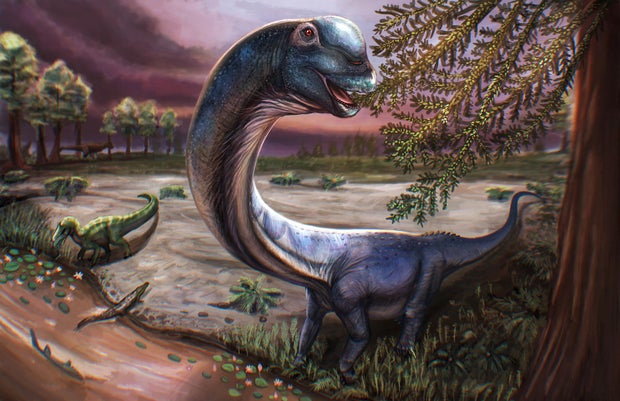
Meet Nagatitan, Southeast Asia's largest dinosaur
An artist’s reconstruction shows the dinosaur whose fossils were unearthed in Thailand.

Patchanop Boonsai/Handout via Reuters

The Thai Ph.D. student called the newly discovered sauropod “the last titan” because it was unearthed in one the youngest rock formations where dinosaurs are found in Thailand, according to University College London.

The region later became a shallow sea, he added, “so this may be the last or most recent large sauropod we will find in Southeast Asia.”

The first remains of the enormous creature were unearthed a decade ago by locals in northeast Thailand, but the excavation was not completed until 2024, according to the study, published Thursday.

The remains partially resembled those of previously discovered sauropods, but had enough unique features to be considered a new species.

It has been dubbed Nagatitan chaiyaphumensis after a “mythological serpent-like creature found in various Asian cultures, especially in northeastern Thailand, often associated with water and Buddhism, and titan, a giant in Greek mythology,” the authors write.

At the time the Nagatitan roamed the region, the ecosystem’s largest predator was a relative of the meat-eating dinosaur Carcharodontosaurus, which measured about 26 feet long and weighed about 3.5 tons.

“At that size, it was dwarfed by Nagatitan. At full size, Nagatitan likely had very little to fear in terms of predation,” Sethapanichsakul told the Reuters news agency.
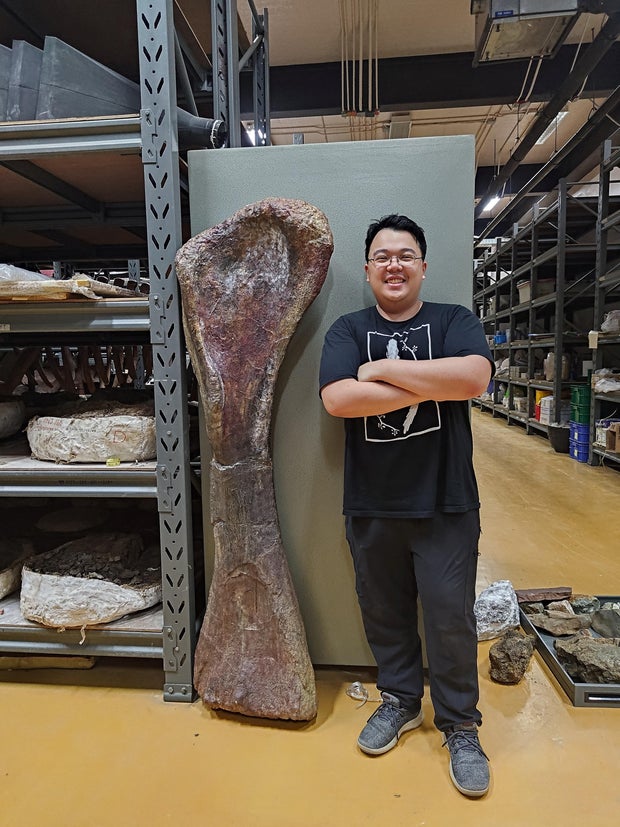
Meet Nagatitan, Southeast Asia's largest dinosaur
Researcher Thitiwoot Sethapanichsakul poses with a front leg bone of the Nagatitan at the Sirindhorn Museum in Thailand in a photograph released May 14, 2026.

Thitiwoot Sethapanichsakul/Handout via Reuters

A life-size reconstruction is on display at Bangkok’s Thainosaur Museum, according to University College London.

In 2023, a dinosaur skeleton uncovered by scientists in northeastern Thailand was also deemed to be a newly discovered species. The skeleton of Minimocursor phunoiensis — which lived 150 million years ago on what is now the Khorat Plateau — represented “one of the best-preserved dinosaurs ever found in Southeast Asia,” scientists said at the time.
False claims about miscarriage risk from Covid-19 vaccines are spreading online. They use a faulty interpretation of data

(CNN) — Numerous studies have shown that Covid-19 vaccines are safe during pregnancy, but Republican senators have recently stirred up false and misleading claims that are now spreading on social media.On Monday, Sens. Ron Johnson of Wisconsin and Rand Paul of Kentucky released a batch of text messages retrieved from Dr. Anthony Fauci’s former government phone as part of an investigation into the former health official’s leadership and actions during the Covid-19 pandemic – including messages in which he discusses the possible risks and safety of the vaccine during pregnancy.These messages were a launching pad for the spread of inaccurate data, particularly claims about an 82% risk of miscarriage associated with Covid-19 vaccines. The incorrect figure spread online, including in a since-deleted post by Sen. Ted Cruz.“This is a well-studied area. We knew this in 2021, that there wasn’t an increased risk, and now we have five more years of data. So it’s hard to believe we would miss a factor of eight increase in miscarriages,” Dr. Kevin Ault, an ob/gyn and president-elect of the National Foundation for Infectious Diseases, told CNN’s Erin Burnett on Thursday.In a ​news release, Johnson references an exchange Fauci had in January 2021, in which he said that a second dose of a Covid-19 vaccine “theoretically could be associated with miscarriage in the 1st trimester,” as well as a criticism of a study that was published in the New England Journal of Medicine in April 2021.In that study, researchers used data from a vaccine safety monitoring system to track outcomes for nearly 4,000 women enrolled in the registry who received Covid-19 vaccines in the early months of the rollout. Among them, the researchers identified 827 women who had a “completed pregnancy” — of which 712 were live births, 104 were spontaneous abortions or miscarriages, and 11 were other outcomes.Initially, the researchers used this data to suggest that Covid-19 vaccines had a 12.6% miscarriage rate: 104 spontaneous abortions out of 827 completed pregnancies. That’s comparable with the average miscarriage rate of 10% to 20%, according to the Mayo Clinic.However, a correction was issued in September 2021 to clarify that there was not enough data to calculate the risk of miscarriage using this particular study. The follow-up time was limited, so outcomes were unknown for the vast majority of participants, and the denominator of 827 completed pregnancies did not sufficiently represent the full sample of nearly 4,000 participants.Still, that correction has been used to manipulate the study data in a way that significantly misrepresents miscarriage risk associated with Covid-19 vaccinations.The researchers note that 700 of the completed pregnancies were in their third trimester when the mother was vaccinated, and they say that “any risk estimate would need to account for gestational week-specific risk of spontaneous abortion.” This meant “no denominator was available to calculate a risk estimate for spontaneous abortions.”But in their claims about the risks of vaccination, critics are instead inaccurately constricting the denominator to exclude those 700 completed pregnancies in the third trimester. This would lead to an overestimation of miscarriage risk of 82%, based on a faulty calculation of 104 spontaneous abortions out of 127 pregnancies completed in the first or second trimester.Experts in public health and pregnancy care emphasize that the benefits that the Covid-19 vaccine offers pregnant moms — and their babies — significantly outweigh any risk.“It is without question that the benefits of the vaccine outweigh the risks, and the world’s literature on this topic includes hundreds of thousands of women,” said Dr. Brenna Hughes, chair of the Society for Maternal-Fetal Medicine’s Infectious Disease and Emerging Threats Committee.The US Centers for Disease Control and Prevention cites dozens of studies on its website that come to the same conclusion.”COVID-19 vaccination before and during pregnancy did not increase health risks for pregnant women or their babies,” the agency says. “In addition, studies have also shown that COVID-19 vaccination during pregnancy provides protection to both the pregnant woman and the baby.”Hughes says that miscarriage concerns are common for pregnant women and that doctors are constantly discussing risks and benefits with their patients.“When we offer any intervention in pregnancy, the first question is: ‘Is it safe for me? Is it safe for the baby?’”With Covid-19 vaccines, the risks she tells people about most are a sore arm and some possible fatigue. The benefits are “incredibly clear,” she said, and outcomes are “quite the opposite of what of what some of this misinformation is saying.”Covid-19 infection poses significantly more risk to pregnant women than the vaccines, experts say.“We had hundreds of maternal deaths in 2021 due to Covid, and we still have severe illnesses, ICU stays, stillbirth, preterm deliveries related to those respiratory diseases,” Ault said. “Vaccination during pregnancy reduces the risk of all those things. So if somebody’s making decisions on these bad sources of information, that has a real downstream effect on maternal health.”And Hughes says she worries that the resurfacing of misinformation about Covid-19 vaccines may leave pregnant women with broader doubts about other interventions.“One of the concerns that we’re seeing now is that people aren’t sure who to trust and who the trusted messenger should be,” Hughes said, but medical societies are the most reliable sources of information.“We are very careful about the science that we put into our guidelines,” she said. “We rigorously assess it for quality. We debate it to make sure that we think that the science is strong enough, and it is not one person making a decision or a recommendation. This is a committee of people with decades of expertise on these topics who really carefully look at the literature and ensure that we feel that it’s adequate before we make these recommendations.”The-CNN-Wire™ & © 2026 Cable News Network, Inc., a Warner Bros. Discovery Company. All rights reserved.
Read Next Story