
Navy identifies missing sailor after Arabian Sea emergency landing

▶ Watch Video: U.S. helicopter goes down in Arabian Sea, crew member missing, Navy says

The U.S. Navy on Tuesday identified Cmdr. Gabriel Edwards as the missing sailor who was aboard a helicopter that went down in the Arabian Sea on July 1.

Edwards, the commanding officer of Helicopter Sea Combat Squadron 5, was missing when three members of the four-person MH-60S Sea Hawk helicopter crew were rescued at sea after what the U.S. Navy said was an emergency water landing. The search for Edwards was suspended after more than 102 hours, the U.S. Naval Forces Central Command said Sunday.

“The thoughts and prayers of every member of the Carrier Strike Group 10 team are with the Edwards family. While we are far from home, our heartfelt support remains at your side,” Carrier Strike Group 10 commander Rear Adm. Todd Cimicata said in a statement Tuesday. 

Cimicata remembered Edwards as a “fearless leader” whose legacy will never be forgotten.
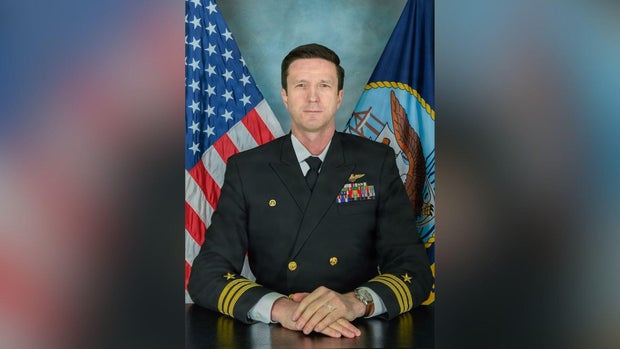
cmdr-gabriel-edwards-wings.jpg
The U.S. Navy identified Cmdr. Gabriel Edwards as the sailor who went missing after an MH-60S Sea Hawk helicopter made an emergency landing in the Arabian Sea.

U.S. Navy / Cmdr. Gabe Edwards Bio Photo

Acting Secretary of the Navy Hung Cao said in a statement that he has directed that Edwards be posthumously promoted to his selected rank of captain. 

“I am deeply grateful to every sailor and airman who took part in the search and who continue to support his family, friends, and shipmates,” Cao said.

Edwards was an Oakland, Oregon, native who had served for 20 years after earning a Bachelor of Science degree in physics and being commissioned through the Naval ROTC.  

He earned his aviator “Wings of Gold” in 2008 as a helicopter pilot and served with HSC-22, HSC-84, Naval Special Warfare Group (NSWG) 4, HSC-85 and assumed command of HSC-5 in July of last year, according to the Navy.

The search covered more than 14,000 square miles and involved multiple aircraft carriers, guided-missile destroyers, helicopter squadrons, anti-submarine squadrons and U.S. Air Force aircraft, according to the Navy.

Edwards is survived by his wife, Rebecca, and two children, the military said.

“We are profoundly grateful to every Sailor, aviator, and Airman who devoted countless hours, extraordinary skill, and unwavering determination in the effort to bring Gabe home,” Rebecca Edwards said in a statement. “Gabe has dedicated his life to serving his country with honor, courage, and commitment. He led with humility, integrity, and compassion, always putting his people before himself. To those who served alongside him, he was a respected leader and mentor. To our family, he is the love of my life, an extraordinary father to his children, and the foundation of our home. His greatest joy was always his family.”

The three crew members who were rescued were returned to the USS George H.W. Bush, to which the helicopter was assigned.

The cause of the emergency landing is under investigation, the Navy said. There was “no indication” that the helicopter was shot down by hostile action, according to the military.

What the death sentence for former Syrian dictator Bashar al-Assad tells us about the future of the country

(CNN) — The judge who sentenced Syrian President Bashar al-Assad to death in absentia last week was himself sentenced to death in absentia by the same regime years earlier.Irony in its purest form.Judge Fakhr al-Din al-Aryan defected from the Ministry of Justice in 2013 joining the judicial bodies of the opposition. His reinstatement as judge after Assad was toppled and fled the country for Russia in December 2024 is an illustration of the country’s pursuit of transitional justice.Some Syrians celebrated in the streets after the death sentence handed down to al-Assad and his younger brother, Maher. Words like “historic” and “symbolic” tripped off the tongue.For the first time, after decades of brutal Assad rule – by both Bashar al-Assad and his father, Hafez al-Assad before him - the model of impunity in Syria has been broken, even if the penalty is unlikely to ever be carried out.The Syrian civil war, which started in 2011, killed hundreds of thousands of people, displaced millions more and has ravaged the country’s economy.Ibrahim al-Assil, a senior research fellow at the Harvard Kennedy School’s Middle East Initiative, said the sentences handed down last week are “significant politically and significant emotionally, but at the same time this is only one part of justice that many Syrians have waited for - and are still demanding.”For the United Nations, justice is just one of the “four pillars of transitional justice” with truth, reparation and guarantees of non-recurrence carrying equal weight.What does Assad’s sentencing mean for Syria?When Assad fled Syria for exile in Moscow in December 2024, he left behind institutions and a legal system his family had built over six decades.Al-Assil says the sentencing was “the first step to look at the new state, to ask these questions, are new rules and new institutions emerging in Syria that differentiate between justice under Assad and justice post-Assad.”Another question is whether this sentencing met the standards of credible transitional justice.Amnesty International has urged Syria to end trials in absentia and the use of the death penalty, incorporate crimes under international law into domestic legislation and reform the judiciary. The justice ministry rejected the criticism, saying the proceedings complied with Syrian law and included the participation of victims and their representatives.Fadel Abdul Ghany, founder of the Syrian Network for Human Rights which has been documenting victims of the Assad regime since 2011 says: “We need lots of cases, not only one, especially targeting the highest rank, so that the feeling of anger in between the people is reduced, so that Syria can move ahead.”Al-Assil agrees that more localized trials need to follow, bringing as many perpetrators of the former regime’s brutal system to justice as possible. “For many families, they are still looking for those who disappeared, and they want to know where they are, what happened to them…maybe for a family in Homs transitional justice looks very different to a family in Dara’a.”Few believe Russian President Vladimir Putin would ever extradite Assad from his self-imposed exile in Moscow. The death sentence complicates any extradition under Russian law, but a decision not to hand over a former close ally to face justice would be far more political than legal, experts say.What is going right in SyriaThe legalities of transitional justice may be complex, but this verdict is still seen as a landmark moment for justice.When asked what else gives him hope for Syria’s future, Abdul Ghany says; “I think what’s working is freedom of speech, freedom of criticism… Syrians can speak freely and criticize the government, authority, even the high-ranking.” He added that he frequently criticizes the new government without repercussions.Ahmed al-Sharaa, the former rebel commander who has served as Syria’s President since 2025, has been outward looking since taking power.After Assad’s ouster, Syria has bolstered ties with the United States which has lifted most of its crippling sanctions on the country. It has renewed relations with its Arab neighbors who cut ties with Damascus during Assad’s crackdown on protests and welcomed French President Emanuel Macron to Syria in July, the first Western leader to visit since 2024.Al Sharaa reached an agreement with Moscow just days ago over two key Russian outposts in Syria; the Mediterranean coastal bases will be transferred to Syrian control.Entrenched challenges remain, however, in the quest for national unity in Syria. Tensions between the Syrian Army and the Druze minority in southern Syria continue to spark deadly encounters. Al-Assil says he sees no breakthrough on the horizon yet. “The government still seems to deal with the issue as only security and military issue while it’s also a social issue.”There is also persistent friction between Arab and Kurdish communities in the northeast of the country, and the government has had to respond to pockets of violence against the religious Alawite minority along Syria’s coast.Al-Assil also insists that Syria still needs a national dialogue process “to talk about all those divisions between ethnicities and minorities but also to talk about what Syria is and what they want Syria to be and that process is still not there.”The-CNN-Wire™ & © 2026 Cable News Network, Inc., a Warner Bros. Discovery Company. All rights reserved.
Read Next Story