
NASA astronaut joins Russian cosmonauts in launch to International Space Station

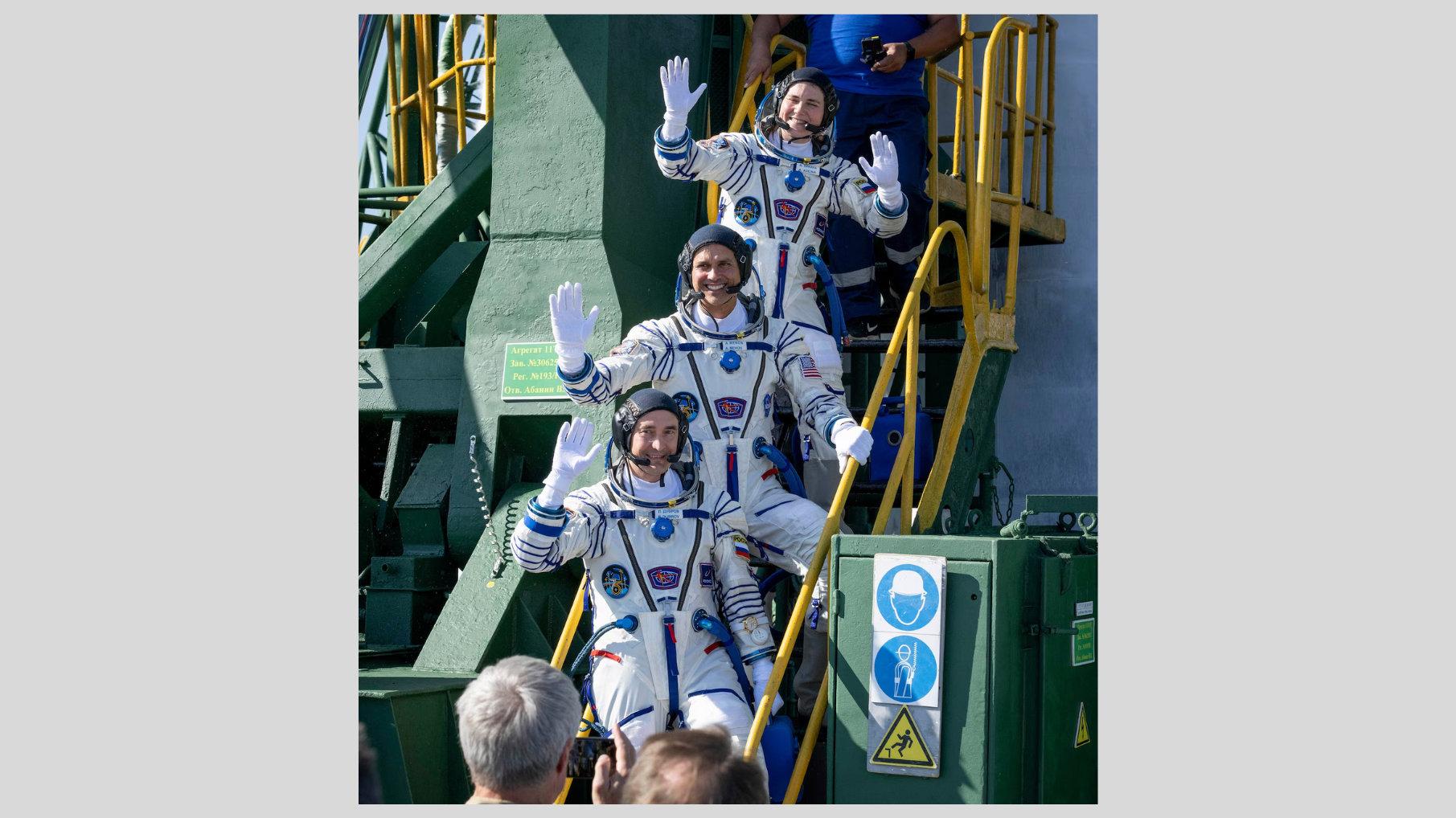
Expedition 75 Roscosmos cosmonaut Anna Kikina (top), NASA astronaut Anil Menon (C) and Roscosmos cosmonaut Pyotr Dubrov wave farewell prior to boarding the Soyuz MS-29 spacecraft for launch on July 14, 2026, at the Baikonur Cosmodrome in Baikonur, Kazakhstan. (Bill Ingalls/NASA via Getty Images)

(NEW YORK) — A NASA astronaut blasted off from a launch site in Kazakhstan Tuesday along with two Russian cosmonauts as part of a mission to the International Space Station.

Anil Menon launched aboard the Roscosmos Soyuz MS-29 spacecraft from the Baikonur Cosmodrome site around 10:47 a.m. ET along with cosmonauts Pyotr Dubrov and Anna Kikina.

This marks Menon’s first space flight, and the second flight for the Russian cosmonauts, according to NASA.

The space craft docked with the station at 1:52 p.m. ET.

Once aboard the station, they will join up with the members of Expedition 74 crew, three NASA astronauts, one European Space Agency astronauts and three cosmonauts, who have been on the station conducting scientific experiments.

Menon, Dubrov and Kikina’s mission will last about eight months and they are scheduled to return to Earth in April 2027.

Menon, an emergency medicine doctor, will “conduct scientific research and technology demonstrations aimed at advancing human space exploration and benefiting life on Earth,” according to NASA.

That includes research into production of semiconductor crystals in space, and testing augmented reality and artificial intelligence tools for medical support in space, NASA said.

“He will be a test subject helping researchers understand how blood flow is affected in space to protect future astronauts. He also will test bioprinting vascular constructs in microgravity to improve understanding of the aging process to advance therapeutic developments,” the agency added.

During an April news conference, Menon said the mission is a critical stepping stone as NASA sets its sights on building a moon base and, eventually, sending people to Mars.

“I’ve always thought about these long-duration missions like Mars, it might take three years to get there, or the lunar base where you’re actually working on the moon, which would be an opportunity for a lot of people in the future,” Menon said.

In June, Menon spoke with ABC News’ medical correspondent Dr. Darien Sutton about the upcoming mission, explaining that his work caring for patients is often more challenging to him than preparing for his trip to space because, as a physician, he is always trying to minimize risk for his patients.

“I think I have a little bit more of a sense of adventure for myself and I’m willing to take on a little more, make my own decisions about where my risk lands and where I put my energy. And so I think taking care of patients is a little more difficult for that reason,” Menon told ABC News.

Menon and his wife, Anna, are both NASA astronauts, a development he says the couple never anticipated.

“There was a 0% chance we thought this would happen,” he said during the April news conference, adding that he had previously been rejected by NASA before ultimately being selected in December 2021.

“I wanted to be an astronaut, but I thought that door was closed because I had tried and had been unsuccessful at an interview.”

Copyright © 2026, ABC Audio. All rights reserved.

Así fue el rescate de dos marineros que conmueve a México: “No pensamos que fuéramos a sobrevivir”

Sobrevivieron cinco días a la deriva en el océano Pacífico, flotando sobre una hielera y aferrándose a su fe. Es una extraordinaria historia de supervivencia que los pescadores mexicanos José Luis Portales y Daniel Guerrero vivieron para contar.“La hielera que usamos como balsa y unos botes de gasolina fueron los que nos mantuvieron en equilibrio”, relató Portales, de 32 años.Los dos hombres zarparon a bordo del bote “Camaronera” para cumplir con una jornada de pesca como cualquier otra. Sin embargo, relataron que una ola golpeó su pequeña embarcación y los dejó a la deriva, a más de 240 kilómetros de la costa de Chiapas, en el sur de México.Perdieron el bote y todo lo que llevaban dentro. Una hielera de color azul claro se convirtió entonces en su única tabla de salvación.Sin comida ni agua potable, se refugiaron en ese reducido espacio mientras flotaban en medio de la inmensidad del Pacífico mexicano.“Es lo más duro que puede haber y no se lo deseo a nadie, ni aunque fuera mi peor enemigo”, confesó Daniel Guerrero, de 53 años.Paradójicamente, después de la experiencia, contó a la prensa local que pescar sigue siendo lo que más le gusta hacer.De acuerdo con sus familiares, la última comunicación que tuvieron con ellos fue el 14 de agosto. Tras recibir una llamada de auxilio del personal de una cooperativa pesquera, la Marina mexicana desplegó un operativo de búsqueda para tratar de localizarlos.Durante los días de incertidumbre, Portales y Guerrero pensaron constantemente en sus seres queridos.“Sí pensábamos en la familia. Lo único era pedirle a Dios y esperar la ayuda de la Marina para que nos pudieran auxiliar”, sostuvo Portales.El rescate se produjo el 19 de agosto. Cuando la esperanza comenzaba a desvanecerse, el sonido de una aeronave les hizo saber que la ayuda finalmente estaba cerca. Los pescadores fueron localizados a unas 130 millas náuticas (unos 241 kilómetros) de la costa de Chiapas.“Cuando vimos la avioneta y empezó a dar vueltas, dije: ‘Gracias a Dios’. Me hinqué a orar y a darle gracias. Fue lo primero que hice”, recordó Guerrero.Después de ubicarlos desde el aire, una Patrulla Oceánica de la Armada de México se aproximó hasta el punto donde se encontraban y logró ponerlos a salvo.“No pensamos que fuéramos a sobrevivir todos estos días”, confesó Guerrero.Fueron en total cinco días expuestos al sol, al oleaje y a la incertidumbre, pero los pescadores regresaron a tierra firme. Allí se reencontraron con sus familias, agradecidos por una segunda oportunidad y por aquella hielera que, en medio del océano, terminó convirtiéndose en su balsa salvavidas.The-CNN-Wire™ & © 2026 Cable News Network, Inc., a Warner Bros. Discovery Company. All rights reserved.
Read Next Story