
The mothers of Black newborns are more likely than those of White newborns to be referred to law enforcement over allegations of substance use during pregnancy, according to The Marshall Project’s new analysis of child welfare data from eight states. The referrals are often the result of unreliable hospital drug tests performed at childbirth that are easily misinterpreted and produce false positive results as much as half of the time, which can prompt incorrect reporting to child welfare and law enforcement authorities.
Medical centers can report claims of pregnancy substance use to child welfare agencies, which can then refer the cases to law enforcement. Using birth rates in eight states, The Marshall Project estimated that Black babies are around two and a half times more likely than White babies to be flagged to law enforcement over claims of substance exposure in the womb. The analysis is the first to measure the overrepresentation of Black newborns among these referrals and the disproportionate impact they can have on Black families.
During a seven-year period, child welfare agencies across 20 states referred the parents of more than 25,000 Black newborns to police or prosecutors over alleged pregnancy substance use, The Marshall Project found. In eight of those states that had enough detailed data to compare estimated rates of referrals across Black and White children, all showed referrals were more common when the cases involved Black families.
Child welfare data on newborns of other races and ethnicities was not provided to The Marshall Project.
In Oklahoma, an estimated 1 in 11 Black babies were flagged to law enforcement over accusations of pregnancy substance use. In Minnesota, the families of Black newborns were estimated to be about three and a half times more likely than those of White newborns to be referred to police.
Child welfare agencies can refer allegations to police or prosecutors even when their investigations clear the parents or find no evidence that they posed an urgent threat. The Marshall Project found this occurred with a considerable number of Black families. In a seven-year period, more than 14,000 cases involving Black newborns were sent to law enforcement agencies in the eight states, even though child welfare authorities did not conclude that child abuse or neglect occurred.
The data does not spell out why cases against Black families are more common, but decades of research spanning the country has shown that racial disparities are embedded through every step of the child welfare process. Black women are more likely than White women to be drug tested at childbirth and reported to child welfare authorities, more likely to be investigated and more likely to be separated from their children, previous studies have found.
The data also does not specify what happens after cases are referred to law enforcement. Many of these reports are filed away without consequence. But other mothers have been shamed, surveilled, arrested, jailed, prosecuted and left with enduring trauma.
The referrals to police likely contribute to higher rates of depression and stress among Black postpartum women, exacerbating the Black maternal mortality crisis, said Miriam Mack, senior legal counsel at the advocacy group Movement for Family Power.
“It’s not about what you do, what substances you use, how much you’re using, whether you’re using, but it’s about who you are,” Mack said. “It’s about the simple fact that you are Black and you have given birth in the hospital.”
The Marshall Project has previously documented the harms to Black mothers who are drug tested during childbirth. Ayanna Harris-Rashid was arrested in South Carolina in 2021 after testing positive due to legal CBD gummies and a topical hemp-based ointment she took during her pregnancy. Amid the stress of criminal charges and incarceration, she lost the ability to breastfeed her newborn son.
Melissa Robinson, a Black elementary school librarian in Alabama, was investigated in 2024 after she had a false positive test for cocaine. The hospital barred Robinson from breastfeeding and child welfare officials told her she could not be alone with her baby, even though a second hospital drug test disproved the allegation against her. The case was ultimately closed due to insufficient evidence.
“To have such a beautiful experience tainted by something like that, it’s difficult,” Robinson told The Marshall Project in 2024. “Truthfully, it’s turned me into somebody different.”
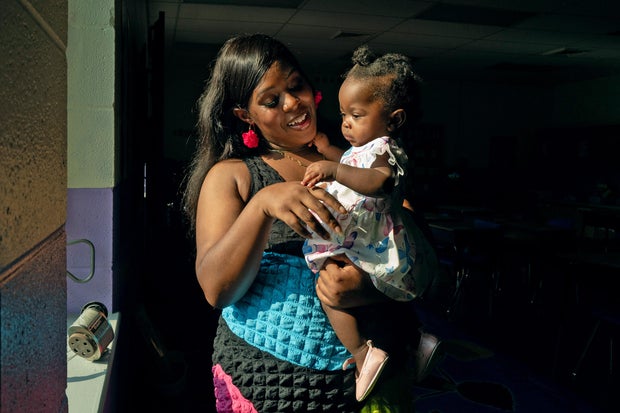
Lynsey Weatherspoon for The Marshall Project
To conduct the analysis, The Marshall Project obtained seven years of data, stretching between mid-2018 and mid-2024, from the National Data Archive on Child Abuse and Neglect, which stores the information from state child welfare agencies. The eight states with more detailed numbers on newborn race and referrals were California, Georgia, Kentucky, Minnesota, Ohio, Oklahoma, South Carolina and Texas.
Child welfare officials in the eight states were allowed to review the findings. In Oklahoma, officials called the analysis “misleading and inaccurate” because it excludes children who have a multiracial parent if the other parent is not Black or White, which could overestimate how often law enforcement referrals take place. The Marshall Project conducted a subsequent analysis and found that the overrepresentation of Black newborns was consistent in the data whether the children of multiracial parents were Black, White or neither. Read more about the methodology here.
Seven of the states included in the analysis have policies requiring child welfare to automatically share cases of pregnancy substance use with law enforcement, even if the allegations are unfounded.
When child welfare workers review a claim of drug exposure in the womb, they may investigate and find no evidence of child abuse or neglect, or decide the risk to the child is low enough to offer support services rather than conduct an investigation. Even so, the agency can be required to share these allegations with law enforcement, potentially leading to unnecessary surveillance, arrest or prosecution. Those referrals typically occur before child welfare has completed its reviews of the cases.
For the eight states in the analysis, among families referred to law enforcement, child welfare agencies were 25% more likely to dismiss or divert pregnancy substance use allegations made against Black families compared to White families. The difference was especially stark in Kentucky, where child welfare workers were 38% more likely to close a case without a finding of abuse or neglect when the newborn was Black. The findings suggest that Black parents are more likely to be reported to authorities over substance use claims that are unfounded or pose a low safety risk to their children.
The Marshall Project interviewed more than a dozen doctors, researchers and parent advocates to understand why Black newborns were overrepresented in the data. Most pointed to the fact that hospitals disproportionately drug test and report Black mothers and babies. Racial bias and poverty also play a role, with providers more likely to report someone that they perceive as lacking financial or social support, even if the parents may be competent and caring, doctors said.
Another reason may stem from changes in state and federal policies. Drug testing of pregnant women began in the 1980s during the crack epidemic, when fears of “crack babies” spurred state laws classifying substance use during pregnancy as child abuse or neglect. During the opioid epidemic in the early 2000s, hospital drug testing policies expanded again, with Congress directing states to identify all newborns “affected by” substance use, whether illegal or not. As a result, more parents are now reported to child welfare over positive tests triggered by legal substances, including prescribed medications, over-the-counter products and marijuana.
Two cases from a single hospital near Myrtle Beach, South Carolina, show how a positive drug test for marijuana can produce vastly different outcomes.
When a Black mom and her newborn at Tidelands Waccamaw Community Hospital tested positive for THC in July of 2024, the hospital reported her to the state Department of Social Services, which referred her to law enforcement, Georgetown County Sheriff’s records show. A positive THC test can be triggered by legal substances, such as a CBD gummy. The documents do not indicate that officers interviewed the mother or attempted to identify the cause of the positive test before arresting her days later on a charge of child abuse.
Two months later, a White woman giving birth tested positive at the same hospital for the same substance. This time, however, a child welfare investigator told police the agency did not want to press charges. The patient had told the investigator that she tested positive because of a single CBD edible she had purchased at a store. The child welfare agency “believes the offender is not a threat to the victim,” the police report said. Police did not arrest the mother.
The community hospital and sheriff’s department did not respond to requests for comment about the two cases. The South Carolina Department of Social Services declined to comment.
Marijuana testing floods the system with families who are not likely to harm their children, said Joseph Ryan, a professor of social work at the University of Michigan. He co-authored a study that found that the parents of Black newborns were more likely to be reported to child welfare over positive marijuana tests but rarely went on to commit child abuse or neglect.
“There’s really no reason to be testing for THC,” Ryan said. Though he said alcohol has far more detrimental effects on a developing fetus than marijuana, hospitals rarely screen for it. Reducing testing and reporting of marijuana would lessen the disproportionate number of Black families getting reported into the system, he said.
Attorneys and advocates for parents said the data may also obscure the reality of many cases that end up dismissed or that go through a process known as “alternative response.” During a child welfare investigation or assessment, parents may be asked to submit to drug tests and home inspections, to turn over their children to other caregivers or to agree to complete what are considered voluntary services in exchange for avoiding a formal child abuse or neglect case. These agreements can come with an implicit or explicit threat — if parents do not sign, child welfare may open an investigation or petition a judge to remove their child anyway. Many parents quickly agree, often without a lawyer present.
In Kentucky, such agreements are common and can lead to weeks or months of surveillance or separation, said civil rights attorney Paul Hill, who has represented people who signed prevention plans under threat of their children being sent to foster care. One of Hill’s clients was required to be supervised by her husband after testing positive at her child’s birth due to poppy seeds, according to court records.
A spokesperson for Kentucky’s Cabinet for Health and Family Services said the agency has seen “firsthand the positive impact that prevention plans play in supporting families and kids across our commonwealth” and welcomes feedback on each case.
Even cases that are eventually dismissed cause distress during a crucial bonding time and open the door to further intervention, advocates said.
Mothers can find themselves subject to new child welfare cases later on in their children’s lives if they struggle with their mental health or have trouble paying bills. Child welfare or police reports documenting the original substance use allegations from childbirth could be cited as evidence, even if the claims were unfounded. The hospital reports also erode trust between providers and patients, leading many parents to avoid medical care altogether.
For Brittany Pettway, a Black mom in Kentucky, the experience of being drug tested and reported on two separate occasions after she gave birth has made her scared to have another child.
“I think race does play a big part in it,” she said. “It just seems like they already think we’re unfit and unstable.”
All of this worsens health outcomes, experts say. The stress of an investigation, even one ultimately closed, can trigger relapse into substance use or otherwise harm the health of the mother or infant — in a healthcare landscape in which Black women are already at higher risk of death.
“The sheer fear of living with being investigated by the police, of living with being investigated by CPS — that in and of itself is the harm,” said Mack, the attorney at Movement for Family Power. “The impact that that has on a person’s body, a person’s health, a person’s well-being, that’s the harm.”
For many advocates and doctors, the solutions are clear. Leading medical groups advise against routine drug testing of pregnant women. Such tests do not prove that someone has an addiction and are often conducted without a patient’s knowledge or consent.
Earlier this year, following The Marshall Project’s reporting, the state of New Jersey began requiring hospitals to confirm drug screens with more precise tests prior to sharing results with child welfare authorities. The state also instructed providers to obtain informed consent before drug testing pregnant patients and confirmed that a positive result alone does not constitute child abuse or neglect. The state now has an anonymized form for hospitals to share information about substance-affected infants without triggering a child welfare investigation.
Instead of funding the punishment of women through costly child welfare or criminal cases, advocates said officials should fund family support services, such as drug treatment programs that offer childcare and food assistance.
“These places, they’re not invested in Black parenting. They’re not even invested in Black motherhood survival,” said Erin Miles Cloud, a civil rights attorney who has represented mothers with child welfare cases. Cloud said the default response to these structural problems has become punishment. “We should all be worried about a system that is set up to divert people to the police.”
Methodology
The Marshall Project analyzed data that state child welfare agencies voluntarily submit to the federal Children’s Bureau, which is part of the Department of Health & Human Services. That information is provided to and stored by the National Data Archive on Child Abuse and Neglect (NDACAN), a federal contractor. Upon request, NDACAN staff provided The Marshall Project with data from fiscal years 2018 to 2024 showing the number of prenatal substance exposure cases reported to state child welfare agencies, as well as the number shared with police or prosecutors.
The data detailed the number of allegations involving Black and White newborns and whether child welfare deemed the babies to be either “victims” of abuse or neglect or “nonvictims.” A newborn is considered a victim if abuse or neglect is substantiated or suspected by child welfare workers. Nonvictim cases occur when child welfare does not substantiate a claim of maltreatment or redirects the family to support services rather than opening an investigation.
Due to low or unreliable counts, no other racial or ethnic categories beyond White or Black were provided. As a result, these other categories were excluded from our analysis.
Over the seven-year period, 20 states submitted at least one year of referral data on Black newborns. We added up all these available counts to produce a minimum total of how many cases against Black families were referred to law enforcement during this time.
NDACAN did not provide numbers when annual counts fell below 10 individuals to protect people’s privacy. Seven states had no suppressed numbers in any years. In California, there were four years of data without any suppressed values. We included non-suppressed values in these eight states in a more detailed race analysis.
In the NDACAN data, children can be included in more than one race category and thus can appear in the aggregated totals for both Black and White newborns. State child welfare agencies can follow different practices for collecting this race information from families. We also incorporated data from CDC WONDER on the number of children born each federal fiscal year, which runs from October to September, to estimate how often the families of newborns of each race have a case of pregnancy substance use shared with law enforcement. A small number of suppressed values, when counts fell below 10, were excluded from the birth totals. Using the CDC WONDER data, which collects race information from parents’ birth certificates, we counted a child as Black if at least one parent was Black, and a child as White if at least one parent was White.
Our calculations excluded newborns whose parents were listed as “more than one race” in the CDC data if the other parent was not White or Black because the data did not specify the races of multiracial parents. As a result, the analysis could overestimate the frequency of referrals or exaggerate the difference in referral rates between Black and White newborns. The Marshall Project calculated minimum and maximum estimates of birth counts in each state by assigning all mixed-race parents as Black but not White, and then White but not Black. We found that the overrepresentation of Black newborns was consistent in the data whether the children of multiracial parents were Black, White or neither.
Classifying all multiracial parents as only Black substantially lowers the estimates of potential racial disparity, because Black birth counts are relatively small in most states. Counting multiracial parents as only White produces maximum estimates but does not shift the results as dramatically, because the number of White babies born in each state is relatively large. These calculations provide a range of possible values, but without clear data specifying how many multiracial parents are Black and White, they don’t indicate where within the range the actual values fall.
The analysis of referral rates by race can only produce estimates rather than exact results because of a lack of precision in the birth data. For this reason, and because the data only covers eight states, The Marshall Project does not encourage ranking or comparing results across states.
The analysis does not examine trends occurring during the seven-year period of data. States could have experienced changes in referral rates and nonvictim case rates over this time period.
The Marshall Project consulted with several scholars on this analysis, including Dr. Mishka Terplan, a Maryland OB-GYN and leading researcher on substance use disorders during pregnancy. We also provided the data and analysis to the eight state child welfare agencies and NDACAN before publication and gave them a chance to share feedback.
The quality and comprehensiveness of the NDACAN data varies by state. Read more about The Marshall Project’s work with the data here.
This article was published in partnership with The Marshall Project, a nonprofit news organization covering the U.S. criminal justice system. Sign up for their newsletters, and follow them on Instagram, TikTok, Reddit and Facebook.