Margaret Brennan: I spoke with Lindsey Graham a day before he died

▶ Watch Video: Shortly before Lindsey Graham’s death, he was hopeful about new Russia sanctions bill

Fierce Ukraine supporter Lindsey Graham passed away Saturday on the heels of his tenth trip to the warzone, and at a key moment for one of the South Carolina Republican senator’s proudest accomplishments.

I spoke twice by phone on Friday with Graham while he was in Kyiv. He told me it was a big day, and he was excited to share the news that the Trump White House had finally given him the green light for Congress to move his long-sought bill to put significant financial penalties on Russia by punishing buyers of Russian oil.

I asked what had changed to make this possible, and he said Vladimir Putin’s constant attacks made it very clear that the Russian president was “saying one thing and doing another.” He had just met with Ukrainian President Volodymyr Zelenskyy, and said that he thinks President Trump sees the Ukrainian leader as “more of a winner now.” 

Graham told me that he didn’t want to get ahead of Mr. Trump but he believed that this package of punishing financial measures would create leverage on China and India, the two biggest purchasers of Russian fuel. He believed this would get overwhelming support among his Republican colleagues, and bragged that past versions had gotten 85 signatories.

In an increasingly rare act of bipartisanship in these hyperpartisan times, Graham wanted me to know that Sen. Richard Blumenthal of Connecticut, his Democratic colleague, deserves a lot of credit. Twice, he urged me to call Blumenthal and make sure we got him on record too. The gesture had shades of the type of across-the-aisle work Graham and Republican Sen. John McCain used to broker with another Connecticut lawmaker, Sen. Joe Lieberman.
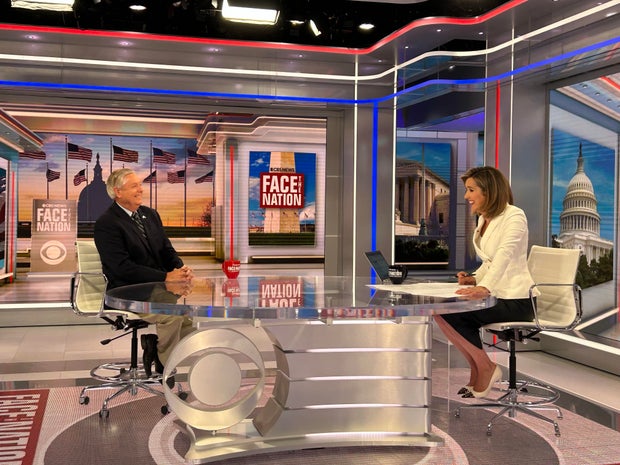
image-from-ios.jpg
Sen. Lindsey Graham on “Face the Nation with Margaret Brennan.”

It was almost exactly one year ago to the day that Graham and Blumenthal had joined us on “Face to Nation” to talk about their bipartisan effort to pressure Russia through sanctions and tariffs on buyers of their oil. Graham told us in that July 13, 2025, interview that he wanted to hand Mr. Trump “a sledgehammer to go after Putin’s economy, and all those countries who prop up the Putin war machine.”

The two senators had just traveled through Europe together, urging European countries to cut off their own purchases of Russian fuel and building support among European countries to try to mirror the sanctions.

Blumenthal told me Friday that he and Graham would get the votes to make sure this passed. Following Graham’s passing, it falls to Republican leaders in the Senate and House to make the decision on whether to take it up.

When Graham and I spoke Friday, he said he wanted to come back on “Face the Nation” with Blumenthal once again. He’d just appeared with us three weeks ago to push another big goal: Turning the morass of the Iran war into an opportunity for normalization of relations between Saudi Arabia and Israel. He had worked with then-President Joe Biden to try to get that done, but the work was stymied by the horrific attack of Oct. 7, 2023.

That unfinished business also now lays waiting.

Judge dismisses charges against billionaire Adani, but sharply criticizes DOJ

▶ Watch Video: Todd Blanche to be sworn in as attorney general after narrow Senate confirmation A federal judge on Monday dismissed the criminal fraud charges against Indian billionaire Gautam Adani and several of his co-defendants, after politically appointed leaders in the Justice Department decided to kill the case in May.But in an unusual twist, U.S. District Judge Nicholas G. Garaufis for the Eastern District of New York refused to dismiss two of the counts against five other co-defendants, saying the Justice Department had failed to provide him with a sufficient reason for doing so.In a scathing 47-page ruling, Garaufis took aim at Trent McCotter, the principal associate deputy attorney general, who he said bears sole responsibility for trying to dismiss the case."The irregularities in the decision to dismiss the indictment are concerning," Garaufis wrote. "On the current record, McCotter appears to have eschewed the professional opinions of innumerable officials from various federal offices and replaced them with his singular judgment. The fact that McCotter came to this decision largely in collaboration with defense counsel, and seemingly without input from the FBI and SEC agents who investigated the alleged misconduct, or the attorneys from the Department, SEC, and U.S. Attorney's Office who brought the case, appears to be highly unusual."The high-profile foreign bribery case against Adani was brought at the tail end of former President Joe Biden's tenure, and it managed to survive even after President Trump ordered the Justice Department and the Securities and Exchange Commission to conduct a review into all of their pending foreign bribery cases.But after Adani retained Bob Giuffra and Jamie McDonald of Sullivan & Cromwell, the Justice Department in May moved to dismiss the case entirely.McCotter made the determination after he and other government officials met with McDonald, Giuffra and Andrew DeFilippis of Sullivan & Cromwell, sources previously told CBS News. McDonald has since been nominated by Mr. Trump to serve as U.S. Attorney for the Southern District of New York.In one of these meetings at the Justice Department about the Adani case, Giuffra made a presentation that disputed evidence of the alleged bribery scheme, according to sources familiar with the matter and records reviewed by CBS News. One slide touted how one of Adani's companies is "powering India's progress," and another slide said the Trump administration "would not have brought the case."If prosecutors were to drop the charges, Giuffra also said at the meeting, Adani would be willing to invest $10 billion in the American economy, sources told CBS News.Adani is one of the wealthiest people in India, and is widely seen as an ally of Indian Prime Minister Narendra Modi. He leads the Adani Group, a massive conglomerate that owns airports, seaports, power plants and other assets.Adani said in a social media post after the charges against him were dismissed: "I welcome the US court's decision with humility and deep respect for the judicial process. Throughout this challenging period, our faith in truth, fairness and the rule of law remained unwavering. My deepest gratitude to those who never lost faith in us, in the system and in India's capacity for justice."CBS News has reached out to Adani's lawyer for comment.A spokesperson for the Justice Department declined to comment beyond the letter McCotter submitted to the court about the case, in which he said he made the decision to dismiss the charges "after conducting numerous meetings with defense counsel" and reviewing "hundreds of pages of materials."Judges have some discretion to review motions to dismiss charges, but it is unusual for them to extensively question the government's rationale for tossing out indictments.The decision to dismiss the Adani case has raised eyebrows and sparked questions from the judge. Two career prosecutors who were involved in the case withdrew from the matter after the motion to dismiss was filed. Additionally, politically appointed officials —  the U.S. Attorney for the Eastern District of New York and McCotter—  were the only signatories on the motion to dismiss.McCotter initially pushed back when Garaufis first started raising questions about the motion to dismiss the case, prompting the judge to order Adani last month to provide answers to the court on whether there was any sort of quid pro quo arrangement. Adani ultimately told the judge no such arrangement existed.In his ruling Monday, Garaufis said that Federal Rule of Criminal Procedure 48(a) requires the government to "set forth the basis for its motion to dismiss," which should include its reasons and underlying factual basis for doing so."It is evident throughout McCotter's musings on 'judicial inquisitions,' the 'separation of powers,' and 'prosecutorial discretion' that he would like the court to have no role in reviewing this motion," Garaufis wrote."However, the rule's legislative history and relevant case law confirm that rule 48(a) was enacted to ensure the court's limited, but key, role in scrutinizing the government's decision to dismiss charges once a grand jury returns an indictment."He criticized McCotter for failing to provide adequate reasons for dismissing the obstruction and foreign bribery counts, noting he was "unpersuaded" by McCotter's "unsworn statements regarding hypothetical concerns of 'diplomatic strife' and 'waste[d] resources,' or his unsubstantiated claim that 'India can better manage its internal systems than can prosecutors in Brooklyn and Washington.'"The judge did accept some of the Justice Department's arguments for dismissing the charges against Adani, saying it was "conceivable that the anti-bribery language used in the financial documents is so generic and vague that it would raise legal risks to the prosecution."But he was angered by McCotter's contention that the case was brought by the Biden-era Justice Department as a name-and-shame exercise."McCotter appears to be accusing officials across four different government offices of bringing a detailed 54-page, 5-count indictment out of spite," he wrote. "However, he has not provided a scintilla of evidence to suggest that the timing of the unsealing of the indictment, or the charging decisions, in this case was politically motivated. McCotter's baseless assertion is unbecoming of his office."He gave the Justice Department an Aug. 31 deadline to advise on its reasons for seeking to dismiss the two counts against the five remaining co-defendants. He also ordered attorneys for the remaining defendants to inform the court that they consent to the dismissal.
Read Next Story