
Man fatally shot by federal officer in Houston was not ICE target, DHS says

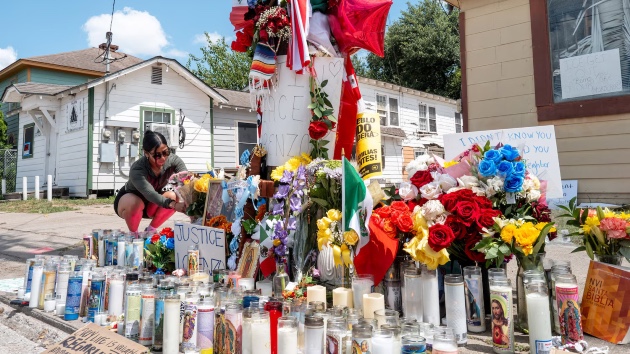
A person places flowers at the site where Mexican immigrant Lorenzo Salgado Araujo was killed, on July 9, 2026, in Houston, Texas. (Brandon Bell/Getty Images)

(HOUSTON) — The man fatally shot during a traffic stop by an Immigration and Customs Enforcement officer in Houston this week was seemingly not the original target of the immigration enforcement operation, a Department of Homeland Security official told ABC News.

The DHS official said Lorenzo Salgado Araujo, a Mexican national, “resembled the target.”

“After receiving a credible tip from our law enforcement partners, our officers conducted surveillance on a target’s address. Weeks prior to the incident, they noted two white vans at the property,” the official said.  “On July 7, officers were almost at the target’s address when they observed a white van with an individual who resembled the target. Officers then initiated the vehicle stop.”

The Harris County Medical Examiner has listed Lorenzo Salgado’s death as a homicide. The primary cause of death was “penetrating gunshot wound of the torso,” according to the office.

The update from DHS comes as Salgado’s family and local officials are pushing for answers and demanding an independent and transparent investigation into the incident.

In a previous statement, ICE said officers attempted to stop a vehicle driven by Salgado Araujo around 6:50 a.m. on Tuesday as part of a targeted operation.

Salgado Araujo allegedly didn’t follow verbal commands, according to ICE, and the agency alleged that Salgado Araujo “weaponized his vehicle” and tried to run over an officer during the stop, prompting the officer to fire their weapon “in self-defense.”

DHS said the shooting remains under investigation by its Office of the Inspector General.

Earlier Thursday, DHS said the ICE officers involved in the incident had not been issued body-worn cameras.

Salgado Araujo’s sons have called for an independent investigation into their father’s death, as they say they have many questions for ICE, including why he was targeted and why deadly force was used.

“My dad had no criminal history,” Ronaldo Salgado, 29, one of Salgado Araujo’s three sons, told ABC News on Thursday. “My dad, you know, wasn’t doing anything illegal. He was picking up his workers to go to work.”

Ronaldo Salgado said no one from DHS or ICE has contacted the family, and that he and only learned of their father’s death on social media, watching a Facebook post of his father, lying on the street after being shot.

“We still don’t have any answers,” Ronaldo Salgado said. “All we have to go for is their statement that they released.”

Four Democratic Texas congress members — Reps. Sylvia Garcia, Al Green, Lizzie Fletcher and Christian Menefee — have also called for an “immediate, fully independent, and transparent investigation” into Salgado Araujo’s death.

In a letter to DHS Secretary Markwayne Mullin and Acting ICE Director David Venturella on Wednesday, the four lawmakers demanded answers to multiple questions about the incident, including whether the officers had body-worn cameras, and asked for the “complete, unedited body camera footage from all officers present at the incident, as well as all dash camera footage from both vehicles.”

Salgado Araujo, who had been in the U.S. for nearly 35 years, was undocumented, according to ICE. Ronaldo Salgado said his father’s priority had been providing for his family and getting his three sons through school, and that last year he had started the process of getting a work permit.

“I just want all Americans to know that my dad was a hardworking man, a family man who wanted nothing more than to put food on the table and to watch his sons achieve the American dream,” he told ABC News.

Three men, including Salgado Araujo’s brother, who were in the van being driven by Salgado Araujo were detained in the incident, according to the Texas congress members, who asked for an update on their current status in their letter to the DHS and ICE leaders.

The deadly shooting has sparked protests in Houston, with hundreds of people marching Wednesday through the neighborhood where the incident occurred.

In the wake of the shooting, Mexican officials said they plan to file criminal complaints over the deaths of Mexicans in the U.S. in connection with immigration operations.

Mexico’s foreign affairs secretary, Roberto Velasco, referenced Salgado Araujo’s death during a press briefing announcing the legal measures on Thursday, calling it a “painful situation,” and said Mexico’s president has instructed them to begin legal action to “protect the human rights of Mexicans in the United States.”

Regarding body-worn cameras, a DHS spokesperson said the officers involved in the incident were “not issued” them, pointing to two partial government shutdowns — one in the fall of 2025 and the other one earlier this year — for the delay in issuing cameras to ICE law enforcement officers.

“The process of purchasing and issuing body-worn cameras to all of our ICE field offices was interrupted by the Democrats multiple government shutdowns,” the spokesperson said. “Body cameras have been deployed to more than half the field offices with the remaining half to receive them in the next 60 days.”

Copyright © 2026, ABC Audio. All rights reserved.

Aunque las tensiones entre México y EE.UU. aumenten, hay algo que parece no cambiar: la cooperación en seguridad

Puede que las relaciones entre México y Estados Unidos estén atravesando un momento de tensiones recurrentes, especialmente luego de que la semana pasada uno de los hijos del expresidente Andrés Manuel López Obrador dijera que le revocaron la visa estadounidense, una decisión cuestionada por la presidenta Claudia Sheinbaum.Pero anuncios recientes por parte de autoridades de ambos países muestran que, más allá de declaraciones políticas, la cooperación bilateral en materia de seguridad, uno de los elementos más importantes del vínculo bilateral, se mantiene firme.El último roce comenzó la noche del jueves, cuando Andrés López Beltrán, hijo de López Obrador y exsecretario de Organización del oficialista partido Morena, anunció en su cuenta de Instagram que Estados Unidos le retiró el visado. En una carta dirigida al presidente Donald Trump, atribuyó la medida al secretario de Estado, Marco Rubio, y al subsecretario Christopher Landau, exembajador en México, a quienes acusó de querer intervenir en otros países.“Como es evidente, esta decisión es de carácter político, más bien politiquero y propagandístico, al estilo hitleriano, pues no existe ninguna razón que justifique tan arrogante proceder”, dijo López Beltrán, quien quiere ser candidato a diputado federal en las elecciones de 2027.Al día siguiente, durante su conferencia de prensa diaria, Sheinbaum consideró que la revocación de la visa a López Beltrán y casos previos representan decisiones arbitrarias de las que buscan sacar provecho las fuerzas políticas de oposición en México. Además de López Beltrán, otros políticos mexicanos a quienes se les ha retirado el visado son la gobernadora del estado de Baja California, Marina del Pilar Ávila, y su exesposo Carlos Torres, entre otros.“Mi opinión es que esta cancelación de visas que han hecho, ellos le llaman a ‘personas políticamente expuestas’, tiene un sentido político, esencialmente porque no es parejo a todos los países, si su sentido fuera relacionado con delincuencia o con alguna prueba de algún tema relacionado con la entrada de un ciudadano a Estados Unidos”, dijo Sheinbaum.Un día después, Estados Unidos dio su contrarréplica, en voz de la Embajada en México y de Landau. En su cuenta de X, la delegación diplomática compartió un video de Rubio —publicado en febrero pasado— junto con un posicionamiento: “Nuestro mensaje es claro y consistente. Estados Unidos cancelará cualquier visa cuando existan razones para hacerlo, sin importar quién sea el titular, dónde viva o cuáles sean sus opiniones políticas. Las visas son un privilegio no un derecho”. De su lado, Landau pidió que este episodio no “distraiga” a la relación bilateral.“Como han reconocido el presidente de EE.UU., Donald Trump, y la presidenta mexicana Claudia Sheinbaum, ambos países prosperan cuando cooperamos en un espíritu de respeto mutuo en temas críticos como la seguridad, la migración y el comercio. No debemos permitir que el ocasional estallido de drama político nos distraiga de este punto fundamental”, dijo en X.En línea con ese mensaje, el embajador de Estados Unidos en México, Ronald Johnson, informó el domingo sobre dos hechos relacionados con la cooperación bilateral en seguridad.Por la mañana, anunció en X que ambos gobiernos firmaron una declaración de intención con la que la Secretaría de la Defensa Nacional de México (Sedena) podrá comprar a Estados Unidos drones y sistemas antidrones para enfrentar a los grupos del narcotráfico.“Esta tecnología fortalecerá nuestra capacidad para combatir a los carteles y hacer frente a nuestros retos compartidos de seguridad”, dijo. La propia Sedena había informado sobre el acuerdo días atrás, cuando se refirió a una visita reciente a México del secretario del Ejército de Estados Unidos, Dan Driscoll.Más tarde, Johnson también dio a conocer que México entregó a Estados Unidos a tres personas sospechosas de diversos delitos: un presunto integrante del Cartel Jalisco Nueva Generación, un hombre acusado de cargos con armas de fuego y otra persona sospechosa de fraude. “Nuestra cooperación, impulsada por el presidente Donald Trump y la presidenta Claudia Sheinbaum, envía un mensaje claro a los delincuentes: serán capturados y rendirán cuentas”, señaló.Desde que Trump inició su segundo mandato presidencial en enero de 2025, México ha enviado a Estados Unidos a alrededor de 100 presuntos delincuentes, incluyendo algunos capos del narcotráfico.Aunque las relaciones entre México y Estados Unidos suelen tener tensiones y México rechaza declaraciones de Trump y algunos otros funcionarios sobre que los carteles controlen territorio mexicano, ambos gobiernos continuamente dicen tener disposición para colaborar en seguridad y combate al crimen. En medio de las fricciones por la reciente revocación de la visa al hijo del expresidente López Obrador, el acuerdo para una eventual compra de drones y los nuevos traslados de más sospechosos son una muestra de eso.The-CNN-Wire™ & © 2026 Cable News Network, Inc., a Warner Bros. Discovery Company. All rights reserved.
Read Next Story