Man describes harrowing escape from wildfire that killed wife and friends

▶ Watch Video: Another major heat wave fueling European wildfires

A British man caught up in Spanish wildfires has described how he survived the inferno as his wife and friends died trying to escape.

Malcolm Timbrell, 70, lived with his wife Annette Kilgore, 69, in the village of Bedar, in the Almeria province of southeast Spain. 

The area was scorched by wildfires on July 9 that killed 13 people, one of the deadliest fires in the country’s history. 

Timbrell spoke to CBS News’ partner network BBC News on Monday — outside his blackened, destroyed hillside home — about the ordeal.

“You’d never imagine it could happen,” he said, “and when it does, and you’re the only survivor, then you’re left in a situation of, ‘What can I do?'”

Timbrell and Kilgore moved to Spain after several years sailing together. Having both previously lost partners to terminal illness, they were together for 17 years.

They had hoped to spend the rest of their lives together in the southern Spanish hills of Andalusia.

“She was such a happy, outgoing person,” Timbrell said of Kilgore. “We have had an amazing life together — and now it’s stopped.”

The wildfire spread rapidly, fueled by sweltering temperatures, high winds and dry land, scorching an area larger than Manhattan and at times racing across the parched landscape at more than 300 feet per minute.
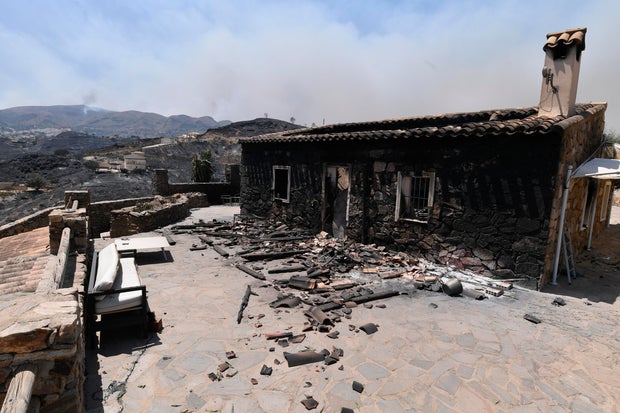
Fire In Los Gallardos (almeria)
Malcolm Timbrell and Annette Kilgore’s burnt-out house  in Los Gallardos, Almeria, Andalusia, Spain, on 10 July, 2026, a day after it was engulfed in flames. 

Europa Press News

With the flames getting closer and closer to their home, Timbrell, Kilgore and their friends had to make a snap decision about how and when to flee.

They were going to try driving, but Timbrell quickly went back into their home to get the couple’s cats, Charlie and Lilly.

“If we’d have done the sensible thing and gone the other way and let our cats die, we both would be alive,” he told The BBC. “But when you’ve got animals, you don’t think like that.”

After grabbing Charlie and Lilly, Timbrell tried to rejoin the group, but saw that for some reason they had gotten out of their cars.

“My wife and our other seven friends and neighbors — against me screaming at them not to — decided the only safe way was to walk out in front of the firewall,” he said. “I’ve subsequently heard that that fire wall was moving at 20 kilometers (12 miles) per hour, plus. They had no chance.”

Timbrell tried to escape the flames in one of the abandoned cars.

“Of the six cars, four of them instantly combusted and as each one started to go, I moved back one car.”

“For some reason of fate, the last two cars, although very, very badly singed and paint bubbled and burnt, survived,” he said. “I survived inside the last one with a cat.”

Malcolm was eventually recused by local authorities, but eight bodies were found down the road from the couple’s house.

Three Britons — including a 93-year-old woman — and one French, Belgian and Spanish national, are among the confirmed fatalities.

Spanish authorities have said four more bodies, discovered in a burnt-out vehicle, are thought to be British.

Kilgore has not yet been formally identified.

“There’s just that little spark of hope,” Timbrell said, “even though I know a body has been found clutching a cat. Hard cold facts are pointing to the bodies they’ve found.”

“So we are just waiting now for DNA clarification. And after that, I will probably just fall apart.”

The blaze in Spain came as Europe swelters under record-setting heat — part of a growing climate crisis that is driving up average temperatures on the continent about twice as quickly as the rest of the globe.
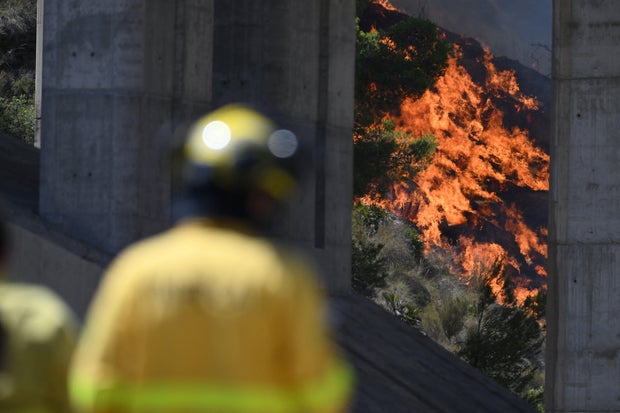
TOPSHOT-SPAIN-FIRE-EMERGENCY
Firefighters of the Andalusia Wildfire Service monitor a fire in the area of the wildfire that killed 13 near Bedar, in Los Gallardos district, in Almeria Province, July 10, 2026.

JOSE JORDAN/AFP/Getty

Western Europe has just endured its hottest June ever recorded, causing nearly 10,700 excess deaths, and Italy has already entered its third major heat wave of the season. 

In France, wildfires have already burned more land this year than during all of 2025. Tanker planes have been skimming the River Seine to scoop up water to try and douse blazes raging about 40 miles south of central Paris.

Hundreds of firefighters have been battling two blazes that have already charred about 4,900 acres in the Fontainebleau forest and forced about 1,000 people to evacuate from their homes, according to local authorities.

While much larger fires have hit southern France, the Fontainebleau blazes are relatively close to the densely populated region surrounding Paris.

No deaths or injuries have been reported in the area, and two people have been arrested in connection with the Fontainebleau fires, Interior Minister Laurent Nunez said Tuesday on France’s BFM television.


The US Navy’s plan for almost 20 guided-missile subs and why that will matter around China

(CNN) — The US Navy this week announced a “pivotal shift” in its future submarine force, and it’s a move analysts say provides important insights into how Washington would fight any possible conflict in the Pacific, where China is rapidly building up its forces.The Pentagon announced that 19 planned nuclear-powered Virginia-class attack submarines (SSNs) would now be classified as guided-missile submarines (SSGNs) and fitted with the Virginia Payload Module (VPM), an 84-foot-long section which adds 28 missile-launch cells to the 12 on current versions of these subs.Those cells can be loaded with Tomahawk land-attack missiles as well as hypersonic vehicles. Combined with the stealthy abilities of submarines, this will provide the new boats with a crucial ability to get inside China’s missile defenses, analysts say.“Submarines are one of the few capabilities which can loiter forward, near or within the first island chain in relative safety,” said Sidharth Kaushal, senior fellow at the Royal United Services Institute (RUSI) in London, referring to the string of islands from Japan southward through Taiwan and the Philippines, inside of which Beijing can bring the most firepower to bear.“Second, hypersonic missiles represent a capability against which US adversaries – which otherwise enjoy robust air defenses – have more limited defenses,” Kaushal said. And getting the high-speed, maneuverable missiles closer to their targets strains adversary reaction time.Key strike platforms being retiredThe details of the new sub plan come at a critical time for the Navy.This year it is beginning to retire its four Ohio-class guided-missile subs. Those boats were converted to SSGNs 20 years ago from their nuclear deterrent role as ballistic-missile subs, or boomers, after the US and Russia reduced their nuclear forces with the 1993 START II treaty.Once armed with nuclear-tipped Trident ballistic missiles, the four reconfigured Ohio-class subs can carry up to 154 Tomahawks each, and have been prized assets for deterrence and combat missions around the globe.Speaking to CNN in 2021, Bradley Martin, a former Navy captain turned naval researcher at the RAND Corp think tank, called the Ohio-class SSGNs “the platform with the single largest ability to deliver conventional missile payloads.”During the 2025 Operation Midnight Hammer strikes on Iranian nuclear sites, an Ohio-class boat was called upon to augment B-2 bomber strikes.But one of the four Ohio-class SSGNs, the USS Georgia, began its deactivation process last month and the other three are scheduled to do the same over the next several years.Retirement of those boats will reduce the Navy’s undersea strike capability by up to 60%, according to the Washington, DC-based Submarine Industrial Base Council.The first of the Virginia-class SSGNs are not scheduled to join the fleet until 2029, so the Navy is likely to see a shrinkage in its missile strike capabilities in the meantime. The last of the new subs isn’t due to join the fleet until 2038.Current inventory includes at least 24 smaller versions of the Virginia class as well as around 20 older Los Angeles-class subs and three specialized Seawolf-class boats, so the Navy is not without conventional sub-launched missile capability.In the long run, leaders are confident the 19 new boats will prove suitable replacements for the Ohios.“These VPM-equipped SSGNs will ensure the Navy continues to dominate the undersea domain for decades to come. By integrating this additional payload capacity, we will have the ability to surge strike power to assure our allies, deter aggression, outmatch any adversary,” Vice Adm. Rob Gaucher, director of submarine programs, said in a statement.“Georgia and her sister ships proved the enduring value of combining undersea stealth with unmatched clandestine strike capability,” the chief of naval operations, Adm. Daryl Caudle, said.“The next generation of Virginia-class SSGNs builds on that legacy with greater survivability, adaptability, and sustained combat power,” Caudle added.Not a one-for-one swapAnalysts caution that the move from the Ohio class to the Virginia class is not a one-for-one trade, as a single Virginia-class sub will carry only about 26% of the missiles of an Ohio-class one. That means it will take four future boats to equal the firepower of one currently.Analyst Bryan Clark, a Hudson Institute senior fellow and former Navy officer, notes another key difference between the two – the Ohio class has two rotating crews while the Virgina class has only one, meaning the former could spend twice as long actually on patrol.But being able to disperse missiles over a greater number of platforms has its advantages, says Alessio Patalano, professor of war and strategy at King’s College, London.“They expand the number of platforms that can bring the fight deep into an enemy’s territory, and as such opponents will have to contend with more assets they have to track, or at least try to,” Patalano said.It’s a key point in any possible conflict over Taiwan, the democratically governed island that the Chinese Communist Party claims as sovereign territory despite never having controlled it.China has been in the midst of an aggressive submarine-building program in recent years.According to a February report from the International Institute for Strategic Studies, the PLA Navy ramped up its production of nuclear-powered submarines over the past five years to the point where it is launching subs faster than the US, threatening to negate a sea-power advantage that has long belonged to Washington.From 2021 to 2025, China’s submarine building surpassed that of the US in both numbers of subs launched – 10 to 7 – and tonnage – 79,000 to 55,500, says the report.In an attack sub configuration, that’s more hunters of US subs in regional waters.Beijing has been rapidly building its missile forces, too.In December 2024, the Pentagon estimated that China’s rocket force had boosted its missile supply by 50% in the preceding four years.The People’s Liberation Army wants “to set the conditions for the invasion of Taiwan,” Decker Eveleth, an associate research analyst at the non-profit national security group CNA and an expert on China’s missile forces, told CNN last year. “So that’s shooting at ports, shooting at helicopter bases, shooting at supply bases … shooting at anything that can theoretically let you bring support to Taiwan.”“They want to destroy things in theater and keep everything else out,” Eveleth said.This buildup comes at a time when the US military’s own munitions stockpiles have seen significant depletion since President Donald Trump’s decision to join Israel and bomb Iran.Close-in operationsAnalysts said the new Virginia-class subs help negate China’s missile advantage, especially in the early days of any conflict.US subs that can get inside that first island chain would be in prime position to take out radars and command posts that would be coordinating defenses and helping Chinese missile targeting, analysts said.That could “degrade an adversary’s anti-surface capabilities to a level sufficient to enable other platforms such as surface ships to be moved forward at less risk, thus setting the conditions for aircraft carriers to provide follow-on strikes,” RUSI’s Kaushal said.Hypersonic launch capabilities enhance the new Virginia class further, analysts said, noting that testing of a hypersonic glide vehicle is well underway.They help give the newest Virginia class “a genuine uplift in the strike function,” said Patalano at King’s College.“That’s what gives an adversary an extra moment of pause,” he said.What can’t be forgotten, however, is that China won’t be standing still.At a military parade in Beijing last fall, China showed off a dizzying amount of new missiles, including a range of hypersonic vehicles, that many analysts say put the PLA at the forefront of that technology.Also in the parade ranks were new uncrewed submersible vehicles – underwater drones, stealthy in their own right, that could pose a threat to any of Beijing’s adversaries.The realities of that are surely obvious to the US Navy. But its leadership retains confidence in an area where it has been unmatched since World War II.“Armed with state-of-the-art sensors, unmatched stealth, and advanced automation, these reclassified SSGNs will operate with impunity in contested waters, ensuring the United States Navy maintains absolute undersea supremacy,” a Navy statement said.The-CNN-Wire™ & © 2026 Cable News Network, Inc., a Warner Bros. Discovery Company. All rights reserved.
Read Next Story