
Man describes harrowing escape from wildfire that killed wife and friends

▶ Watch Video: Another major heat wave fueling European wildfires

A British man caught up in Spanish wildfires has described how he survived the inferno as his wife and friends died trying to escape.

Malcolm Timbrell, 70, lived with his wife Annette Kilgore, 69, in the village of Bedar, in the Almeria province of southeast Spain. 

The area was scorched by wildfires on July 9 that killed 13 people, one of the deadliest fires in the country’s history. 

Timbrell spoke to CBS News’ partner network BBC News on Monday — outside his blackened, destroyed hillside home — about the ordeal.

“You’d never imagine it could happen,” he said, “and when it does, and you’re the only survivor, then you’re left in a situation of, ‘What can I do?'”

Timbrell and Kilgore moved to Spain after several years sailing together. Having both previously lost partners to terminal illness, they were together for 17 years.

They had hoped to spend the rest of their lives together in the southern Spanish hills of Andalusia.

“She was such a happy, outgoing person,” Timbrell said of Kilgore. “We have had an amazing life together — and now it’s stopped.”

The wildfire spread rapidly, fueled by sweltering temperatures, high winds and dry land, scorching an area larger than Manhattan and at times racing across the parched landscape at more than 300 feet per minute.
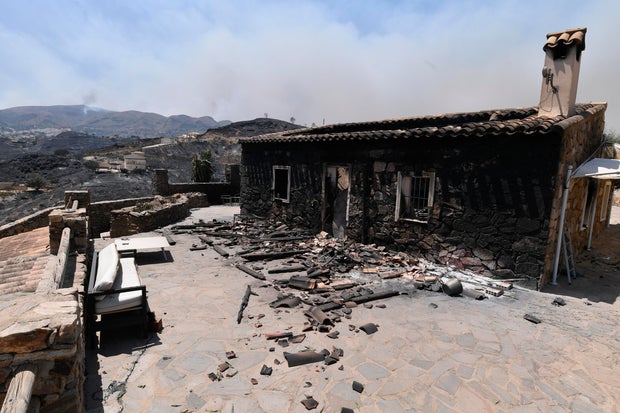
Fire In Los Gallardos (almeria)
Malcolm Timbrell and Annette Kilgore’s burnt-out house  in Los Gallardos, Almeria, Andalusia, Spain, on 10 July, 2026, a day after it was engulfed in flames. 

Europa Press News

With the flames getting closer and closer to their home, Timbrell, Kilgore and their friends had to make a snap decision about how and when to flee.

They were going to try driving, but Timbrell quickly went back into their home to get the couple’s cats, Charlie and Lilly.

“If we’d have done the sensible thing and gone the other way and let our cats die, we both would be alive,” he told The BBC. “But when you’ve got animals, you don’t think like that.”

After grabbing Charlie and Lilly, Timbrell tried to rejoin the group, but saw that for some reason they had gotten out of their cars.

“My wife and our other seven friends and neighbors — against me screaming at them not to — decided the only safe way was to walk out in front of the firewall,” he said. “I’ve subsequently heard that that fire wall was moving at 20 kilometers (12 miles) per hour, plus. They had no chance.”

Timbrell tried to escape the flames in one of the abandoned cars.

“Of the six cars, four of them instantly combusted and as each one started to go, I moved back one car.”

“For some reason of fate, the last two cars, although very, very badly singed and paint bubbled and burnt, survived,” he said. “I survived inside the last one with a cat.”

Malcolm was eventually recused by local authorities, but eight bodies were found down the road from the couple’s house.

Three Britons — including a 93-year-old woman — and one French, Belgian and Spanish national, are among the confirmed fatalities.

Spanish authorities have said four more bodies, discovered in a burnt-out vehicle, are thought to be British.

Kilgore has not yet been formally identified.

“There’s just that little spark of hope,” Timbrell said, “even though I know a body has been found clutching a cat. Hard cold facts are pointing to the bodies they’ve found.”

“So we are just waiting now for DNA clarification. And after that, I will probably just fall apart.”

The blaze in Spain came as Europe swelters under record-setting heat — part of a growing climate crisis that is driving up average temperatures on the continent about twice as quickly as the rest of the globe.
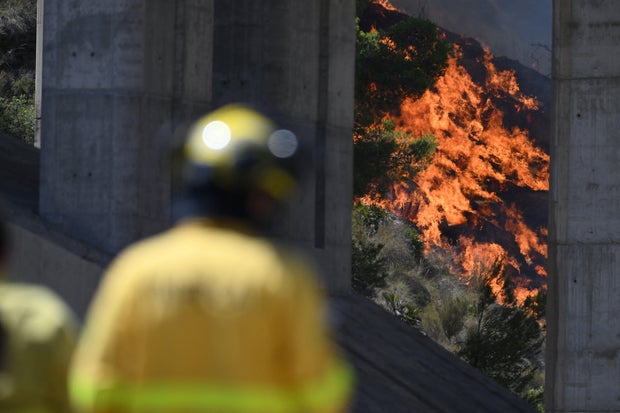
TOPSHOT-SPAIN-FIRE-EMERGENCY
Firefighters of the Andalusia Wildfire Service monitor a fire in the area of the wildfire that killed 13 near Bedar, in Los Gallardos district, in Almeria Province, July 10, 2026.

JOSE JORDAN/AFP/Getty

Western Europe has just endured its hottest June ever recorded, causing nearly 10,700 excess deaths, and Italy has already entered its third major heat wave of the season. 

In France, wildfires have already burned more land this year than during all of 2025. Tanker planes have been skimming the River Seine to scoop up water to try and douse blazes raging about 40 miles south of central Paris.

Hundreds of firefighters have been battling two blazes that have already charred about 4,900 acres in the Fontainebleau forest and forced about 1,000 people to evacuate from their homes, according to local authorities.

While much larger fires have hit southern France, the Fontainebleau blazes are relatively close to the densely populated region surrounding Paris.

No deaths or injuries have been reported in the area, and two people have been arrested in connection with the Fontainebleau fires, Interior Minister Laurent Nunez said Tuesday on France’s BFM television.

‘Aura farming’ began as a meme. Latin American youth have turned it into a competitive sport

(CNN) — A group of rowdy spectators gathers in a public square, encircling two young men facing each other with intense looks in their eyes. The crowd points their phones at the pair, who are alternating between short dances, rhythmic movements, and striking poses.This is not a scene from “Zoolander;” the crowd is attending a championship of “aura” in Costa Rica’s capital, San Jose, according to videos posted to TikTok and Instagram.Tuesday’s event at the University of Costa Rica is one of many so-called “aura battles” that have taken off in Latin American countries, including Mexico, Argentina, and Brazil. The contests appear to be designed for virality, with young competitors often demonstrating exaggerated versions of popular TikTok dance moves for the audience.Outrageousness seems to be the point of these battles, which have no apparent criteria, judges, or rules. Instead, contestants compete for crowd reaction and are rewarded with attention and, in some cases, small cash prizes.The phenomenon may have a special appeal to youth in the region due to a culture of assembling in public areas, Frederick Luis Aldama, a humanities professor at the University of Texas at Austin, told CNN.“These are definitely collective and public and person to person, and because in Latin America, we have a long history of the plaza, of the courtyard, of the gathering in the parks,” Aldama explained.They also provide a free, nonviolent space for youth to seek human connection among their peers and may reflect a desire to disconnect from technology and be present, he said.Aldama happened to witness one such “aura battle” in Mexico City’s Parque México.“What I noticed was completely against what I had been trained to think would be the winner, which is someone who was doing a more high-intensity kind of move,” he said. “I realized that the one that won was the one who just brought the kind of aura, the glow of absolute total composure.”Taking inspiration from ‘aura farming’The battle’s precursor comes from “aura farming,” a term that has taken renewed meaning online in recent years.“Aura farming” is described by the Merriam Webster dictionary as “the act of doing something to look cool, impressive, stylish, etc., especially — and importantly — without trying too hard.”The phrase first surfaced in early 2024 and has grown in popularity since, according to Know Your Meme. It reached a wider audience the following year through viral videos featuring an 11-year-old Indonesian boy named Rayyan Arkan Dikha, dancing at the front of a boat.With a steely disposition, Dikha is seen in the videos standing at the very front of a thin boat, executing a repetitive series of dance moves as a line of rowers propel them through a river. As the videos quickly gained traction, commenters and other social media users remarked on the high levels of “aura” possessed by Dikha.Since then, Dikha has accrued thousands of followers on Instagram and was named a tourism ambassador for his home province of Riau.As his performance amassed millions of views, the term “aura farming” began frequently appearing across the internet: from video edits glorifying anime characters to X posts celebrating athletes or celebrities.‘They become a character’“Aura battles” have begun appearing in public spaces across Latin American countries, often organized by local content creators and engineered for maximum virality. Videos of the competitions have received hundreds of thousands of views on social media.Victor Gabriel Tourinho Camargo, a Brazilian content creator known as Uvitinho, organized several tournaments in the city of Suzano.More than 200 people participated, Uvitinho said. Videos showed the participants packed into a park, including one dressed as a sheikh with a briefcase full of Brazilian reais.“The aura farming championship was something created with the focus of taking something popular on the internet and bringing it to reality, mixing it with childhood games and showing people and children that there is still hope for a more real life with genuine moments,” Uvitinho told CNN.“There was a mix of shy, antisocial and extroverted people… and in that moment, they all put aside all that, played together, and made friends,” he added.Mexican YouTuber Alex Crashers described encountering an aura battle in Mexico in a video shared this week. “Even though it seems silly, I got hyped every time someone pulled off a new move,” he said.Argentinian content creator Cielo, known as Cieloween, helped organize an “aura battle” in Chinatown in Buenos Aires scheduled for this Saturday after watching viral videos of a previous battle in the coastal city of Mar del Plata just days before. “The concept of ‘aura farming’ has been around for a while, but now the competition aspect has started to take off,” she told CNN.In many ways, the events resemble past versions of youth “battles” in which competitors were equipped with Pokémon cards, Beyblades or rap verses.Cieloween explained that the moves shown by participants vary widely. “It depends on the person and what they want to show. Some are more serious, while others are more humorous and entertaining. It depends on the person and the character they want to portray, because ultimately, they become a character,” she said.Cieloween said she doesn’t know how many people will attend Saturday’s event, but that the goal is to build community. “That’s what it’s all about: meeting people, being together, connecting with people who share your interests. Making friends, laughing. That’s what we’re going for,” she said.But the showcase has also attracted skeptics.The battle at the University of Costa Rica gained significant attention, with some viewers leaving comments on the videos over the spectacle.In the Brazilian city of Cuiabá, the mayor, Abílio Brunini, prohibited one such championship from taking place in the city’s main public space. “I believe that, in the future, the people who participate in this game will feel very ashamed,” he said.Still, social media videos showed individuals defiantly competing in front of the City Hall building in July.Despite some derision, the competitions have continued as participants embrace the absurdity and young people seek connection. “All this stuff that’s thrown at them, having gone through lockdown, having been like pulled away from these so-called third spaces, these plazas, these places of engagement. No wonder it’s coming back like a storm,” Aldama, the University of Texas professor, told CNN.He compares the criticism to the backlash faced by the Australian breakdancer Raygun, who was mocked for her viral Olympic performance.“There’s always going to be that negativity,” Aldama said. “But what I saw and experienced was really working-class youth, especially in Latin America, gathering to celebrate something joyful.”The-CNN-Wire™ & © 2026 Cable News Network, Inc., a Warner Bros. Discovery Company. All rights reserved.
Read Next Story