‘Little House on the Prairie’: The beloved books are back on screen

▶ Watch Video: A return to “Little House on the Prairie”

It’s maybe not by accident that a new adaptation of Laura Ingalls Wilder’s semi-autobiographical book series, “Little House on the Prairie,” returns to screens this summer, the 250th anniversary of the country’s founding. “A lot of people consider them children’s literature, but I really do think they’re really about sort of how America became America,” said writer and showrunner Rebecca Sonnenshine.
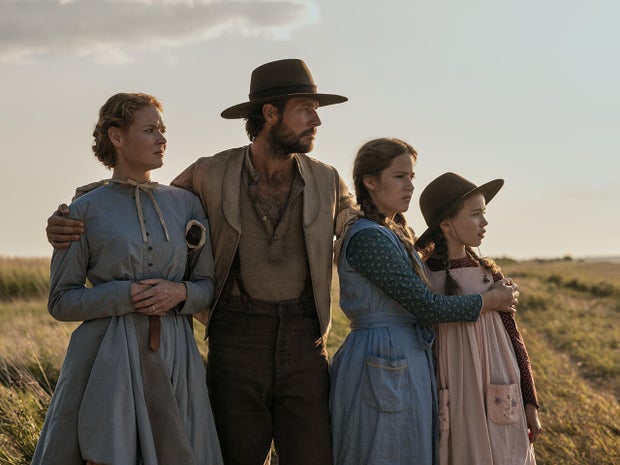
little-house-on-the-prairie-family-portrait-a-netflix-1280.jpg
“Little House on the Prairie” stars Crosby Fitzgerald as Caroline Ingalls, Luke Bracey as Charles Ingalls, Skywalker Hughes as Mary Ingalls, and Alice Halsey as Laura Ingalls. 

Eric Zachanowich/Netflix © 2026

The new series, a joint Netflix-CBS Studios production, follows the trials and tribulations of the Ingalls family. Sonnenshine says “Little House on the Prairie” is about our country’s big dreams: “It’s all about myth-making. Our culture is really wrapped up in the stories we tell about ourselves. And the Ingalls, in the books, they told stories all the time, and they sing songs that tell stories.”

Asked what music means to the Ingalls family, Crosby Fitzgerald (who plays the mother, Caroline), replied, “It’s, like, one of the only things they have.”

“Other than each other!” said Skywalker Hughes, who plays Mary Ingalls.

“They couldn’t really do a lot on the prairie,” said Alice Halsey, who plays Laura Ingalls. “There weren’t a lot of available activities, other than go farming!”

“And that’s the tradition,” said Fitzgerald. “These songs have been passed down. It reminds them of the home they left. It is something they probably taught the girls.”

“Music gives them hope,” said Hughes.

And Luke Bracey (who plays Charles, the father), adds, “It’s one thing that can’t be taken away from them.”
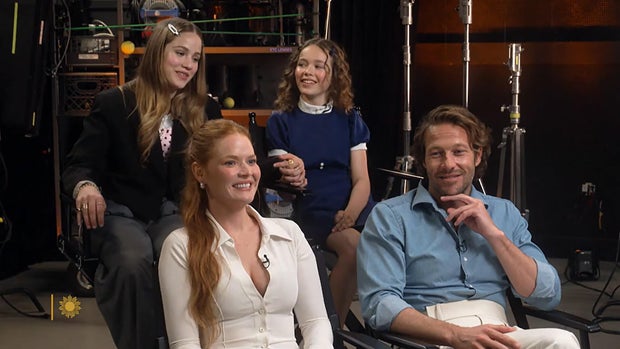
little-house-on-the-prairie-cast.jpg
The cast of “Little House on the Prairie,” clockwise from top left: Skywalker Hughes (Mary Ingalls), Alice Halsey (Laura Ingalls), Luke Bracey (Pa), and Crosby Fitzgerald (Ma). 

CBS News

You could say hope for a better life drives the Ingalls family by covered wagon on their perilous journey from Wisconsin to the West, to what was then Osage territory.

Fans of the beloved 1970s television show with Michael Landon might not remember how much actual danger and suffering the family experienced. The new show was shot in Manitoba, Canda, which provides the big sky – and the raging rivers.

“Laura’s in a life-or-death situation every single day,” said Halsey. “She helps and protects her family every day. And in those times, in that century – as a girl, too – it’s hard, but she stays strong throughout it. And I think a lot of people admire her for that. And I think that’s part of the reason that all the books are so popular.”

Joy Gorman Wettels, the show’s executive producer, rediscovered the books while reading them with her family during the pandemic. She says a Wilder quote – “All that I told is true, but it is not the whole truth” – became her North Star. “There’s so much to piece together that Laura lived through, that could never have been covered completely in the books, and could never have been covered in the original series,” she said. “There’s so many characters who didn’t have a voice in the originals, that could now.”

The show brings us into the lives of characters from the books that weren’t fully explored, like Dr. Tann, the book’s Black doctor. Their neighbor, Mr. Edwards, is a battle-scarred Civil War veteran. The Ingalls’ other neighbors, who strike fear in Ma, are an Osage family.

And while some critical voices might wail that the show is “woke,” Wettels is not concerned that it may become fodder for culture wars. “I knew that there would be controversy around how this is done,” she said. “I just think that it doesn’t help us to look back and erase the literature, or erase the mistakes. It helps us to look at them through a new lens in a way that welcomes new readers and welcomes new viewers.”

And it’s that kind of expansive feeling of community that Alice Halsey says “Little House” is all about: “Sometimes adventure doesn’t just come in easy forms,” she said. “Sometimes you have to face a lot of danger, but you’ll be rewarded at the end with new friends, new family that you didn’t know would be there at the start.”

That hopeful sentiment – epitomized by Charles Ingalls’ insistence that “Hope is everything” – strikes at the heart of this “Little House.”

“The thing I love about Charles is, he’s always asking the question: What if it’s great?” said Bracey. “And that’s a wonderful way to look at life. And that’s what he thinks of when he thinks of his family. He wants the best for them. He just wants to sit there and go, ‘Imagine if this is great. My family’s having a great time, and my family’s happy and my family’s hopeful.'”

Maybe better put in the girls’ favorite song from the show, “Always Hope”:

Always hope
And I come to you my love
Always hope
And I come to you my love
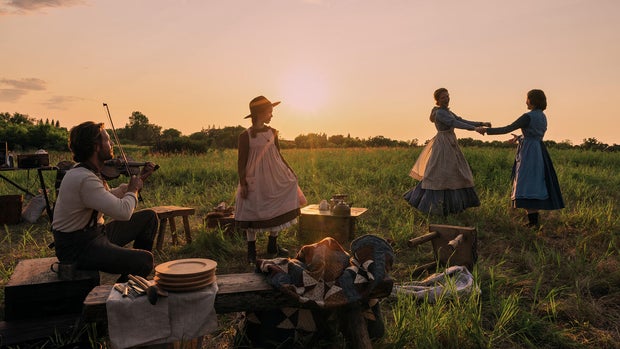
little-house-on-the-prairie-music-netflix.jpg

Eric Zachanowich/Netflix © 2026

To watch a trailer for “Little House on the Prairie,” click on the video player below:

For more info:

     
Story produced by Anthony Laudato. Editor: Jason Schmidt.

A mission to save NASA’s falling observatory spun out of control. What happens next

(CNN) — A daring mission to rescue one of NASA’s crucial space observatories from falling to Earth has encountered issues of its own — but there may still be hope for both spacecraft to beat the odds.The Neil Gehrels Swift Observatory has served as an astrophysics multitool in low-Earth orbit since it launched nearly 22 years ago, acting as NASA’s first responder in space when celestial objects flare with activity, according to mission scientists.But atmospheric drag intensified by solar activity exerted its forces on the observatory. Without any intervention, Swift is likely to reenter our planet’s atmosphere this fall once it sinks below an optimal altitude of about 185 miles (300 kilometers) above Earth, according to NASA’s predictions.The agency selected Arizona-based Katalyst Space Technologies to design, build, test and launch — all in the span of just nine months — a spacecraft capable of rendezvousing with Swift and boosting its orbit.The robotic satellite, named LINK, launched on July 3. It lifted off on a Northrop Grumman Pegasus XL rocket, which was released midair by the company’s modified L-1011 aircraft, Stargazer.Everything appeared to go according to plan until LINK began to spin in space around July 25, causing a temporary loss of communications, Katalyst and NASA said on July 28.While LINK’s spin now appears to be largely under control, the satellite’s rendezvous with Swift is facing a delay. Now, it remains unclear whether LINK will reach the observatory in time.“I think one of the difficult things to convey is how amazing it is that we’ve gotten this far,” said Shawn Domagal-Goldman, division director of astrophysics at NASA, during a June 17 news conference. “Even if everyone does everything perfectly, there still might be risks that we cannot control ahead of us. I’m just deeply thankful that we’re even giving this a go.”Here’s everything that has happened so far.A tumble in the timelineAfter LINK’s successful launch into orbit, Katalyst’s mission operations team confirmed it was in communication with the satellite.Katalyst’s original plan included a few weeks of health checks for LINK’s navigation and sensors in space.Both Katalyst and NASA reported about a week after launch that commissioning was going according to plan. The satellite had deployed its solar arrays and was firing its thrusters.Katalyst said on July 13 that LINK was halfway through the activation phase. Two days later, NASA posted a similar update but also said the team had run into some issues.“The Katalyst team also quickly addressed early communications and attitude control issues seen during flight operations, including an issue with one of the spacecraft’s three reaction wheels,” according to NASA’s post on July 15. “After identifying the cause, they implemented flight software patches and operational updates that restored reliable communications and stable attitude control.”Katalyst said over a week later that the team was validating LINK’s performance, and the spacecraft was preparing for its upcoming rendezvous with Swift. Part of the process included increasing the duration of the satellite’s thruster burns to get ready for the multi-hour firings needed while grappling the observatory.But on July 28, the company said LINK had been in a multi-axis spin for three days.“Preliminary investigation shows that two of LINK’s three reaction wheels currently are not operable, and there is some loss of functionality in its cold gas thruster system,” NASA shared in a post that day, adding that Katalyst had a plan to reduce the spin and would reassess any plans related to Swift.Two days later, Katalyst provided an update that the team had reduced LINK’s spin rate from about 9 degrees per second to 4 degrees per second using a series of thruster burns.“Teams also further evaluated LINK’s functionality and determined there are still potential paths forward for a boost,” NASA shared in a post on July 31. “NASA is working closely with Katalyst to consider revised, innovative approaches.”Now, Katalyst has confirmed it is making progress with LINK to restore its original mission to save Swift. The mission team has curbed the spacecraft’s spin rate to 1.47 degrees per second. LINK will maintain this rotation speed while the team prepares for its next steps, the company said on Wednesday.“The team used one of LINK’s electric propulsion thrusters to slow the spacecraft down, consuming less than 100 grams of propellant to conserve fuel for the rendezvous and boost phase of the mission,” Katalyst said in its post.The mission team plans to send a flight software update that will restore LINK’s orientation in space and allow for the maneuvers necessary to align the satellite’s orbit with that of the observatory.A risky rescue missionOriginally, LINK was expected to conduct a survey of Swift, presumably at the end of July, to determine the best grappling points on the observatory, but that’s now expected to happen a month later.After securing Swift in its grasp, LINK will carefully fire its three ion thrusters, aiming to boost the observatory back to its original orbit over the course of two to three months.It’s unclear how the delay will impact the original plans for the mission, but prior to the satellite’s launch, members of the Swift and LINK teams both acknowledged that the path to boosting the observatory was full of risks that could cause the mission to fail.“All of this is challenging and risky,” said Kieran Wilson, principal investigator for LINK at Katalyst, during a June 17 news conference. “There’s a lot of spacecraft that have had far longer development cycles with far more funding behind them that have failed for mundane reasons.”Named for fast-flying swift birds due to its ability to pivot rapidly to peer at cosmic events and afterglows, the telescope has enabled the study of comets, gravitational waves and black holes over long periods of time.With no plans on the horizon for a telescope that has Swift’s unique capabilities, NASA decided it was more cost-effective to try to save the observatory. To prevent a drainage of power, Swift isn’t currently making science observations, but that could change this fall if LINK is successful.The-CNN-Wire™ & © 2026 Cable News Network, Inc., a Warner Bros. Discovery Company. All rights reserved.
Read Next Story