
Lindsay Clancy murder trial centers on ex’s 911 call: ‘She killed the kids’

▶ Watch Video: Lindsay Clancy trial features emotional testimony from ex-husband

As the triple murder trial of Lindsay Clancy continues in the South Shore of Massachusetts, jurors have heard a 911 call made by her ex-husband and were presented with harrowing details from the defense of the mother’s severe mental health struggles that persisted months before she strangled their three children on Jan. 24, 2023.

Prosecutors and Clancy’s attorneys have provided conflicting narratives: Plymouth County prosecutors allege the 35-year-old mother made a “calculated decision” in killing her kids, while the defense says she was overmedicated and suffering from extreme postpartum psychosis.

The trial so far has centered on Patrick Clancy’s testimony about his ex-wife’s past suicidal ideation and alleged statements that she had thoughts of harming the children. 

Lindsay Clancy has pleaded not guilty to three counts of first-degree murder in the deaths of her children — 5-year-old Cora, 3-year-old Dawson and 8-month-old Callan — in the family’s home in Duxbury. According to court testimony, after strangling the children, she then attempted suicide by cutting her wrists and neck and jumping out of her second-floor bedroom window.

Here’s what to know following Day 2 of the high-profile trial:

Patrick Clancy’s 911 call: “She killed the kids”

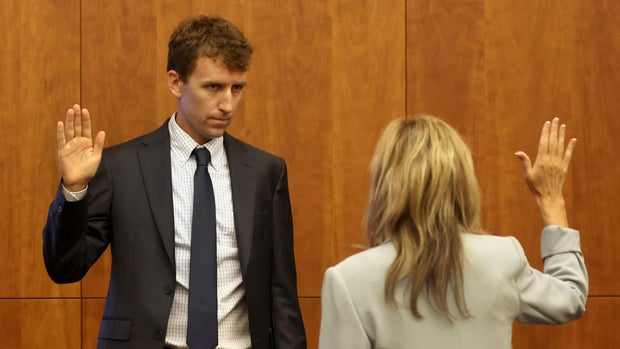
Patrick Clancy, who is divorced from Lindsay Clancy and has since remarried, testified Wednesday that he found his bloodied ex-wife outside the home after he returned from picking up takeout food and medicine for the kids on that tragic night.
david-l.jpg
Patrick Clancy is sworn in for his second day of testimony in Plymouth Superior Court on Wednesday, July 29, 2026.

David L. Ryan/Pool

In the harrowing 911 call that lasted roughly 6 minutes, Patrick could be heard telling the dispatcher that his wife attempted to kill herself as he tried to keep her from losing consciousness.

“Lindsay, what did you do?” Patrick Clancy is heard in the call. “Where are the kids, Lindsay?”

He testified that she answered that the children were in the basement. She did not indicate that they were in danger or injured, he told the court.

Patrick Clancy is later heard in the call telling the dispatcher, “I’ve got to go check on my kids.” His footsteps can be heard as he apparently looks through the house before he’s heard screaming, “I need help in the basement right now … She killed the kids.”
Lindsay Clancy murder trial
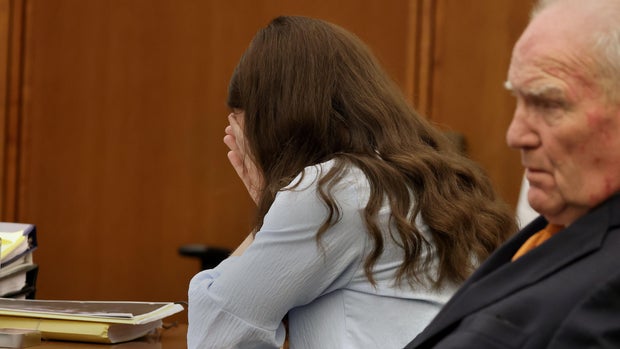
Lindsay Clancy cried as she listened to the 911 recording from Jan. 24, 2023, at her trial in Plymouth Superior Court on July 29, 2026.

David L. Ryan/Pool

In the courtroom, Lindsay audibly sobbed as she listened to the call for the first time with her face in her hands. Patrick Clancy had already left the courtroom after finishing his testimony before the call was played.

The judge previously approved Patrick Clancy’s request to keep the audio of the 911 call private and not release it to the media.

CBS Boston’s Kristina Rex, who was inside the courtroom, said hearing the call was “as horrific as you can imagine.”

Prosecutors show children’s clothes as ex-husband recalls gruesome details

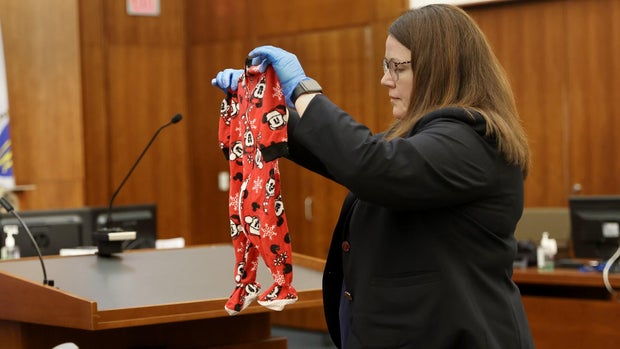
Before playing the distressing 911 call, the prosecution showed the jury the clothing worn by the three children and the exercise bands Lindsay Clancy allegedly used to strangle them. The mother did not look up during the presentation of evidence.
david-l-2.jpg
Pajamas are presented as evidence during Lindsay Clancy’s murder trial.

David L. Ryan/Pool

Patrick Clancy testified that when he reached the basement, he first saw his 5-year-old daughter, Cora.

“She had a band around her neck,” he said, referring to the exercise band. “She was face down.”

Patrick Clancy said he untied the band, but she was unresponsive. He said he then saw 8-month-old Callan next to her with an exercise band around his neck as well. The father said he next searched for 3-year-old Dawson and found him in his office, also with a band around his neck.

“I knew he was gone,” Patrick Clancy testified. 

He said he went “back and forth” between the children, trying to give CPR before first responders arrived and took over.

Patrick Clancy testifies ex-wife “heard a man’s voice”

Patrick Clancy said that his ex-wife was a loving mother to her kids, but she struggled with chronic insomnia, anxiety and intrusive thoughts. He said her mental health deteriorated in the months leading up to the tragedy.

“She was very dedicated. She did everything,” Patrick testified under cross-examination, adding that Lindsay would read the children books, make up songs, and bring them to music classes.

Patrick Clancy said he got a phone call from Lindsay Clancy a week after the children’s deaths, during which she talked about what she was going through at the time.
david-l-1.jpg
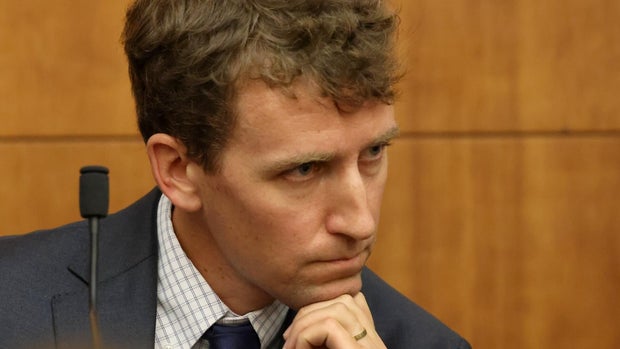
Patrick Clancy testifies in the murder trial of his ex-wife, Lindsay Clancy, who is accused of killing their three children.

David L. Ryan/Pool

“She said she heard a man’s voice telling her if she didn’t do it now she would lose her chance, or something like that,” Patrick testified.

He said he didn’t remember if Lindsay Clancy told him that she had psychosis.

“I didn’t know what psychosis was until after this happened,” he said.

Defense attorney details long list of Lindsay Clancy’s medications

Defense attorney Kevin Reddington on Wednesday detailed the long list of medications Lindsay Clancy had been prescribed, showing a diary the mother kept of how they made her feel.

One entry dated Dec. 12 said, “2.5 valium 200 seroquel — slept well horrible thoughts & no motivation.”

Patrick Clancy testified that Lindsay Clancy took the medications as she was instructed, but when questioned by Assistant District Attorney Jennifer Sprague, he clarified that he believed she did but “was not standing over her as she took the pill.”

On Monday, Patrick Clancy also spoke about his ex-wife’s mental health struggles, which included a stay at McLean Hospital for psychiatric treatment about one month before the children were killed.

He said that despite her recent struggles, Lindsay Clancy had “one of her best days” in the hours leading up to their deaths.

What’s next in the Lindsay Clancy trial

Jurors on Friday will visit the Duxbury home where Lindsay Clancy is accused of killing her three children, the judge said. 
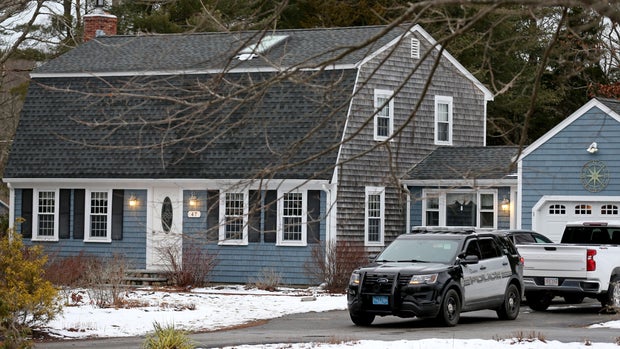
Duxbury Murder
A police cruiser sits in the driveway at 47 Summer Street, the home of Lindsay Clancy, 32, who strangled her three children and then attempted suicide, Jan. 24, 2023, in Duxbury, Massachusetts.

Matt Stone/MediaNews Group/Boston Herald via Getty Images

Police will secure the area during the jury visit on Summer Street.

“The parties will be permitted to visually inspect the outside of the property as well as the following interior areas: the basement, all rooms on the first floor, and all rooms on the second floor of the premises,” the court order states. “Parties are not permitted to open closet doors, touch any items within the premises, or disturb items.”


If you or someone you know is in emotional distress or a suicidal crisis, you can reach the 988 Suicide & Crisis Lifeline by calling or texting 988. You can also chat with the 988 Suicide & Crisis Lifeline here.

For more information about mental health care resources and support, The National Alliance on Mental Illness HelpLine can be reached Monday through Friday, 10 a.m.–10 p.m. ET, at 1-800-950-NAMI (6264) or email info@nami.org.

El entusiasmo de los simpatizantes de Trump va “de mal en peor” y los republicanos comienzan a preocuparse

Los republicanos comienzan a preocuparse por la falta de entusiasmo de sus partidarios antes de las elecciones intermedias de 2026.Esos votantes ya eran desproporcionadamente menos propensos participar en las elecciones en las que Donald Trump no participaba, y ahora el Partido Republicano tiene que enfrentarse a que el presidente sea más impopular que nunca.Y una nueva encuesta de CNN resalta el problema: grandes partes de los partidarios de Trump se siente desilusionadas por varias de sus decisiones recientes.En una serie de preguntas, sobre temas que van desde la economía y la guerra con Irán, hasta el enriquecimiento personal de Trump y los esfuerzos para renovar Washington, un gran porcentaje de republicanos e independientes que se inclinan por el Partido Republicano están mostrando su descontento. Esto es, a menudo 30 %, 40 %, 50% o más.En general, la encuesta de CNN muestra que el 30 % de los republicanos e independientes que se inclinan por el Partido Republicano desaprueban a Trump.Ese número es bastante alto en sí mismo. Pero en realidad podría subestimar el nivel de desilusión en algunos aspectos.Sin duda, los números más preocupantes para Trump y el Partido Republicano se refieren a la economía.No solo es la economía en general la mayor preocupación de los votantes; también es el ámbito en que Trump presenta los peores números.Es decir, entre los republicanos e independientes que se inclinan por el Partido Republicano en la encuesta:64 % dicen que los altos precios de la gasolina les han causado al menos una “dificultad moderada”56 % dicen que la economía es muy o algo pobre56 % dicen que Trump no ha hecho lo suficiente para reducir el precio de los bienes de consumo diario56 % desaprueban la actuación de Trump en los precios de la gasolina51 % dicen que Trump no tiene un plan claro para los precios de la gasolina50 % dicen que las políticas de Trump no han mejorado las condiciones económicas (con un 31 % diciendo que sus políticas han empeorado las cosas)50 % dicen que las políticas de Trump no han mejorado las condiciones económicas (con un 31 % diciendo que sus políticas han empeorado las cosas)47% desaprueban a Trump en inflaciónEsto es alrededor de la mitad o más de lo que deberían ser los propios seguidores de Trump que tienen muchas quejas sobre la economía y su manejo de la misma en este momento.Los números son ligeramente menos sombríos sobre el conflicto en Irán, pero todavía bastante sombríos.De nuevo, entre los republicanos e independientes que se inclinan por el Partido Republicano:64 % piensan que es probable una guerra a largo plazo con Irán45 % dicen que el costo de la guerra, en vidas y dinero, no ha valido la pena45 % dicen que Trump no tiene un plan claro para Irán40 % desaprueban a Trump en general sobre Irán39 % dicen que sus decisiones sobre la acción militar en Irán han perjudicado a los Estados Unidos (en contraposición al 44 % que dice que ha ayudado, siendo el resto neutral)Y la tendencia de Trump con respecto a Irán sigue siendo mala. La desaprobación de Trump sobre Irán entre estos grupos aumentó de un 30 % en marzo al 40 % este miércoles.La encuesta también muestra que a muchos miembros de los partidarios de Trump simplemente no les gusta en qué se ha enfocado, incluyendo sus finanzas personales y proyectos como el salón de baile de la Casa Blanca y el estanque reflectante del Monumento a Lincoln.Entre estos grupos:45 % dice que Trump no está “en contacto con los problemas que enfrentan los estadounidenses comunes en su vida diaria”, un aumento desde el 34 % en enero.39 % dice que no ha prestado suficiente atención a los problemas más importantes del paísun, aumento desde el 25 % en enero.Alrededor de 3 de cada 10 encuestados dicen que “fue demasiado lejos” al cambiar instituciones como el Smithsonian y el Kennedy Center (en los que Trump puso su nombre antes de que un juez lo eliminara), remodelando la Casa Blanca y otros lugares emblemáticos de Washington y persiguiendo intereses comerciales personales mientras está en la Casa Blanca.30 % dice que Trump no pone el bienestar del país por encima de su ganancia personal.26 % dice que está enfadado o insatisfecho con el salón de baile y el estanque reflectante (en comparación con solo el 39 % que tiene una opinión positiva de estos proyectos)Sería bastante malo para Trump si la economía no fuera óptima y la gente pensara que las cosas que él hace no están funcionando.Pero estos números, combinados con la mayoría de los seguidores de Trump que dice que el presidente descuidó la inflación, dejan claro que muchos de sus seguidores piensan que está obsesionado con cuestiones que no valen la pena o bien son muy impopulares.Cuando se hicieron muchas de estas preguntas durante los primeros meses de Trump en su segundo mandato, había un sentido palpable de entusiasmo con sus partidarios.Cuando se les preguntó para describir sus sentimientos mirando hacia adelante al resto del segundo mandato de Trump, casi nueve de cada diez de los republicanos e independientes que se inclinan hacia el Partido Republicano dijeron que estaban “entusiasmados” u “optimistas”.Ahora, ese número ha disminuido hasta el 70 %.Y el 30 % dice que están “pesimistas” o “asustados”.Ese 30 % que tiene una perspectiva negativa es bastante notable. Poco después de que el expresidente Barack Obama fue reelegido en 2012, solo el 8 % de los demócratas e independientes con tendencia demócrata dijeron que se sentían pesimistas o asustados. Y justo antes de la reelección del expresidente George W. Bush en 2004, solo el 5 % de los republicanos e independientes con tendencia al Partido Republicano dijeron lo mismo sobre él.Luego están los hallazgos de una encuesta reciente del Pew Research Center.Esa encuesta mostró que el 81 % de los demócratas e independientes que se inclinan hacia la democracia dijeron que su voto en las elecciones intermedias sería un voto contra Trump, en comparación con solo el 44 % de los republicanos e independientes con tendencia al Partido Republicano que dijeron que votarían por Trump.Existen signos de este tipo de malestar desde hace un año, cuando explotó la saga de Jeffrey Epstein. Los últimos números sugieren que ahora cobró fuerza en amplios sectores de la bancada del Partido Republicano, en un momento muy inoportuno para el partido.The-CNN-Wire™ & © 2026 Cable News Network, Inc., a Warner Bros. Discovery Company. All rights reserved.
Read Next Story