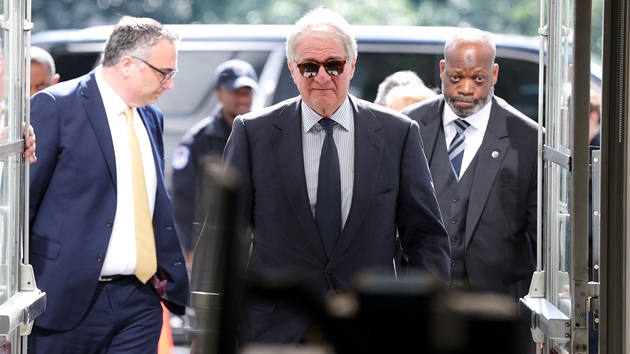
(WASHINGTON) — Private equity billionaire Leon Black walked out of his transcribed interview with the House Oversight Committee regarding his decades-long relationship with Jeffrey Epstein after refusing to answer questions about nondisclosure agreements allegedly related to the disgraced sex offender, according to a transcript of the June 26 interview released by the committee Friday.
While he said he would be willing to talk about three women involved in lawsuits against him, Black repeatedly declined to answer questions about how many nondisclosure agreements he was involved in, citing the advice of his attorneys.
“I’m not here to talk about confidential NDAs,” Black said, later adding. “I’m not here to talk about who has NDAs.”
Black was issued two subpoenas after his refusals — one compelling him to participate in a deposition and another to turn over any NDAs. A House Oversight Committee spokesperson said Black’s attorney confirmed Black would appear for a deposition on Sept. 3, and he will turn over the NDAs sometime next week.
Black, who maintained a social relationship with Epstein since the mid-1990s and eventually paid him more than $170 million for “tax and estate planning advice,” according to the Senate Finance Committee, appeared before the Oversight panel as part of its ongoing probe into the government’s investigation of the convicted sex offender.
Black acknowledged that he discussed at least one nondisclosure agreement with Epstein, though he denied he sought Epstein’s advice on the matter. According to Black, he agreed to pay a woman with whom he had a six-year affair after she allegedly “blackmailed and extorted” him, ultimately agreeing to pay her more than $21 million over 15 years. Because Epstein was helping manage his finances, Black said he made Epstein aware of the agreement and payments.
“I don’t know whether he had any experience on NDAs. He was not my NDA adviser,” Black said of Epstein, according to the transcript.
Black was served the two subpoenas after he declined to answer broader questions about other alleged nondisclosure agreements. His lawyers argued that Black was not at liberty to discuss confidential agreements he was a party to, and called the subpoenas a stunt.
“Mr. Black came here voluntarily to assist the committee. This was nothing more than a planned political stunt,” said Black’s attorney Aaron Cutler. “Mr. Epstein had no involvement with any NDAs, whether they exist or not.”
Before the interview was cut short, Black faced questions about his decades-long relationship with Epstein, who he first began to see socially before hiring him to manage part of his estate. While Black acknowledged that he saw Epstein somewhat regularly — about once a month — he claimed they were not close friends.
“Friendship is an amorphous term. This is somebody who knew intimately the goings on in my family tax and estate planning entities. It’s also something where, as I mentioned, I’d go over and meet his friends. I know there are emails where he claims that we’re best friends. We were never best friends,” Black said, per the transcript.
Lawmakers pushed back when Black sought to distance himself from Epstein, including by asking about a message Black wrote for a book that Maxwell, Epstein’s longtime associate, created for Epstein’s 50th birthday. According to the Wall Street Journal, Black wrote a two-line poem — “Blonde, Red or Brunette, spread out geographically … with this net of fish, Jeff’s now ‘The Old Man and The Sea'” — which he signed “Love and kisses, Leon.”
Asked to explain the note, Black said he was referencing how Epstein “seemed to know women all over the world,” though he denied knowing any of the women were underage.
“He enjoyed the company of good-looking women, and he was a bachelor,” Black said, saying how Epstein’s surrounding himself with “mostly good-looking women” was “a little bit out of like a James Bond movie.”
The interview was cut short after the topic transitioned to nondisclosure agreements, and Black was not asked about the more than $158 he paid Epstein for “tax and estate planning advice.” During his opening remarks, Black claimed that he paid Epstein so much because he solved a “massive estate problem … that would have destroyed enormous value.” He denied that the money was related to any illegal activities.
“I have never paid Epstein for access to women. I was never blackmailed by Epstein. I was not involved with, and had no knowledge of, any of Epstein’s heinous conduct,” Black said, according to the transcript.
Copyright © 2026, ABC Audio. All rights reserved.